
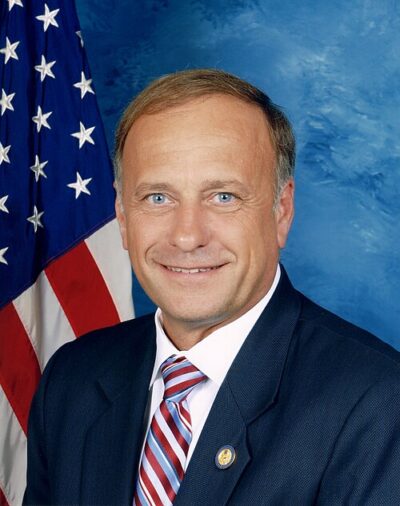
Steve King
Steve King is an US Representative for Iowa. Born May 28, 1949, in Storm Lake. Positions held include member of the State Senate of Iowa (1997–2003) and United States representative (2003–2021). Educated at Northwest Missouri State University.
Facts
12 facts · 1 confirmed by two sources · 4 cited · 7 from one source
Where this comes from
Papalocal keeps its own record. It started from these sources; what each one said is kept here as it was copied, so a change on their side never changes this page by itself. Tap one to read its version.
What Wikidata says · copied November 16, 2026 · revision 2501912208
- Described as
- US Representative for Iowa (1949-)
- Other names
- Steven Arnold King, Steven King
- Born
- May 28, 1949
- Born in
- Storm Lake
- Citizen of
- United States
- Occupation
- politician; business executive · 1 reference; businessperson · 1 reference
- Positions held
- member of the State Senate of Iowa (1997–2003); United States representative (2003–2021) · 2 references
- Political party
- Republican Party
- Education
- Northwest Missouri State University (1967–1970) · 1 reference
- Religion
- Catholic Church
- Website
- https://steveking.house.gov · 1 reference
- Wikipedias with a page
- 22
Wikidata item Q749710 (wikidata.org/wiki/Q749710), public domain (CC0). Copied November 16, 2026.
What Wikipedia says · copied November 16, 2026 · revision 1385417454
Steven Arnold King (born May 28, 1949) is an American politician and businessman who was a member of the United States House of Representatives from Iowa from 2003 to 2021. A member of the Republican Party, he represented Iowa's 5th congressional district until 2013 and the state's 4th congressional district from 2013 to 2021.
Born in 1949 in Storm Lake, Iowa, King attended Northwest Missouri State University from 1967 to 1970. He founded a construction company in 1975 and worked in business and environmental study before seeking the Republican nomination for the 6th district in the Iowa Senate in 1996. He won the primary and the general election, and was reelected in 2000. In 2002, King was elected to the U.S. House of Representatives from Iowa's 5th congressional district after the incumbent, Tom Latham, was reassigned to the 4th congressional district after redistricting. He was reelected four times before the 2010 United States census removed the 5th district, after which King ran for the 4th district, which he represented from 2013 to 2021.
King is an opponent of immigration and multiculturalism, and has a long history of racist and anti-immigrant rhetoric. The Washington Post described King in 2018 as "the Congressman most openly affiliated with white nationalism." King has been criticized for his affiliation with white supremacist ideas, made controversial statements against immigrants, and supported European right-wing populist and far-right politicians who have engaged in racism, antisemitism and Islamophobia.
King's views and policy platforms did not attract major intra-party condemnation until shortly before the 2018 election, when the National Republican Congressional Committee withdrew funding for King's reelection campaign and its chairman, Steve Stivers, condemned King's conduct, although Iowa's Republican senators and governor continued to endorse him. King was narrowly reelected, but after a January 2019 interview in which he questioned the negative connotations of the terms "white nationalist" and "white supremacy", he was widely condemned by both parties, the media, and public figures, and the Republican Steering Committee removed him from all House committee assignments. King ran for reelection but, campaign funding and support having declined, lost the June 2020 Republican primary election to Randy Feenstra by 10 points.
- Born, in its opening lines
- May 28, 1949
From the Wikipedia article “Steve King” (en.wikipedia.org/wiki/Steve_King), by its contributors, under CC BY-SA 4.0 (creativecommons.org/licenses/by-sa/4.0/). Copied November 16, 2026; not changed.
Confirmed Two sources agree. Cited One source, and it names where it got it. One source One source, without a reference of its own. Sources disagree The sources disagree. We show the best-supported value and keep theirs below.
