
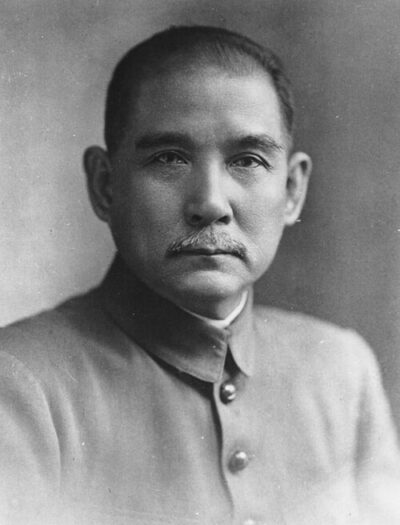
Sun Yat-sen
Sun Yat-sen was a Chinese politician, physician, and revolutionary. Born November 12, 1866, in Cuiheng. Died March 12, 1925, in Peking Union Medical College Hospital. Positions held include Extraordinary President of the Republic of China (1921–1923), Great President of the Republic of China (1912) and president. Educated at Queen's College and Punahou School. Awards include Order of Merit for National Foundation.
Facts
45 facts · 2 confirmed by two sources · 22 cited · 21 from one source
Where this comes from
Papalocal keeps its own record. It started from these sources; what each one said is kept here as it was copied, so a change on their side never changes this page by itself. Tap one to read its version.
What Wikidata says · copied November 16, 2026 · revision 2568305437
- Described as
- Chinese politician, physician, and revolutionary (1866–1925)
- Other names
- Yahtsīn, Sun Zhongshan, Sun Yatsen, Sun Chung-san, Sūn Démíng, Sun Yi Xian, Sun Teming, Sun I-hsien, Sūn Rìxīn, Guofu, Yixian, Sun Rixin
- Born
- November 12, 1866 · 9 references
- Died
- March 12, 1925 · 11 references
- Born in
- Cuiheng · 1 reference
- Died in
- Peking Union Medical College Hospital · 2 references
- Buried in
- Sun Yat-sen Mausoleum · 1 reference
- Cause of death
- liver cancer · 1 reference
- Citizen of
- Republic of China (1912–); Qing dynasty (–1912)
- Occupation
- politician · 1 reference; physician · 1 reference; philosopher; revolutionary · 1 reference; author · 1 reference
- Positions held
- Extraordinary President of the Republic of China (1921–1923); Great President of the Republic of China (1912) · 1 reference; president · 1 reference
- Political party
- Kuomintang; Tongmenghui · 1 reference
- Worked for
- Nanjing University
- Education
- Queen's College · 1 reference; Punahou School (–1883) · 1 reference; ʻIolani School (–1882) · 1 reference; Hong Kong College of Medicine for Chinese (1887–1892) · 2 references; Boji Medical College (1886–1887) · 1 reference; Li Ka Shing Faculty of Medicine
- Member of
- Tiandihui · 1 reference; Freemasonry
- Awards
- Order of Merit for National Foundation · 1 reference
- Spouse
- Lu Muzhen (1884–1915); Chen Cuifen (1891–1906); Haru Asada (1897–1902); Kaoru Otsuki (1905–1906); Soong Ching-ling (1915–1925) · 1 reference
- Children
- Sun Fo · 1 reference; Sun Wan; Fumiko Miyagawa; Sun Yan · 1 reference
- Father
- Sun Dacheng
- Mother
- Madame Yang
- Siblings
- Sun Mei · 1 reference
- Religion
- Congregational churches
- Military branch
- Republic of China Army · 1 reference
- Military rank
- generalissimo
- Lived in
- San Francisco (1896) · 1 reference; Haxell's Hotel (1896) · 1 reference
- Wikipedias with a page
- 154
Wikidata item Q8573 (wikidata.org/wiki/Q8573), public domain (CC0). Copied November 16, 2026.
What Wikipedia says · copied November 16, 2026 · revision 1385705419
Sun Yat-sen (; 12 November 1866 – 12 March 1925) was a Chinese physician, revolutionary and political philosopher who founded the Republic of China (ROC) and the Kuomintang (KMT). Sun is credited with leading the 1911 Revolution and overthrowing the Qing dynasty. He served as the first president of the Provisional Government of the Republic of China (1912) and as the inaugural premier of the Kuomintang.
Born to a poor peasant family in Guangdong, Sun was educated in Hawaii before graduating from the Hong Kong College of Medicine for Chinese in 1892. In 1894 he submitted a petition to reform the Qing government to Li Hongzhang, which was rejected. Sun subsequently went into exile and led anti-Qing movements overseas, founding the Revive China Society, the Tongmenghui, and the People's News.
Following the 1911 Revolution, Sun proclaimed the establishment of the Republic of China but relinquished the presidency to Beiyang Army leader Yuan Shikai in exchange for securing the Qing court's abdication. After the assassination of Song Jiaoren in 1913, widely attributed to Yuan, Sun led a failed Second Revolution against him, after which Sun fled to Japan. In 1917, Sun established a Constitutional Protection junta in Guangzhou, but before his planned Northern Expedition against the warlords, he was forced to resign due to infighting. Sun assumed the junta leadership in 1921, survived Chen Jiongming's revolt, and collaborated with Soviet Union and the Chinese Communist Party to form the First United Front. In late 1924, he traveled north beyond his base in Guangdong to call for a national assembly and the abolition of unequal treaties, continuing his struggle against the warlords Duan Qirui and Zhang Zuolin. He died in Beijing in 1925.
Sun is revered by both the Republic of China, which designates him "Father of the Nation," and the People's Republic of China, which honors him as the "Forerunner of the Revolution." Sun's flagship ideology, Three Principles of the People, sought to modernize China through nationalism, democracy, and the people's livelihood, within an ethnically harmonious conception of the Chinese nation.
- Born, in its opening lines
- November 12, 1866
- Died, in its opening lines
- March 12, 1925
From the Wikipedia article “Sun Yat-sen” (en.wikipedia.org/wiki/Sun_Yat-sen), by its contributors, under CC BY-SA 4.0 (creativecommons.org/licenses/by-sa/4.0/). Copied November 16, 2026; not changed.
Confirmed Two sources agree. Cited One source, and it names where it got it. One source One source, without a reference of its own. Sources disagree The sources disagree. We show the best-supported value and keep theirs below.
