
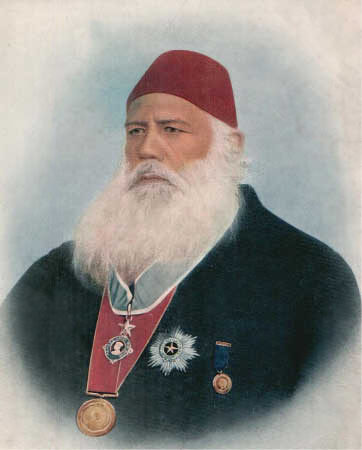
Syed Ahmed Khan
Syed Ahmed Khan was an Indian Muslim reformer and social activist. Born October 17, 1817, in Delhi. Died March 27, 1898, in Aligarh. Positions held include judge. Educated at University of Edinburgh and Anglo Arabic Senior Secondary School.
Facts
18 facts · 2 confirmed by two sources · 3 cited · 13 from one source
Where this comes from
Papalocal keeps its own record. It started from these sources; what each one said is kept here as it was copied, so a change on their side never changes this page by itself. Tap one to read its version.
What Wikidata says · copied November 16, 2026 · revision 2559064824
- Described as
- Indian Muslim reformer and social activist (1817–1898)
- Other names
- Syed Ahmad Khan, Ahmed Khan, Syed Ahmad bin Muttaqi Khan, Sir Syed Ahmad Khan
- Born
- October 17, 1817 · 5 references
- Died
- March 27, 1898 · 5 references
- Born in
- Delhi
- Died in
- Aligarh
- Buried in
- Aligarh · 1 reference
- Name at birth
- Syed Ahmad Taqvi
- Citizen of
- British Raj
- Occupation
- judge; philosopher; knight; lawyer; politician · 2 references; theologian · 1 reference; scholar · 1 reference
- Positions held
- judge
- Education
- University of Edinburgh; Anglo Arabic Senior Secondary School
- Religion
- Islam
- Wikipedias with a page
- 57
Wikidata item Q196546 (wikidata.org/wiki/Q196546), public domain (CC0). Copied November 16, 2026.
What Wikipedia says · copied November 16, 2026 · revision 1381990024
Sir Syed Ahmad Khan (17 October 1817 – 27 March 1898), also spelled Sayyid Ahmad Khan, was an Indian Muslim reformer, philosopher, and educationist in nineteenth-century British India.
Though initially espousing Hindu–Muslim unity, he later became the pioneer of Muslim nationalism in India and is widely credited as the father of the two-nation theory, which formed the basis of the Pakistan movement. Born into a family with strong ties to the Mughal court, Ahmad studied science and the Quran within the court. He was awarded an honorary LLD from the University of Edinburgh in 1889.
In 1838, Syed Ahmad entered the service of East India Company and went on to become a judge at a Small Causes Court in 1867, retiring from this position in 1876. During the Indian Mutiny of 1857, he remained loyal to the British Raj and was noted for his actions in saving European lives. After the rebellion, he penned the booklet The Causes of the Indian Mutiny – a daring critique, at the time, of various British policies that he blamed for causing the revolt. Believing that the future of Muslims was threatened by the rigidity of their orthodox outlook, Sir Ahmad began promoting Western–style scientific education by founding modern schools and journals and organising Islamic entrepreneurs. He founded Victoria School at Ghazipur in 1863 and a scientific society for Muslims in 1864. In 1875, he founded the Muhammadan Anglo-Oriental College, the first Muslim university in Southern Asia. During his career, Syed repeatedly called upon Muslims to loyally serve the British Raj and promoted the adoption of Urdu as the lingua franca of all Indian Muslims. He disagreed with the Indian National Congress over parliamentary democracy, believing it would lack impartiality given the widespread communal tensions and limitations of education in South Asia. He remained committed to secularism and inclusive politics.
Sir Syed maintains a strong legacy in Pakistan and among Indian Muslims. He became a source of inspiration for the Pakistan Movement and its activists, including Allama Iqbal and Muhammad Ali Jinnah. His advocacy of Islam's rationalist tradition, and a broader, radical reinterpretation of the Quran to make it compatible with science and modernity, continues to influence the global Islamic reformation. Many universities and public buildings in Pakistan bear Sir Syed's name. Aligarh Muslim University celebrated Sir Syed's 200th birth centenary with much enthusiasm on 17 October 2017.
- Born, in its opening lines
- October 17, 1817
- Died, in its opening lines
- March 27, 1898
From the Wikipedia article “Syed Ahmad Khan” (en.wikipedia.org/wiki/Syed_Ahmad_Khan), by its contributors, under CC BY-SA 4.0 (creativecommons.org/licenses/by-sa/4.0/). Copied November 16, 2026; not changed.
Confirmed Two sources agree. Cited One source, and it names where it got it. One source One source, without a reference of its own. Sources disagree The sources disagree. We show the best-supported value and keep theirs below.
