
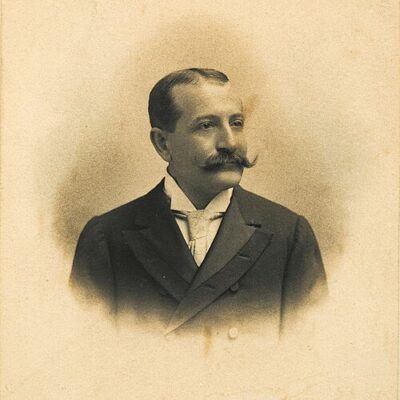
Take Ionescu
Take Ionescu was a Romanian politician. Born October 13, 1858, in Ploiești. Died June 21, 1922, in Rome. Positions held include Prime Minister of Romania, member of the Chamber of Deputies of Romania and Minister of Foreign Affairs of Romania. Educated at University of Paris.
Facts
20 facts · 1 confirmed by two sources · 7 cited · 11 from one source · 1 where the sources disagree
What’s different
- Born: we show October 13, 1858 (Sources disagree). Wikipedia says October 25, 1858
Where this comes from
Papalocal keeps its own record. It started from these sources; what each one said is kept here as it was copied, so a change on their side never changes this page by itself. Tap one to read its version.
What Wikidata says · copied November 18, 2026 · revision 2562766170
- Described as
- Romanian politician (1858-1922)
- Other names
- Take Jonescu
- Born
- October 13, 1858 · 1 reference
- Died
- June 21, 1922 · 2 references
- Born in
- Ploiești · 1 reference
- Died in
- Rome · 1 reference
- Buried in
- Sinaia Monastery
- Cause of death
- typhoid fever
- Citizen of
- Principality of Wallachia; United Principalities of Moldavia and Wallachia; Kingdom of Romania
- Occupation
- journalist · 1 reference; diplomat; lawyer · 1 reference; politician · 1 reference; writer · 1 reference
- Positions held
- Prime Minister of Romania; member of the Chamber of Deputies of Romania; Minister of Foreign Affairs of Romania
- Political party
- National Liberal Party
- Education
- University of Paris
- Siblings
- Thoma Ionescu · 1 reference
- Wikipedias with a page
- 20
Wikidata item Q1243658 (wikidata.org/wiki/Q1243658), public domain (CC0). Copied November 18, 2026.
What Wikipedia says · copied November 18, 2026 · revision 1375162264
Take or Tache Ionescu (Romanian pronunciation: [ˈtake joˈnesku]; born Dumitru Ghiță Ioan and also known as Demetriu G. Ionnescu; 25 October [O.S. 13 October] 1858 – 21 June 1922) was a Romanian centrist politician, journalist, lawyer and diplomat, who also enjoyed reputation as a short story author. Starting his political career as a radical member of the National Liberal Party (PNL), he joined the Conservative Party in 1891, and became noted as a social conservative expressing support for several progressive and nationalist tenets. Ionescu is generally viewed as embodying the rise of middle-class politics inside the early 20th century Kingdom of Romania (occasionally described as Takism), and, throughout the period, promoted a project of Balkan alliances while calling for measures to incorporate the Romanian-inhabited Austro-Hungarian regions of Transylvania, Banat and Bukovina. Representing his own faction inside the Conservative Party, he clashed with the group's leadership in 1907–1908, and consequently created and led his own Conservative-Democratic Party.
An Anglophile promoting an alliance with the Triple Entente, he rallied politicians and intellectuals in support for the idea of Romania entering World War I. When this was accomplished through the 1916–1918 campaign, Ionescu joined the Ion I. C. Brătianu government in Iași as Minister without portfolio. After his country was defeated by the Central Powers and signed the Treaty of Bucharest, he left for Paris and London, organizing a Romanian National Committee to campaign for Greater Romania during the Peace Conference. In 1919, his Conservative-Democrats formed an alliance with the People's League, and Ionescu became Foreign Affairs Minister in the second Alexandru Averescu executive, before briefly holding the office of Premier in 1921–1922. During the period, he successfully campaigned in favor of the Little Entente.
He was the brother of renowned surgeon and political activist Thoma Ionescu, who was his collaborator on several political projects. Take Ionescu is also remembered for promoting Nicolae Titulescu, who went on to have a successful career as a diplomat and politician, and for his friendships with the dramatist Ion Luca Caragiale and the Greek politician Eleftherios Venizelos.
- Born, in its opening lines
- October 25, 1858
- Died, in its opening lines
- June 21, 1922
From the Wikipedia article “Take Ionescu” (en.wikipedia.org/wiki/Take_Ionescu), by its contributors, under CC BY-SA 4.0 (creativecommons.org/licenses/by-sa/4.0/). Copied November 18, 2026; not changed.
Confirmed Two sources agree. Cited One source, and it names where it got it. One source One source, without a reference of its own. Sources disagree The sources disagree. We show the best-supported value and keep theirs below.
