
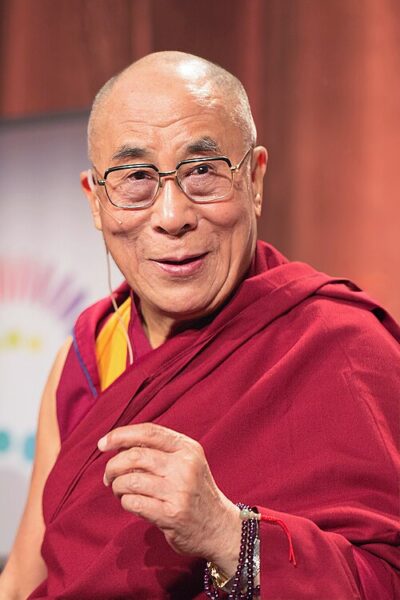
Tenzin Gyatso
Tenzin Gyatso is the 14th Dalai Lama, the spiritual and temporal leader of Tibetans. Born July 6, 1935, in Taktser. Positions held include Dalai Lama (1940–) and National People's Congress deputy. Known for Universal Responsibility and the Good Heart. Educated at University of Melbourne and University of British Columbia. Awards include Nobel Peace Prize, honorary Canadian citizenship and Ramon Magsaysay Award.
Facts
46 facts · 1 confirmed by two sources · 6 cited · 39 from one source
Where this comes from
Papalocal keeps its own record. It started from these sources; what each one said is kept here as it was copied, so a change on their side never changes this page by itself. Tap one to read its version.
What Wikidata says · copied November 16, 2026 · revision 2568458407
- Described as
- 14th Dalai Lama, the spiritual and temporal leader of Tibetans
- Other names
- Lhamo Dondrub, Jetsun Jamphel Ngawang Lobsang Yeshe Tenzin Gyatso, Dalai Lama, Tendzin Gyatso, Lhamo Dhondup, Lhamo Tönzhub, Gyalwa Rinpoche, Gongsachok
- Born
- July 6, 1935 · 12 references
- Born in
- Taktser
- Name at birth
- ལྷ་མོ་དོན་འགྲུབ།
- Citizen of
- Tibet
- Occupation
- Buddhist monk; Lama; politician; cleric · 1 reference
- Positions held
- Dalai Lama (1940–); National People's Congress deputy
- Education
- University of Melbourne; University of British Columbia; Sera Monastery; Drepung Monastery
- Known for
- Universal Responsibility and the Good Heart
- Awards
- Nobel Peace Prize (1989) · 2 references; honorary Canadian citizenship (2006); Ramon Magsaysay Award (1959); Erik Bye's Memorial Prize (2013); Templeton Prize; Four Freedoms Award – Freedom Medal (1994); Philadelphia Liberty Medal; James Parks Morton Interfaith Award; Peace Prize of Hesse (2005); Congressional Gold Medal; Dr. Leopold Lucas Prize (1988) · 1 reference; honorary citizen of Warsaw (2015); honorary citizen of Rome (2009) · 1 reference; honorary citizen of Budapest (2010); Order of the White Lotus · 1 reference
- Father
- Choekyong Tsering
- Mother
- Diki Tsering
- Siblings
- Tsering Dolma; Jetsun Pema; Gyalo Thondup; Thubten Jigme Norbu · 1 reference; Lobsang Samten; Ngari Rinpoché; Lobsang Sandan · 1 reference
- Religion
- Tibetan Buddhism; Rimé movement · 1 reference
- Lived in
- McLeod Ganj (1960–); Potala Palace (1940–1959) · 1 reference; Norbulingka (1940–1959) · 1 reference
- Website
- http://www.dalaiLama.com/; http://dalailama.ru/
- Wikipedias with a page
- 170
Wikidata item Q17293 (wikidata.org/wiki/Q17293), public domain (CC0). Copied November 16, 2026.
What Wikipedia says · copied November 16, 2026 · revision 1385748063
The 14th Dalai Lama (born Lhamo Thondup, 6 July 1935; full spiritual name: Jetsun Jamphel Ngawang Lobsang Yeshe Tenzin Gyatso, shortened as Tenzin Gyatso) is the current Dalai Lama, the highest spiritual leader and head of Tibetan Buddhism. He served as the resident spiritual and temporal leader of Tibet before 1959, and subsequently led the Tibetan government in exile represented by the Central Tibetan Administration in Dharamshala, India.
A belief central to the Tibetan Buddhist tradition as well as the institution of the Dalai Lama is that the reincarnated person is a living Bodhisattva, specifically an emanation of Avalokiteśvara (in Sanskrit) or Chenrezig (in Tibetan), the Bodhisattva of Compassion. The Mongolic word dalai means ocean. The 14th Dalai Lama is also known to Tibetans as Gyalwa Rinpoche ("The Precious Jewel-like Buddha-Master"), Kundun ("The Presence"), and Yizhin Norbu ("The Wish-Fulfilling Gem"). His devotees, as well as much of the Western world, often call him His Holiness the Dalai Lama. He is the leader and a monk of the newest Gelug school of Tibetan Buddhism.
The 14th Dalai Lama was born to a farming family in Taktser (Hongya village), in the traditional Tibetan region of Amdo, at the time a Chinese frontier district. He was selected as the tulku of the 13th Dalai Lama in 1937, and formally recognised as the 14th Dalai Lama in 1939. As with the recognition process for his predecessor, a Golden Urn selection process was waived and approved by the Nationalist government of China. His enthronement ceremony was held in Lhasa on 22 February 1940. Following the Battle of Chamdo, in which PRC forces annexed Central Tibet, the Tibetan government, the Ganden Phodrang, invested the Dalai Lama with temporal duties on 17 November 1950 (at 15 years of age), which he held until his exile in 1959.
During the 1959 Tibetan uprising, the Dalai Lama escaped to India, where he continues to live. On 29 April 1959, the Dalai Lama established the independent Tibetan government in exile in the north Indian hill station of Mussoorie, which then moved in May 1960 to Dharamshala, where he resides. He retired as political head in 2011 to make way for a democratic government, the Central Tibetan Administration. The Dalai Lama advocates for the welfare of Tibetans and since the early 1970s has called for the Middle Way Approach with China to peacefully resolve the issue of Tibet. This policy, adopted democratically by the Central Tibetan Administration and the Tibetan people through long discussions, seeks to find a middle ground, "a practical approach and mutually beneficial to both Tibetans and Chinese, in which Tibetans can preserve their culture and religion and uphold their identity", and China's assertion of sovereignty over Tibet, aiming to address the interests of both parties through dialogue and communication and for Tibet to remain a part of China. He criticised the CIA Tibetan program, saying that its sudden end in 1972 proved it was primarily aimed at serving American interests.
Up until his mid-80s, the Dalai Lama travelled worldwide to give Tibetan Mahayana and Vajrayana Buddhism teachings, and his Kalachakra teachings and initiations were international events. He also attended conferences on a wide range of subjects, including the relationship between religion and science, met with other world leaders, religious leaders, philosophers, and scientists, online and in-person. Since 2018, he has continued to teach on a reduced schedule, limiting his travel to within India only, and occasionally addressing international audiences via live webcasts. His work includes focus on the environment, economics, women's rights, nonviolence, interfaith dialogue, physics, astronomy, Buddhism and science, cognitive neuroscience, reproductive health and sexuality.
The Dalai Lama was awarded the Nobel Peace Prize in 1989. Time magazine named the Dalai Lama Gandhi's spiritual heir to nonviolence. The 12th General Assembly of the Asian Buddhist Conference for Peace in New Delhi unanimously recognised the Dalai Lama's contributions to global peace, his lifelong efforts in uniting Buddhist communities worldwide, and bestowed upon him the title of "Universal Supreme Leader of the Buddhist World"; they also designated 6 July, his birthday, as the Universal Day of Compassion. In addition, an Indian MP delegation led by Sujeet Kumar has advocated for the Dalai Lama to receive the Bharat Ratna, the highest civilian honour in India.
- Born, in its opening lines
- July 6, 1935
From the Wikipedia article “14th Dalai Lama” (en.wikipedia.org/wiki/14th_Dalai_Lama), by its contributors, under CC BY-SA 4.0 (creativecommons.org/licenses/by-sa/4.0/). Copied November 16, 2026; not changed.
Confirmed Two sources agree. Cited One source, and it names where it got it. One source One source, without a reference of its own. Sources disagree The sources disagree. We show the best-supported value and keep theirs below.
