
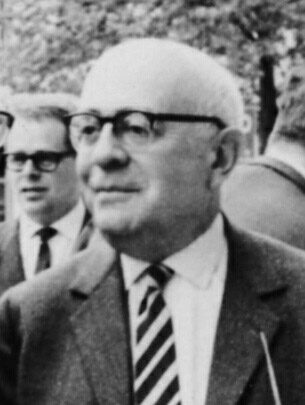
Theodor W. Adorno
Theodor W. Adorno was a German philosopher, sociologist and theorist. Born September 11, 1903, in Frankfurt. Died August 6, 1969, in Visp. Known for Gesammelte Schriften, Negative Dialectics and Aesthetic Theory. Educated at Merton College and Goethe University Frankfurt. Awards include Goethe Plaque of the City of Frankfurt.
Facts
39 facts · 2 confirmed by two sources · 15 cited · 22 from one source
Where this comes from
Papalocal keeps its own record. It started from these sources; what each one said is kept here as it was copied, so a change on their side never changes this page by itself. Tap one to read its version.
What Wikidata says · copied November 13, 2026 · revision 2566391848
- Described as
- German philosopher, sociologist and theorist (1903–1969)
- Other names
- Theodor Wiesengrund Adorno, Theodor Wiesengrund-Adorno, Theodor Wiesengrund, Teodor V. Adorno, Theodore W. Adorno, Theodor Adorno, Theodor Ludwig Wiesengrund, Theodor Ludwig Adorno-Wiesengrund, Theodor Ludwig Adorno-Wellington, Theodor Ludwig Wiesengrund Adorno, Theodor Ludwig Wiesengrund-Adorno
- Born
- September 11, 1903 · 19 references
- Died
- August 6, 1969 · 19 references
- Born in
- Frankfurt · 7 references
- Died in
- Visp · 5 references
- Buried in
- Frankfurt Main Cemetery · 1 reference
- Name at birth
- Theodor Ludwig Wiesengrund
- Citizen of
- United States (1943–); Germany · 1 reference; German Empire (–1918); Austria · 1 reference
- Occupation
- philosopher · 5 references; composer · 2 references; musicologist · 5 references; sociologist · 4 references; university teacher · 2 references; literary critic; music critic; aphorist
- Worked for
- Goethe University Frankfurt
- Education
- Merton College; Goethe University Frankfurt · 1 reference
- Member of
- Second Viennese School
- Genre
- classical music · 1 reference
- Instrument
- piano
- Known for
- Gesammelte Schriften; Negative Dialectics; Aesthetic Theory; Dialectic of Enlightenment; Philosophie und Musik; Minima Moralia; The Authoritarian Personality
- Awards
- Goethe Plaque of the City of Frankfurt (1963)
- Field
- philosophy; sociology · 1 reference; musicology · 1 reference; aesthetics · 1 reference; social theory
- Spouse
- Gretel Adorno · 1 reference
- Mother
- Maria Calvelli-Adorno · 1 reference
- Wikipedias with a page
- 104
Wikidata item Q152388 (wikidata.org/wiki/Q152388), public domain (CC0). Copied November 13, 2026.
What Wikipedia says · copied November 13, 2026 · revision 1383302194
Theodor W. Adorno (; German: [ˈteːodoːɐ̯ aˈdɔʁno] ; born Theodor Ludwig Wiesengrund; 11 September 1903 – 6 August 1969) was a German philosopher, cultural theorist, and music critic. He was a leading member of the Frankfurt School of critical theory, whose work has come to be associated with thinkers such as Ernst Bloch, Walter Benjamin, Max Horkheimer, Erich Fromm, and Herbert Marcuse, for whom the works of Sigmund Freud, Karl Marx, and G. W. F. Hegel were essential to a critique of modern society. As a critic of both fascism and what he called the culture industry, he authored numerous works—such as Dialectic of Enlightenment (1947), Minima Moralia (1951), and Negative Dialectics (1966)—that strongly influenced the European New Left.
In an intellectual climate shaped by existentialism and logical positivism, Adorno developed a dialectical conception of history and philosophy that challenged the foundations of both, anticipating the divide that would later emerge between the analytic and continental traditions. As a classically trained musician, Adorno studied composition with Alban Berg of the Second Viennese School, influenced by his early admiration for the music of Arnold Schoenberg. Adorno's commitment to avant-garde music formed the backdrop of his subsequent writings and led to his collaboration with Thomas Mann on the latter's novel Doctor Faustus (1947), while the two men lived in California as exiles during the Second World War. Working at the newly relocated Institute for Social Research, Adorno collaborated on influential studies of authoritarianism, antisemitism, and propaganda that would later serve as models for sociological studies the institute carried out in post-war Germany.
Upon his return to Frankfurt, Adorno was involved with the reconstitution of German intellectual life through debates with Karl Popper on the limitations of positivist science, critiques of Martin Heidegger's language of authenticity, writings on German responsibility for the Holocaust, and continued interventions into matters of public policy. As a writer of polemics in the tradition of Friedrich Nietzsche and Karl Kraus, Adorno delivered scathing critiques of contemporary Western culture. Adorno's posthumously published Aesthetic Theory (1970), which he had planned to dedicate to Samuel Beckett, is the culmination of a lifelong commitment to modern art, which seeks to revoke the "fatal separation" of feeling and understanding long demanded by the history of philosophy and explode the privilege aesthetics accords to content over form and contemplation over immersion. Adorno was nominated for the 1965 Nobel Prize in Literature by Helmut Viebrock.
- Born, in its opening lines
- September 11, 1903
- Died, in its opening lines
- August 6, 1969
From the Wikipedia article “Theodor W. Adorno” (en.wikipedia.org/wiki/Theodor_W._Adorno), by its contributors, under CC BY-SA 4.0 (creativecommons.org/licenses/by-sa/4.0/). Copied November 13, 2026; not changed.
Confirmed Two sources agree. Cited One source, and it names where it got it. One source One source, without a reference of its own. Sources disagree The sources disagree. We show the best-supported value and keep theirs below.
