
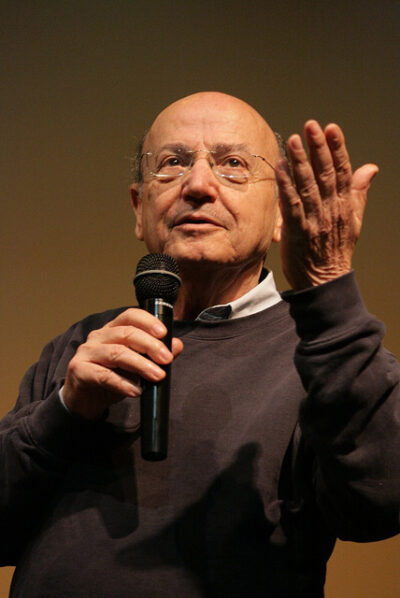
Thodoros Angelopoulos
Thodoros Angelopoulos was a Greek film director, screenwriter and film producer. Born April 27, 1935, in Athens. Died January 24, 2012, in Piraeus. Known for Landscape in the Mist. Educated at University of Paris and Institut des hautes études cinématographiques. Awards include Grand Officer of the Order of Merit of the Italian Republic, Sutherland Trophy and Best Screenplay Award.
Facts
38 facts · 2 confirmed by two sources · 16 cited · 20 from one source
Where this comes from
Papalocal keeps its own record. It started from these sources; what each one said is kept here as it was copied, so a change on their side never changes this page by itself. Tap one to read its version.
What Wikidata says · copied November 16, 2026 · revision 2569143053
- Described as
- Greek film director, screenwriter and film producer (1935–2012)
- Other names
- Theodoros Aggelopoulos, Theodoros Angelopoulos
- Born
- April 27, 1935 · 3 references
- Died
- January 24, 2012 · 9 references
- Born in
- Athens · 4 references
- Died in
- Piraeus · 3 references
- Buried in
- First Cemetery of Athens · 1 reference
- Cause of death
- struck by vehicle · 1 reference
- Name at birth
- Theodoros Angelopoulos · 1 reference
- Citizen of
- Greece · 1 reference
- Occupation
- film director · 2 references; screenwriter · 2 references; film producer · 3 references; film critic; actor · 2 references; journalist; director · 2 references
- Education
- University of Paris; Institut des hautes études cinématographiques; National and Kapodistrian University of Athens
- Known for
- Landscape in the Mist
- Awards
- Grand Officer of the Order of Merit of the Italian Republic (2004); Sutherland Trophy (1975); Best Screenplay Award (1984) · 1 reference; Palme d'Or (1998); Arts and Culture Prize of German Catholics (2001) · 1 reference; Gold Medal of the Círculo de Bellas Artes (2008); European Film Award for Best Film (1989) · 1 reference; European Film Academy Critics Award (2 times) (1995, 2004) · 1 reference; Cannes Film Festival Grand Prix (1995); Golden Lion (1980); Silver Lion (1988); honorary doctorate of Paris Nanterre University (1998) · 1 reference; honorary doctorate of Grenoble-III University (2004) · 1 reference; Aleksandar Lifka Award
- Spouse
- Foivi Oikonomopoulou (1980–2012)
- Children
- Eleni Aggelopoulou; Anna Aggelopoulou; Katerina Aggelopoulou
- Website
- http://www.theoangelopoulos.gr
- Wikipedias with a page
- 53
Wikidata item Q55168 (wikidata.org/wiki/Q55168), public domain (CC0). Copied November 16, 2026.
What Wikipedia says · copied November 16, 2026 · revision 1371475570
Theodoros "Theo" Angelopoulos (Greek: Θεόδωρος Αγγελόπουλος; 27 April 1935 – 24 January 2012) was a Greek filmmaker, screenwriter and film producer. He dominated the Greek art film industry from 1975 on, and Angelopoulos was one of the most influential and widely respected filmmakers in the world. He started making films in 1967. In the 1970s he made a series of political films about modern Greece.
Angelopoulos' films, described by Martin Scorsese as those of "a masterful filmmaker", are characterized by slight movement and distance changes, long takes, and complex, carefully composed scenes. His cinematic method is often described as "sweeping" and "hypnotic." Angelopoulos has said that in his shots, “time becomes space and space becomes time.” The pauses between action or music are important to creating the total effect.
In 1998 his film Eternity and a Day went on to win the Palme d'Or at the 51st edition of the Cannes Film Festival, and his films have been shown at many of the world's esteemed film festivals.
- Born, in its opening lines
- April 27, 1935
- Died, in its opening lines
- January 24, 2012
From the Wikipedia article “Theo Angelopoulos” (en.wikipedia.org/wiki/Theo_Angelopoulos), by its contributors, under CC BY-SA 4.0 (creativecommons.org/licenses/by-sa/4.0/). Copied November 16, 2026; not changed.
Confirmed Two sources agree. Cited One source, and it names where it got it. One source One source, without a reference of its own. Sources disagree The sources disagree. We show the best-supported value and keep theirs below.
