
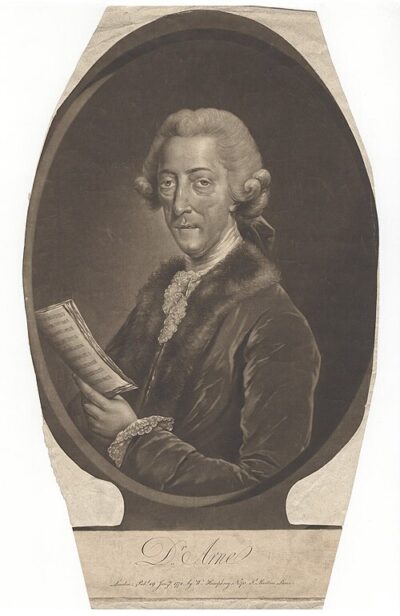
Thomas Arne
Thomas Arne was the 18th-century British composer. Born March 12, 1710, in London. Died March 5, 1778, in London. Known for Comus. Educated at Eton College.
Facts
17 facts · 2 confirmed by two sources · 5 cited · 10 from one source
Where this comes from
Papalocal keeps its own record. It started from these sources; what each one said is kept here as it was copied, so a change on their side never changes this page by itself. Tap one to read its version.
What Wikidata says · copied November 16, 2026 · revision 2567391419
- Described as
- 18th-century British composer
- Other names
- Thomas Augustus Arne, Thomas Augustine Arne
- Born
- March 12, 1710 · 12 references
- Died
- March 5, 1778 · 13 references
- Born in
- London · 1 reference
- Died in
- London · 1 reference
- Buried in
- St Paul's Church, Covent Garden · 1 reference
- Citizen of
- Kingdom of Great Britain; United Kingdom
- Occupation
- composer · 1 reference; actor
- Education
- Eton College · 1 reference
- Genre
- opera
- Instrument
- keyboard instrument
- Known for
- Comus
- Spouse
- Cecilia Young · 1 reference
- Children
- Michael Arne · 2 references
- Father
- Thomas Arne
- Religion
- Catholic Church
- Wikipedias with a page
- 38
Wikidata item Q309709 (wikidata.org/wiki/Q309709), public domain (CC0). Copied November 16, 2026.
What Wikipedia says · copied November 16, 2026 · revision 1378801845
Thomas Augustine Arne (; 12 March 1710 – 5 March 1778) was an English composer of the late Baroque and early Classical periods. He is known for his patriotic song "Rule, Britannia!" and the song "A-Hunting We Will Go", the latter composed for a 1777 production of The Beggar's Opera, which has since become popular as a folk song and a nursery rhyme. Arne was a leading British theatre composer of the 18th century, working at the West End's Drury Lane and Covent Garden. He wrote many operatic entertainments for the London theatres and pleasure gardens, as well as concertos, sinfonias and sonatas.
- Born, in its opening lines
- March 12, 1710
- Died, in its opening lines
- March 5, 1778
From the Wikipedia article “Thomas Arne” (en.wikipedia.org/wiki/Thomas_Arne), by its contributors, under CC BY-SA 4.0 (creativecommons.org/licenses/by-sa/4.0/). Copied November 16, 2026; not changed.
Confirmed Two sources agree. Cited One source, and it names where it got it. One source One source, without a reference of its own. Sources disagree The sources disagree. We show the best-supported value and keep theirs below.
