
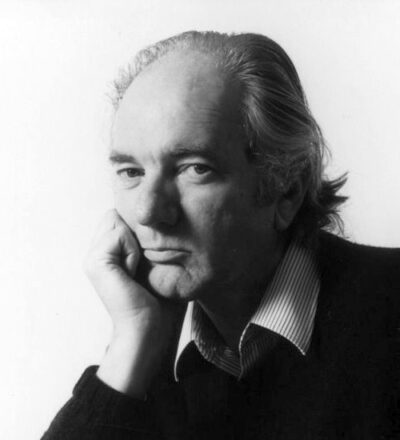
Thomas Bernhard
Thomas Bernhard was an Austrian playwright and novelist. Born February 9, 1931, in Heerlen. Died February 12, 1989, in Gmunden. Known for Correction, Extinction and The Loser. Educated at Mozarteum University Salzburg. Awards include Anton Wildgans Prize, Georg Büchner Prize and Prix Médicis étranger.
Facts
36 facts · 2 confirmed by two sources · 10 cited · 24 from one source
Where this comes from
Papalocal keeps its own record. It started from these sources; what each one said is kept here as it was copied, so a change on their side never changes this page by itself. Tap one to read its version.
What Wikidata says · copied November 16, 2026 · revision 2568987622
- Described as
- Austrian playwright and novelist (1931–1989)
- Other names
- Nicolaas Thomas Bernhard
- Born
- February 9, 1931 · 11 references
- Died
- February 12, 1989 · 14 references
- Born in
- Heerlen · 1 reference
- Died in
- Gmunden · 2 references
- Buried in
- Grinzing Cemetery · 1 reference
- Name at birth
- Nicolaas Thomas Bernhard
- Citizen of
- Austria
- Occupation
- writer · 3 references; novelist; playwright · 2 references; screenwriter; poet; linguist · 1 reference; librettist · 1 reference
- Political party
- Austrian People's Party · 1 reference; Social Democratic Party of Austria · 1 reference
- Education
- Mozarteum University Salzburg
- Genre
- prose
- Known for
- Correction; Extinction; The Loser; Woodcutters; Heldenplatz
- Awards
- Anton Wildgans Prize (1967); Georg Büchner Prize (1970); Prix Médicis étranger (1988); Feltrinelli Prize (1987); Franz Grillparzer Prize (1971) · 1 reference; Grimme-Preis (1972); Literaturpreis der Stadt Bremen (1965) · 1 reference; Austrian Promotional Prize for Literature (1967) · 1 reference; Julius Campe award (1964)
- Father
- Alois Zuckerstätter
- Mother
- Herta Fabjan
- Siblings
- Peter Fabjan · 1 reference
- Website
- https://thomasbernhard.at
- Wikipedias with a page
- 59
Wikidata item Q44336 (wikidata.org/wiki/Q44336), public domain (CC0). Copied November 16, 2026.
What Wikipedia says · copied November 16, 2026 · revision 1385304822
Nicolaas Thomas Bernhard (German: [ˈtoːmas ˈbɛʁnhaʁt]; 9 February 1931 – 12 February 1989) was an Austrian novelist, playwright, poet and polemicist who is considered one of the most important German-language authors of the postwar era. He explored themes of death, isolation, obsession and illness in controversial literature that was pessimistic about the human condition and highly critical of post-war Austrian and European culture. He developed a distinctive prose style often featuring multiple perspectives on characters and events, idiosyncratic vocabulary and punctuation, and long monologues by protagonists on the verge of insanity.
Born in the Netherlands to his unwed Austrian mother, for much of his childhood he lived with his maternal grandparents in Austria and in boarding homes in Austria and Nazi Germany. He was closest to his grandfather, the novelist Johannes Freumbichler, who introduced him to literature and philosophy. As a youth, he contracted pleurisy and tuberculosis and lived with debilitating lung disease for the rest of his life. While recovering in a sanatorium he began writing poetry and stories and met Hedwig Stavianicek, a wealthy heiress who supported his literary ambitions and whom he later described as the most important person in his life.
After his breakthrough novel Frost (1963), he established himself over the next 20 years as a leading novelist and playwright in German. His major works include the novels Correction (1975) and Extinction (1986) and his memoirs Gathering Evidence (1975–82). George Steiner called him "at his best, the foremost craftsman of German prose after Kafka and Musil". He influenced the Austrian vernacular and a younger generation of Austrian writers including Elfriede Jelinek.
Bernhard was controversial in Austria for his public polemics against what he saw as his homeland's post-war cultural pretensions, antisemitism, provincialism, and denial of its Nazi past. While critics labelled him a Nestbeschmutzer (one who fouls his own nest), he described himself as a troublemaker. He died of heart failure in his apartment in Gmunden, Upper Austria, in February 1989. Controversy extended beyond his death when it was revealed that his will sought to prohibit the publication or performance of his works in Austria for 70 years.
- Born, in its opening lines
- February 9, 1931
- Died, in its opening lines
- February 12, 1989
From the Wikipedia article “Thomas Bernhard” (en.wikipedia.org/wiki/Thomas_Bernhard), by its contributors, under CC BY-SA 4.0 (creativecommons.org/licenses/by-sa/4.0/). Copied November 16, 2026; not changed.
Confirmed Two sources agree. Cited One source, and it names where it got it. One source One source, without a reference of its own. Sources disagree The sources disagree. We show the best-supported value and keep theirs below.
