
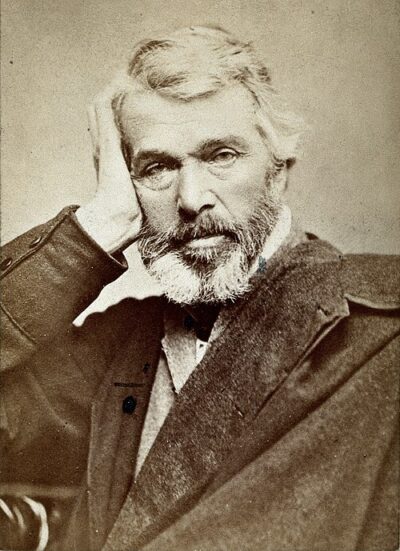
Thomas Carlyle
Thomas Carlyle was a Scottish essayist, historian and philosopher. Born December 4, 1795, in Ecclefechan. Died February 5, 1881, in London. Positions held include Rector of the University of Edinburgh (1865–1868). Known for Sartor Resartus, On Heroes, Hero-Worship, and The Heroic in History and The French Revolution: A History. Educated at University of Edinburgh and Annan Academy. Awards include Pour le Mérite for Sciences and Arts order, Fellow of the American Academy of Arts and Sciences and Pour le Mérite.
Facts
45 facts · 2 confirmed by two sources · 16 cited · 27 from one source
Where this comes from
Papalocal keeps its own record. It started from these sources; what each one said is kept here as it was copied, so a change on their side never changes this page by itself. Tap one to read its version.
What Wikidata says · copied November 16, 2026 · revision 2569995417
- Described as
- Scottish essayist, historian and philosopher (1795–1881)
- Other names
- The Sage of Chelsea
- Born
- December 4, 1795 · 16 references
- Died
- February 5, 1881 · 12 references
- Born in
- Ecclefechan
- Died in
- London · 2 references
- Buried in
- Johnstone United Presbyterian Church, Hoddom Road, Ecclefechan · 1 reference
- Citizen of
- United Kingdom of Great Britain and Ireland; Scotland · 1 reference; Kingdom of Great Britain
- Occupation
- linguist; literary historian; historian · 1 reference; translator · 1 reference; mathematician; philosopher · 1 reference; essayist; writer · 2 references
- Positions held
- Rector of the University of Edinburgh (1865–1868) · 1 reference
- Worked for
- University of Edinburgh (1818–1821) · 1 reference; Annan Academy (1814–1816) · 1 reference; Kirkcaldy High School (1816–1818) · 1 reference
- Education
- University of Edinburgh (1809–1813) · 1 reference; Annan Academy (1806–1809) · 1 reference; Hoddom School, Academy Street, Ecclefechan (–1805) · 1 reference
- Member of
- American Academy of Arts and Sciences
- Known for
- Sartor Resartus; On Heroes, Hero-Worship, and The Heroic in History; The French Revolution: A History; Chartism; Oliver Cromwell's Letters and Speeches: With Elucidations; History of Friedrich II of Prussia; Inaugural Address at Edinburgh University; Occasional Discourse on the Negro Question; Past and Present
- Awards
- Pour le Mérite for Sciences and Arts order; Fellow of the American Academy of Arts and Sciences (1878) · 1 reference; Pour le Mérite · 1 reference; Fellow of the Royal Society of Edinburgh (1866) · 1 reference
- Field
- philosophy; history; mathematics
- Spouse
- Jane Welsh Carlyle (1826–1866) · 1 reference
- Mother
- Margaret Aitken Carlyle · 1 reference
- Siblings
- John Carlyle; Jane Carlyle; Alexander Carlyle · 1 reference
- Wikipedias with a page
- 120
Wikidata item Q151403 (wikidata.org/wiki/Q151403), public domain (CC0). Copied November 16, 2026.
What Wikipedia says · copied November 16, 2026 · revision 1381513919
Thomas Carlyle (4 December 1795 – 5 February 1881) was a Scottish essayist, historian and philosopher. Known as the "sage of Chelsea", his writings strongly influenced the intellectual and artistic culture of the Victorian era.
Carlyle was born in Ecclefechan, a village in Dumfriesshire. He attended the University of Edinburgh, where he excelled in mathematics and invented the Carlyle circle. After finishing the arts course he prepared to become a minister in the Burgher Church while working as a schoolmaster. He quit these and several other endeavours before settling on literature, writing for the Edinburgh Encyclopædia and working as a translator. He initially gained prominence in English-language literary circles for his extensive writing on German Romantic literature and philosophy. These themes were explored in his first major work, a semi-autobiographical philosophical novel entitled Sartor Resartus (1833–34).
Carlyle eventually relocated to London, where he published The French Revolution: A History (1837). Its popular success made him a celebrity, prompting the collection and reissue of his earlier essays under the title of Critical and Miscellaneous Essays (1838–39). His subsequent works were highly regarded throughout Europe and North America, including On Heroes (1841), Past and Present (1843), Cromwell's Letters (1845), Latter-Day Pamphlets (1850), and Frederick the Great (1858–65). He founded the London Library, helped to establish the National Portrait Galleries in London and in Edinburgh, became Lord Rector of the University of Edinburgh in 1865 and received the Pour le Mérite in 1874, amongst other honours.
Carlyle occupied a central position in Victorian culture, being considered the "undoubted head of English letters" and a "secular prophet". Posthumously, a series of publications by his friend James Anthony Froude damaged Carlyle's reputation, provoking controversy about his personal life and his marriage to Jane Welsh Carlyle in particular. His reputation further declined in the aftermaths of the First World War and the Second World War, when his philosophy was seen as a precursor of both Prussianism and fascism. Growing scholarship in the field of Carlyle studies since the 1950s has improved his standing, and although little-read today, he is yet recognised as "one of the enduring monuments of [English] literature".
- Born, in its opening lines
- December 4, 1795
- Died, in its opening lines
- February 5, 1881
From the Wikipedia article “Thomas Carlyle” (en.wikipedia.org/wiki/Thomas_Carlyle), by its contributors, under CC BY-SA 4.0 (creativecommons.org/licenses/by-sa/4.0/). Copied November 16, 2026; not changed.
Confirmed Two sources agree. Cited One source, and it names where it got it. One source One source, without a reference of its own. Sources disagree The sources disagree. We show the best-supported value and keep theirs below.
