
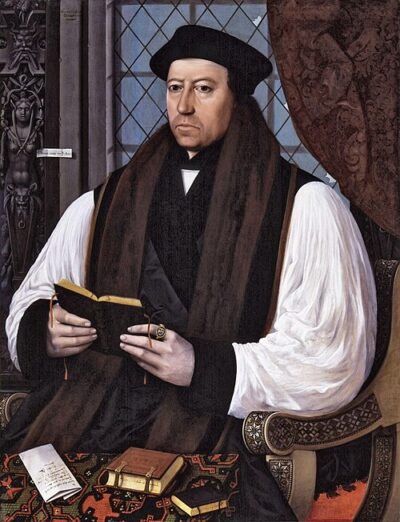
Thomas Cranmer
Thomas Cranmer was a leader of the English Reformation and Archbishop of Canterbury. Born July 2, 1489, in Aslockton. Died March 21, 1556, in Oxford. Positions held include Roman Catholic Archbishop of Canterbury (1533–1555). Educated at Jesus College and Magdalene College.
Facts
23 facts · 2 confirmed by two sources · 10 cited · 11 from one source
Where this comes from
Papalocal keeps its own record. It started from these sources; what each one said is kept here as it was copied, so a change on their side never changes this page by itself. Tap one to read its version.
What Wikidata says · copied November 16, 2026 · revision 2564313086
- Described as
- leader of the English Reformation and Archbishop of Canterbury
- Born
- July 2, 1489 · 3 references
- Died
- March 21, 1556 · 2 references
- Born in
- Aslockton · 1 reference
- Died in
- Oxford · 2 references
- Buried in
- Martyrs' Memorial · 1 reference
- Cause of death
- death by burning
- Citizen of
- United Kingdom
- Occupation
- Anglican priest; theologian · 1 reference; canon law jurist; Catholic bishop (1533–); archbishop · 1 reference; Protestant reformer · 1 reference
- Positions held
- Roman Catholic Archbishop of Canterbury (1533–1555) · 2 references
- Worked for
- University of Cambridge
- Education
- Jesus College · 1 reference; Magdalene College · 1 reference; University of Cambridge · 1 reference
- Spouse
- Margaret Cranmer
- Father
- Thomas Cranmer · 1 reference
- Mother
- Agnes Hatfield · 1 reference
- Religion
- Anglicanism; Catholic Church · 1 reference
- Wikipedias with a page
- 64
Wikidata item Q199894 (wikidata.org/wiki/Q199894), public domain (CC0). Copied November 16, 2026.
What Wikipedia says · copied November 16, 2026 · revision 1385654192
Thomas Cranmer (2 July 1489 – 21 March 1556) was an English theologian who was a leader of the English Reformation and served as Archbishop of Canterbury from 1533 to 1555, during the reigns of Henry VIII, Edward VI and, for a short time, Mary I. He is honoured as a martyr in the Church of England.
Cranmer was ordained a Catholic priest and served on the theology faculty at the University of Cambridge. At the behest of Cardinal Thomas Wolsey, he later served Henry VIII as a diplomat in Europe. Cranmer helped to build the case for the annulment of Henry's marriage to Catherine of Aragon, which was one of the causes of the separation of the English Church from union with the Holy See. Along with Thomas Cromwell, he supported the principle of royal supremacy, in which the king was considered sovereign over the Church within his realm and protector of his people from the abuses of Rome. During Cranmer's tenure as Archbishop of Canterbury, he established the first doctrinal and liturgical structures of the reformed Church of England. Under Henry's rule, Cranmer did not make many radical changes in the Church due to power struggles between religious conservatives and reformers. He published the first officially authorised vernacular (English) service, the Exhortation and Litany.
When Edward, who was devout and had been raised in the tenets of a reformed Church, came to the throne in 1547, Cranmer was able to promote faster changes. He wrote and compiled the first two editions of the Book of Common Prayer, a complete liturgy for the English Church, turning to the language of the people. With the assistance of several Continental reformers to whom he gave refuge, he changed doctrine or discipline in areas such as the Eucharist, clerical celibacy, the role of images in places of worship, and the veneration of saints. Cranmer promulgated the new doctrines through the prayer book, the Homilies and other publications.
After the accession of the Catholic Mary I in 1553, Cranmer was put on trial for treason and heresy. Imprisoned for over two years and under pressure from state and Church authorities, he made several recantations and reconciled himself with the Catholic Church. While this would have customarily absolved him from the heresy charge, Mary wanted him executed on the treason charge, and he was burned at the stake on 21 March 1556; on the day of his execution, he publicly withdrew his recantations, to die a heretic to Catholics and a martyr for the principles of the English Reformation. Cranmer's death was immortalised in Foxe's Book of Martyrs and his legacy lives on within the Church of England through the Book of Common Prayer and the Thirty-nine Articles, an Anglican statement of faith derived from his work.
- Born, in its opening lines
- July 2, 1489
- Died, in its opening lines
- March 21, 1556
From the Wikipedia article “Thomas Cranmer” (en.wikipedia.org/wiki/Thomas_Cranmer), by its contributors, under CC BY-SA 4.0 (creativecommons.org/licenses/by-sa/4.0/). Copied November 16, 2026; not changed.
Confirmed Two sources agree. Cited One source, and it names where it got it. One source One source, without a reference of its own. Sources disagree The sources disagree. We show the best-supported value and keep theirs below.
