
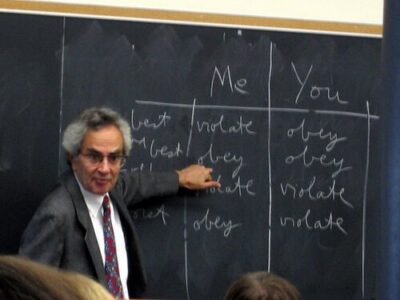
Thomas Nagel
Thomas Nagel is an American philosopher. Born July 4, 1937, in Belgrade. Known for What Is It Like to Be a Bat?, Mind and Cosmos and View from nowhere. Educated at Harvard University and Cornell University. Awards include Guggenheim Fellowship, Balzan Prize and PEN/Diamonstein-Spielvogel Award for the Art of the Essay.
Facts
26 facts · 1 confirmed by two sources · 4 cited · 21 from one source
Where this comes from
Papalocal keeps its own record. It started from these sources; what each one said is kept here as it was copied, so a change on their side never changes this page by itself. Tap one to read its version.
What Wikidata says · copied November 13, 2026 · revision 2567376227
- Described as
- American philosopher
- Born
- July 4, 1937 · 6 references
- Born in
- Belgrade · 1 reference
- Citizen of
- United States
- Occupation
- philosopher · 1 reference; university teacher; writer
- Worked for
- New York University; University of California, Berkeley · 1 reference
- Education
- Harvard University (–1963) · 1 reference; Cornell University
- Member of
- European Academy of Sciences and Arts; American Academy of Arts and Sciences
- Known for
- What Is It Like to Be a Bat?; Mind and Cosmos; View from nowhere
- Awards
- Guggenheim Fellowship (1966) · 1 reference; Balzan Prize (2008); PEN/Diamonstein-Spielvogel Award for the Art of the Essay (1996); Rolf Schock Prize in Logic and Philosophy (2008); honorary doctor of Harvard University (2010) · 1 reference
- Field
- philosophy; ethics; political theory
- Spouse
- Anne Hollander (1979–2014)
- Religion
- atheism
- Website
- http://www.nyu.edu/gsas/dept/philo/faculty/nagel/
- Wikipedias with a page
- 46
Wikidata item Q350239 (wikidata.org/wiki/Q350239), public domain (CC0). Copied November 13, 2026.
What Wikipedia says · copied November 13, 2026 · revision 1381482452
Thomas Nagel (; born July 4, 1937) is an American postanalytic philosopher. He is a professor of philosophy, a professor of law, and University Professor of Philosophy and Law Emeritus at New York University. From 2001 to 2003, he was the Fiorello LaGuardia Professor of Law at the New York University School of Law. His main areas of philosophical interest are political philosophy, ethics, and philosophy of mind.
After earning his doctorate from Harvard University under John Rawls, Nagel was a professor of philosophy at the University of California, Berkeley, from 1963 to 1966 and a professor at Princeton University from 1966 to 1980. In 1967, he and Robert Nozick co-founded an influential group of philosophers known as the Society for Ethical and Legal Philosophy. In the 1970s, Nagel also co-founded the philosophy journal Philosophy & Public Affairs.
Nagel is known for his critique of material reductionist accounts of the mind, particularly in his essay "What Is It Like to Be a Bat?" (1974), and for his contributions to liberal moral and political theory in The Possibility of Altruism (1970) and subsequent writings. He continued the critique of reductionism in Mind and Cosmos (2012), in which he argues against the neo-Darwinian view of the emergence of consciousness.
- Born, in its opening lines
- July 4, 1937
From the Wikipedia article “Thomas Nagel” (en.wikipedia.org/wiki/Thomas_Nagel), by its contributors, under CC BY-SA 4.0 (creativecommons.org/licenses/by-sa/4.0/). Copied November 13, 2026; not changed.
Confirmed Two sources agree. Cited One source, and it names where it got it. One source One source, without a reference of its own. Sources disagree The sources disagree. We show the best-supported value and keep theirs below.
