
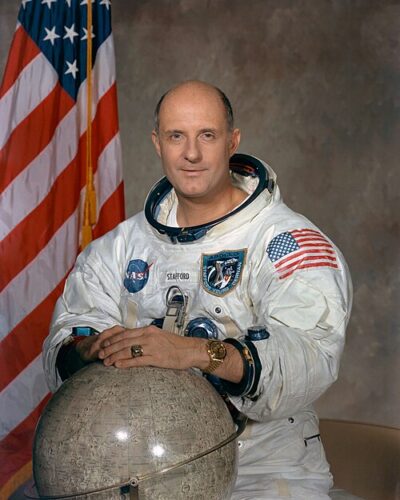
Thomas P. Stafford
Thomas P. Stafford was an American astronaut. Born September 17, 1930, in Weatherford. Died March 18, 2024, in Satellite Beach. Positions held include Chief of the Astronaut Office (1969–1971). Educated at U.S. Air Force Test Pilot School and United States Naval Academy. Awards include Distinguished Flying Cross, Presidential Medal of Freedom and Air Force Distinguished Service Medal.
Facts
34 facts · 2 confirmed by two sources · 10 cited · 22 from one source
Where this comes from
Papalocal keeps its own record. It started from these sources; what each one said is kept here as it was copied, so a change on their side never changes this page by itself. Tap one to read its version.
What Wikidata says · copied November 13, 2026 · revision 2565946428
- Described as
- American astronaut (1930–2024)
- Other names
- Thomas Patten Stafford, Tom Stafford
- Born
- September 17, 1930 · 4 references
- Died
- March 18, 2024 · 1 reference
- Born in
- Weatherford
- Died in
- Satellite Beach
- Name at birth
- Thomas Patten Stafford
- Citizen of
- United States
- Occupation
- military personnel; test pilot; astronaut (1962–1975) · 1 reference; aircraft pilot
- Positions held
- Chief of the Astronaut Office (1969–1971)
- Worked for
- National Aeronautics and Space Administration
- Education
- U.S. Air Force Test Pilot School; United States Naval Academy · 1 reference
- Member of
- National Academy of Engineering · 1 reference; NASA Astronaut Group 2 · 1 reference
- Awards
- Distinguished Flying Cross; Presidential Medal of Freedom (1970) · 1 reference; Air Force Distinguished Service Medal; Harmon Trophy; Congressional Space Medal of Honor (1993) · 1 reference; Medal "For Merit in Space Exploration"; National Aviation Hall of Fame (1997) · 1 reference; United States Astronaut Hall of Fame; Order of Friendship; NASA Distinguished Service Medal (1969) · 1 reference; NASA Outstanding Leadership Medal (1979) · 1 reference; NASA Distinguished Public Service Medal (2006) · 1 reference; NASA Exceptional Service Medal (1965) · 1 reference; Commendation Medal; Allan D. Emil Memorial Award (1980) · 1 reference
- Military branch
- United States Air Force
- Military rank
- Air Force lieutenant general; lieutenant general · 1 reference
- Wikipedias with a page
- 45
Wikidata item Q316417 (wikidata.org/wiki/Q316417), public domain (CC0). Copied November 13, 2026.
What Wikipedia says · copied November 13, 2026 · revision 1378506835
Thomas Patten Stafford (September 17, 1930 – March 18, 2024) was an American Air Force officer, test pilot, and NASA astronaut, and one of 24 Apollo astronauts who flew to the Moon. He also served as chief of the Astronaut Office from 1969 to 1971.
After graduating from the United States Naval Academy, Stafford was commissioned in the United States Air Force, flying the F-86 Sabre before becoming a test pilot. He was selected to become an astronaut in 1962, and flew aboard Gemini 6A in 1965 and Gemini 9A in 1966. In 1969, he commanded Apollo 10, the second crewed mission to orbit the Moon. Here, he and Gene Cernan became the first to fly an Apollo Lunar Module in lunar orbit, descending to an altitude of nine miles (fourteen kilometres).
In 1975, Stafford was the commander of the Apollo-Soyuz Test Project (ASTP) flight, the first joint U.S.-Soviet space mission. A brigadier general at the time, he became the first general officer to fly in space. He was the first member of his Naval Academy class to pin on the first, second, and third stars of a general officer. He made six rendezvous in space and logged 507 hours of space flight.
Stafford flew more than 120 types of fixed-wing and rotary aircraft and three types of spacecraft. After the deaths of Wally Schirra, Eugene Cernan, and John Young, he was the last surviving crew member of Gemini 6A, Gemini 9A, and Apollo 10.
In 1993, the Stafford Air & Space Museum was founded in his hometown of Weatherford, Oklahoma. Originally just two rooms, it has grown to over 63,000 square feet (5,850 m2) of artifact space. It is a Smithsonian affiliate and is the only museum in the world to house test-fired engines that would have been used in the Space Race: a U.S. F-1 engine and a Soviet NK-33 engine. It holds the Gemini 6 spacecraft that he and Schirra flew in a rendezvous with Gemini 7.
- Born, in its opening lines
- September 17, 1930
- Died, in its opening lines
- March 18, 2024
From the Wikipedia article “Thomas P. Stafford” (en.wikipedia.org/wiki/Thomas_P._Stafford), by its contributors, under CC BY-SA 4.0 (creativecommons.org/licenses/by-sa/4.0/). Copied November 13, 2026; not changed.
Confirmed Two sources agree. Cited One source, and it names where it got it. One source One source, without a reference of its own. Sources disagree The sources disagree. We show the best-supported value and keep theirs below.
