
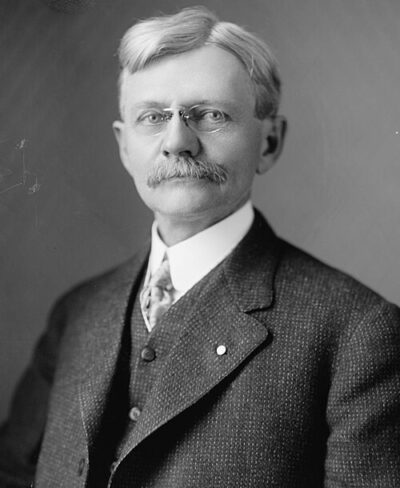
Thomas R. Marshall
Thomas R. Marshall was a vice president of the United States from 1913 to 1921. Born March 14, 1854, in North Manchester. Died June 1, 1925, in Washington, D.C.. Positions held include Vice President of the United States (1913–1921) and Governor of Indiana (1909–1913). Educated at Wabash College.
Facts
23 facts · 2 confirmed by two sources · 12 cited · 9 from one source
Where this comes from
Papalocal keeps its own record. It started from these sources; what each one said is kept here as it was copied, so a change on their side never changes this page by itself. Tap one to read its version.
What Wikidata says · copied November 13, 2026 · revision 2567483279
- Described as
- vice president of the United States from 1913 to 1921
- Other names
- Thomas Marshall, Thomas Riley Marshall
- Born
- March 14, 1854 · 6 references
- Died
- June 1, 1925 · 6 references
- Born in
- North Manchester · 1 reference
- Died in
- Washington, D.C. · 1 reference
- Buried in
- Crown Hill Cemetery · 1 reference
- Cause of death
- myocardial infarction
- Name at birth
- Thomas Riley Marshall
- Citizen of
- United States
- Occupation
- politician · 1 reference; lawyer · 1 reference; writer · 2 references; governor · 1 reference; jurist · 1 reference; vice president · 1 reference
- Positions held
- Vice President of the United States (1913–1921); Governor of Indiana (1909–1913)
- Political party
- Democratic Party
- Education
- Wabash College
- Member of
- Phi Beta Kappa Society
- Spouse
- Lois Irene Kimsey · 1 reference
- Father
- Daniel Marshall · 1 reference
- Mother
- Martha Patterson · 1 reference
- Religion
- Presbyterianism
- Wikipedias with a page
- 58
Wikidata item Q299001 (wikidata.org/wiki/Q299001), public domain (CC0). Copied November 13, 2026.
What Wikipedia says · copied November 13, 2026 · revision 1382980080
Thomas Riley Marshall (March 14, 1854 – June 1, 1925) was the 28th vice president of the United States from 1913 to 1921 under President Woodrow Wilson. A prominent lawyer in Indiana, he became an active and well-known member of the Democratic Party by stumping across the state for other candidates and organizing party rallies that later helped him win election as the 27th governor of Indiana. In office, he attempted to incorporate items from his progressive agenda into the Constitution of Indiana, but was blocked by the Indiana Supreme Court.
Marshall's popularity as Indiana governor, and the state's status at the time as a critical swing state, helped him secure the Democratic vice presidential nomination on the ticket with Wilson in 1912, and they won the subsequent general election. An ideological rift developed between them during their first term leading Wilson to limit Marshall's influence in the administration. Marshall's brand of humor caused Wilson to move Marshall's office away from the White House, further isolating him. Marshall was targeted in an assassination attempt in 1915 for supporting intervention in World War I. During Marshall's second term he delivered morale-boosting speeches across the nation during the war and became the first U.S. vice president to hold cabinet meetings, which he did while Wilson was in Europe during peace negotiations. As he was president of the United States Senate, a small number of anti-war Senators kept it deadlocked by refusing to end debate. To enable critical wartime legislation to be passed, Marshall had the body adopt its first procedural rule allowing filibusters to be ended by a two-thirds majority vote—a variation of this rule remains in effect.
Marshall's vice presidency is most remembered for a leadership crisis following a stroke that incapacitated Wilson in October 1919. Because of their personal dislike for Marshall, Wilson's advisers and wife Edith sought to keep him uninformed about the president's condition to prevent him from assuming presidential powers and duties. Many people, including cabinet officials and congressional leaders, urged Marshall to become acting president, but he refused to forcibly assume Wilson's powers, not wanting to set a standard of doing so. Without strong leadership in the executive branch, the administration's opponents defeated the ratification of the League of Nations treaty and returned the United States to an isolationist foreign policy. Marshall ended his time in office as the first vice president since Daniel D. Tompkins, nearly a century earlier, to serve two full terms, and the first vice president re-elected, since John C. Calhoun.
Marshall was known for his wit and sense of humor. One of his most enduring jokes provoked widespread laughter from his Senate colleagues during a floor debate. Responding to Senator Joseph Bristow's catalog of the nation's needs, Marshall quipped that, "What this country needs is a really good five-cent cigar." After his terms as vice president, he opened an Indianapolis law practice where he authored several legal books and his memoir, Recollections. He continued to travel and speak publicly. In 1925, Marshall died following a heart attack while on a trip to Washington, D.C.
- Born, in its opening lines
- March 14, 1854
- Died, in its opening lines
- June 1, 1925
From the Wikipedia article “Thomas R. Marshall” (en.wikipedia.org/wiki/Thomas_R._Marshall), by its contributors, under CC BY-SA 4.0 (creativecommons.org/licenses/by-sa/4.0/). Copied November 13, 2026; not changed.
Confirmed Two sources agree. Cited One source, and it names where it got it. One source One source, without a reference of its own. Sources disagree The sources disagree. We show the best-supported value and keep theirs below.
