
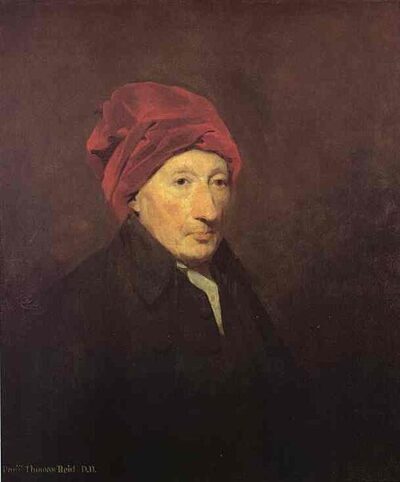
Thomas Reid
Thomas Reid was a Scottish philosopher. Born April 26, 1710, in Strachan. Died October 7, 1796, in Glasgow. Known for An Inquiry into the Human Mind: on the Principles of Common Sense, Essays on the Intellectual Powers of Man and Essays on the Active Powers of the Human Mind. Educated at University of Aberdeen. Awards include Fellow of the Royal Society of Edinburgh.
Facts
23 facts · 0 confirmed by two sources · 9 cited · 14 from one source
Where this comes from
Papalocal keeps its own record. It started from these sources; what each one said is kept here as it was copied, so a change on their side never changes this page by itself. Tap one to read its version.
What Wikidata says · copied November 16, 2026 · revision 2564330817
- Described as
- Scottish philosopher (1710–1796)
- Born
- April 26, 1710 · 8 references
- Died
- October 7, 1796 · 9 references
- Born in
- Strachan · 1 reference
- Died in
- Glasgow · 2 references
- Citizen of
- Kingdom of Great Britain
- Occupation
- philosopher · 1 reference; librarian; mathematician; writer · 1 reference; university teacher · 1 reference; ethicist · 1 reference
- Worked for
- University of Aberdeen; University of Glasgow
- Education
- University of Aberdeen
- Member of
- Royal Society of Edinburgh
- Known for
- An Inquiry into the Human Mind: on the Principles of Common Sense; Essays on the Intellectual Powers of Man; Essays on the Active Powers of the Human Mind
- Awards
- Fellow of the Royal Society of Edinburgh (1783) · 1 reference
- Field
- metaphysics; ethics
- Father
- Lewis Reid
- Religion
- Protestantism
- Wikipedias with a page
- 44
Wikidata item Q316347 (wikidata.org/wiki/Q316347), public domain (CC0). Copied November 16, 2026.
What Wikipedia says · copied November 16, 2026 · revision 1377075030
Thomas Reid (; 7 May (O.S. 26 April) 1710 – 7 October 1796) was a Scottish philosopher best known for his philosophical method, his theory of perception, and its wide implications on epistemology, and as the developer and defender of an agent-causal theory of free will. He also focused extensively on ethics, theory of action, language and philosophy of mind.
He was the founder of the Scottish School of Common Sense and played an integral role in the Scottish Enlightenment. In 1783 he was a joint founder of the Royal Society of Edinburgh. A contemporary of David Hume, Reid was also "Hume's earliest and fiercest critic".
Reid is known for his book Essays on the Active Powers of the Human Mind (1788), in which he discusses the active behavioral nature of the human mind, including discourses about free will, principles of action and morals.
From the Wikipedia article “Thomas Reid” (en.wikipedia.org/wiki/Thomas_Reid), by its contributors, under CC BY-SA 4.0 (creativecommons.org/licenses/by-sa/4.0/). Copied November 16, 2026; not changed.
Confirmed Two sources agree. Cited One source, and it names where it got it. One source One source, without a reference of its own. Sources disagree The sources disagree. We show the best-supported value and keep theirs below.
