
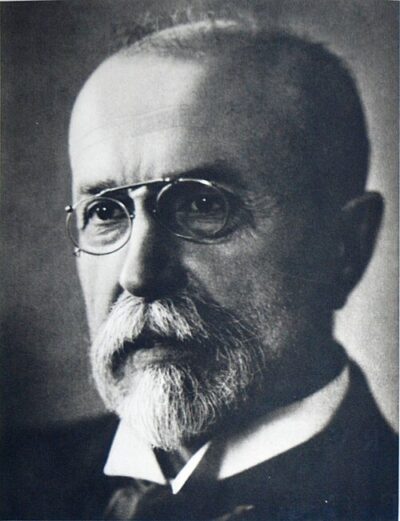
Tomáš Garrigue Masaryk
Tomáš Garrigue Masaryk was a Czechoslovak politician, statesman, sociologist and philosopher; first Czechoslovak president. Born March 7, 1850, in Hodonín. Died September 14, 1937, in Lány Castle. Positions held include President of Czechoslovakia (1918–1935) and Member of Abgeordnetenhaus (2 times) (1891–1917). Known for The Spirit of Russia, The New Europe (The Slav Standpoint) and Světová revoluce: za války a ve válce 1914-1918. Educated at University of Vienna and Akademisches Gymnasium. Awards include honorary citizen of Strakonice (2 times), honorary citizen of Třebíč and Order of the Star of Karađorđe.
Facts
70 facts · 2 confirmed by two sources · 42 cited · 26 from one source
Where this comes from
Papalocal keeps its own record. It started from these sources; what each one said is kept here as it was copied, so a change on their side never changes this page by itself. Tap one to read its version.
What Wikidata says · copied November 16, 2026 · revision 2569140057
- Described as
- Czechoslovak politician, statesman, sociologist and philosopher; first Czechoslovak president (1850–1937)
- Other names
- Tomáš Jan Masaryk, Tomáš Masaryk, Tomás Garrigue Masaryk, Tomas Garrigue Masaryk, T. G. Masaryk, Thomas Masaryk, TGM, Masaryk, Tomáš Garrigue
- Born
- March 7, 1850 · 21 references
- Died
- September 14, 1937 · 20 references
- Born in
- Hodonín · 5 references
- Died in
- Lány Castle · 1 reference
- Buried in
- Grave of Masaryk family
- Name at birth
- Tomáš Jan Masaryk · 1 reference
- Citizen of
- Cisleithania (–1918); Czechoslovakia (1918–)
- Occupation
- politician · 2 references; philosopher · 3 references; pedagogue; writer; sociologist · 1 reference; university teacher · 1 reference; journalist; teacher · 1 reference
- Positions held
- President of Czechoslovakia (1918–1935); Member of Abgeordnetenhaus (2 times) (1891–1917)
- Political party
- Young Czech Party (1890–1893)
- Worked for
- University of Vienna; Charles University; King's College London
- Education
- University of Vienna (1872–1876) · 1 reference; Akademisches Gymnasium (1869–1872) · 1 reference
- Member of
- American Philosophical Society (1936–) · 1 reference; Romanian Academy
- Known for
- The Spirit of Russia; The New Europe (The Slav Standpoint); Světová revoluce: za války a ve válce 1914-1918; Czechoslovak declaration of independence; Česká otázka; Masaryk's First Presidential Message
- Awards
- honorary citizen of Strakonice (2 times) (1918, 1935) · 2 references; honorary citizen of Třebíč (1918) · 1 reference; Order of the Star of Karađorđe (1920) · 1 reference; honorary doctorate from the University of Strasbourg (1920) · 2 references; doctor honoris causa from the University of Paris (1921) · 2 references; Grand Cross of the Legion of Honour (1921) · 2 references; honorary citizen of Prague (1922); honorary doctor of Protestant Theological Faculty – Charles University (1923) · 2 references; Grand Cross of the Order of Charles III (1924) · 1 reference; Order of the Elephant (1925) · 3 references; Order of the White Eagle (1925) · 1 reference; Grand Cross of the Order of the Redeemer (1927) · 1 reference; Order of the Three Stars, 1st Class (1927) · 1 reference; Grand Cross with Collar of the Order of the White Rose of Finland (1930) · 1 reference; Grand Cross of the Military Order of Saint James of the Sword (1930) · 1 reference
- Field
- politics · 1 reference; philosophy · 1 reference; sociology · 1 reference; journalism · 1 reference; educational system · 1 reference; literature · 1 reference
- Spouse
- Charlotte Garrigue (1878–1923) · 3 references
- Children
- Alice Masaryková · 1 reference; Herbert Masaryk; Jan Masaryk · 1 reference; Olga Masaryková; Eleonora Masaryková
- Father
- Jozef Maszárik · 1 reference
- Mother
- Terezie Masaryková · 1 reference
- Siblings
- Ludvík Masaryk
- Religion
- Evangelical Church in Austria (1781-1918) (1880–1918) · 1 reference; Evangelical Church of Czech Brethren (1918–1937) · 1 reference
- Military branch
- Czechoslovak Legions · 1 reference
- Lived in
- birth house of Tomáš Garrigue Masaryk; house of Tomáš Garrigue Masaryk (1856–1862) · 1 reference; Mutěnice (1852–1853) · 1 reference; Čejč · 1 reference; Brno (1865–1869) · 1 reference
- Wikipedias with a page
- 96
Wikidata item Q78492 (wikidata.org/wiki/Q78492), public domain (CC0). Copied November 16, 2026.
What Wikipedia says · copied November 16, 2026 · revision 1385712643
Tomáš Garrigue Masaryk (7 March 1850 – 14 September 1937) was a Czechoslovak statesman, political activist and philosopher who served as the first president of Czechoslovakia from 1918 to 1935. He is regarded as the founding father of Czechoslovakia.
Born in Hodonín, Moravia (then part of the Austrian Empire), Masaryk obtained a doctorate at the University of Vienna and was a professor of philosophy at the Czech Charles-Ferdinand University in Prague. He began his political career as a deputy of the Austrian Reichsrat, serving from 1891 to 1893 and from 1907 to 1914. He was an advocate of restructuring the Austro-Hungarian Empire into a federal state, but by the outbreak of the First World War, he had become a supporter of Czech and Slovak independence. He went into exile, and travelled around Europe to organise and promote the Czechoslovak cause. He played a pivotal role in the establishment of the Czechoslovak Legion, which fought against the Central Powers during the war. In 1918, Masaryk, along with his protégés Edvard Beneš and Milan Rastislav Štefánik, travelled to the United States to obtain support from President Woodrow Wilson and Secretary of State Robert Lansing. Their negotiations resulted in the Washington Declaration, which proclaimed the independence of a Czechoslovak state.
With the fall of Austria-Hungary in late 1918, the First Czechoslovak Republic received recognition from the Allied powers and Masaryk was recognised as head of its provisional government. He was formally elected president in November, and was reelected three times subsequently. Masaryk presided over a period of stability as Czechoslovakia emerged as a strong democratic state. He resigned from office in 1935 due to old age, and was succeeded by Beneš. He retired to the village of Lány and died two years later at the age of 87.
- Born, in its opening lines
- March 7, 1850
- Died, in its opening lines
- September 14, 1937
From the Wikipedia article “Tomáš Masaryk” (en.wikipedia.org/wiki/Tomáš_Masaryk), by its contributors, under CC BY-SA 4.0 (creativecommons.org/licenses/by-sa/4.0/). Copied November 16, 2026; not changed.
Confirmed Two sources agree. Cited One source, and it names where it got it. One source One source, without a reference of its own. Sources disagree The sources disagree. We show the best-supported value and keep theirs below.
