
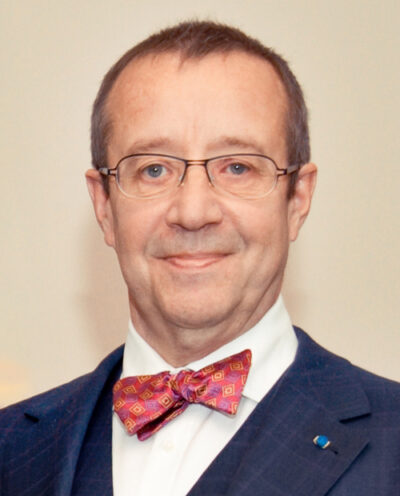
Toomas Hendrik Ilves
Toomas Hendrik Ilves is an Estonian politician and diplomat, fourth president of Estonia. Born December 26, 1953, in Stockholm. Positions held include President of Estonia (2006–2016), Member of the European Parliament (2004–2006) and Minister of Foreign Affairs (1996–2002). Educated at Columbia College and Columbia University. Awards include Grand Cross with Collar of the Order of the White Rose of Finland, Knight Grand Cross of the Order of the Falcon and Cross of Recognition.
Facts
45 facts · 1 confirmed by two sources · 6 cited · 38 from one source
Where this comes from
Papalocal keeps its own record. It started from these sources; what each one said is kept here as it was copied, so a change on their side never changes this page by itself. Tap one to read its version.
What Wikidata says · copied November 16, 2026 · revision 2569159205
- Described as
- Estonian politician and diplomat, fourth president of Estonia (born 1953)
- Other names
- Toomas-Hendrik Ilves, T. H. Ilves
- Born
- December 26, 1953 · 8 references
- Born in
- Stockholm · 1 reference
- Citizen of
- Estonia
- Occupation
- politician · 2 references; journalist; diplomat; psychologist
- Positions held
- President of Estonia (2006–2016); Member of the European Parliament (2004–2006); Minister of Foreign Affairs (1996–2002); ambassador of Estonia to the United States (1993–1996); member of the Riigikogu (1999–2007)
- Political party
- Social Democratic Party (1999–); People's Party (1998–1999); Peasants' Party (1997–1998); Volt Europa (2025–)
- Education
- Columbia College; Columbia University; University of Pennsylvania; Leonia High School
- Member of
- European Council on Foreign Relations
- Awards
- Grand Cross with Collar of the Order of the White Rose of Finland (2007) · 1 reference; Knight Grand Cross of the Order of the Falcon; Cross of Recognition; Order of the Three Stars, 1st Class; Knight Grand Cross in the Order of the Netherlands Lion; Collar of the Order of the Cross of Terra Mariana; Grand Cross with collar of the Order of Vytautas the Great; Collar of the Order of the Star of Romania; Grand Officer of the Legion of Honour · 1 reference; Grand Cross of the Order of Merit of Hungary; Grand Cordon of the Supreme Order of the Chrysanthemum; Grand Cross Special Class of the Order of Merit of the Federal Republic of Germany (2013); St. George's Order of Victory · 1 reference; Order of the Golden Fleece · 1 reference; Royal Order of the Seraphim · 1 reference
- Spouse
- Ieva Ilves (2016–2023) · 1 reference; Evelin Ilves (2004–2015) · 2 references; Merry Bullock (1981–2004)
- Children
- Luukas Ilves
- Father
- Endel Ilves · 1 reference
- Siblings
- Andres Ilves
- Religion
- Lutheranism · 1 reference
- Website
- http://www.thilves.ee/; https://www.presidentilves.ee/
- Wikipedias with a page
- 75
Wikidata item Q57289 (wikidata.org/wiki/Q57289), public domain (CC0). Copied November 16, 2026.
What Wikipedia says · copied November 16, 2026 · revision 1381413785
Toomas Hendrik Ilves (Estonian pronunciation: [ˈtoːmɑs ˈhendrik ˈilves]; born 26 December 1953) is an Estonian politician who served as the fourth president of Estonia from 2006 until 2016.
Ilves worked as a diplomat and journalist, and he was the leader of the Social Democratic Party in the 1990s. He served in the government as Minister of Foreign Affairs from 1996 to 1998 and again from 1999 to 2002. Later, he was a Member of the European Parliament from 2004 to 2006. He was elected as President of Estonia by an electoral college on 23 September 2006 and his term as President began on 9 October 2006. He was reelected by Parliament in 2011.
On 1 May 2025, Ilves announced that he had "broken with my promise to avoid all party politics" and joined Volt Europa.
- Born, in its opening lines
- December 26, 1953
From the Wikipedia article “Toomas Hendrik Ilves” (en.wikipedia.org/wiki/Toomas_Hendrik_Ilves), by its contributors, under CC BY-SA 4.0 (creativecommons.org/licenses/by-sa/4.0/). Copied November 16, 2026; not changed.
Confirmed Two sources agree. Cited One source, and it names where it got it. One source One source, without a reference of its own. Sources disagree The sources disagree. We show the best-supported value and keep theirs below.
