
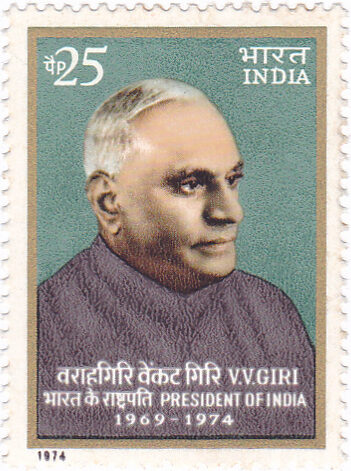
V. V. Giri
V. V. Giri was an Indian politician and 4th president of India. Born August 10, 1894, in Brahmapur. Died June 23, 1980, in Chennai. Positions held include Vice President of India (1967–1969), President of India (1969–1974) and Governor of Uttar Pradesh (1957–1960). Educated at University College Dublin and University of Madras. Awards include Bharat Ratna, anniversary medal at the occasion of the 2500th anniversary of the founding of the Iranian Empire and honorary doctor of Comenius University.
Facts
24 facts · 1 confirmed by two sources · 2 cited · 20 from one source · 1 where the sources disagree
What’s different
- Died: we show June 23, 1980 (Sources disagree). Wikipedia says June 24, 1980
Where this comes from
Papalocal keeps its own record. It started from these sources; what each one said is kept here as it was copied, so a change on their side never changes this page by itself. Tap one to read its version.
What Wikidata says · copied November 16, 2026 · revision 2563963327
- Described as
- Indian politician and 4th president of India (1894-1980)
- Other names
- Varahagiri Venkata Giri
- Born
- August 10, 1894 · 5 references
- Died
- June 23, 1980
- Born in
- Brahmapur · 1 reference
- Died in
- Chennai
- Citizen of
- India (1950–); British Raj (–1947); Dominion of India (1947–1950)
- Occupation
- politician; trade unionist; writer · 1 reference
- Positions held
- Vice President of India (1967–1969); President of India (1969–1974); Governor of Uttar Pradesh (1957–1960); Governor of Kerala (1960–1965); governor of Karnataka (1965–1967)
- Political party
- Indian National Congress
- Education
- University College Dublin; University of Madras
- Awards
- Bharat Ratna (1975); anniversary medal at the occasion of the 2500th anniversary of the founding of the Iranian Empire · 1 reference; honorary doctor of Comenius University (1973) · 1 reference
- Siblings
- Adruti Laxmibai
- Religion
- Hinduism
- Lived in
- Odisha
- Wikipedias with a page
- 63
Wikidata item Q312557 (wikidata.org/wiki/Q312557), public domain (CC0). Copied November 16, 2026.
What Wikipedia says · copied November 16, 2026 · revision 1379640231
Varahagiri Venkata Giri (; 10 August 1894 – 24 June 1980), better known as V. V. Giri was an Indian statesman, activist, and diplomat who served as the president of India from 1969 to 1974. He previously served as the vice president of India from 1967 to 1969 and the minister of labour from 1952 to 1954.
Born in Berhampur to a Telugu Brahmin family, Giri completed his higher education at Khallikote College where he was elected to the student union, and was active in the freedom movement. He moved to Ireland in 1913 to study law at the University College Dublin (UCD) and the Honourable Society of King's Inns, Dublin. He was called to the Irish Bar in June 1916 but he did not complete his studies for a BA in UCD. He enrolled at Madras High Court in 1916 upon returning to India. Giri became a member of the Indian National Congress and the Home Rule Movement. After abandoning his legal career as part of the Non-Cooperation Movement in 1920, he was arrested for demonstrations in 1922. Giri was closely associated with the Indian labour movement, and was elected president of the All India Trade Union Congress in 1926.
Giri was elected a member of the Imperial Legislative Assembly in 1934, and became the minister for labour and industry in 1937 under C. Rajagopalachari. After the congress ministries resigned in protest at India being made to be a part of the Second World War in 1939, Giri returned to the Labour movement and was later arrested, spending 15 months in prison until 1941. He was arrested again after the launch of the Quit India Movement, and he was imprisoned for three years from 1942 to 1945. In the General Elections of 1946, Giri was elected to the Madras Legislative Assembly and became a minister again in charge of the labour portfolio under T. Prakasam. From 1947 to 1951, he served as India's first High Commissioner to Ceylon.
Giri was elected to the 1st Lok Sabha from Pathapatnam Lok Sabha Constituency in 1951. He served as the Union minister of labour in the Nehru government from 1952 until his resignation in 1954. He was defeated in the Pathapatnam constituency at the 1957 elections and was appointed the Governor of Uttar Pradesh in the same year. He then served as the Governor of Kerala from 1960 to 1965 and the Governor of Karnataka 1965 to 1967. Giri was elected vice president in the 1967 election. Following the death of president Zakir Husain, Giri became acting president in May 1969 before resigning in July to contest the subsequent presidential election as an independent candidate. His endorsement by prime minister Indira Gandhi helped his victory in the election, and Giri served as president of India from 1969 to 1974. Gandhi chose not renominate him in 1974. After the end of his full term, Giri was honoured by the Government of India with the Bharat Ratna in 1975. He died of a heart attack at the age of 85 in 1980.
- Born, in its opening lines
- August 10, 1894
- Died, in its opening lines
- June 24, 1980
From the Wikipedia article “V. V. Giri” (en.wikipedia.org/wiki/V._V._Giri), by its contributors, under CC BY-SA 4.0 (creativecommons.org/licenses/by-sa/4.0/). Copied November 16, 2026; not changed.
Confirmed Two sources agree. Cited One source, and it names where it got it. One source One source, without a reference of its own. Sources disagree The sources disagree. We show the best-supported value and keep theirs below.
