
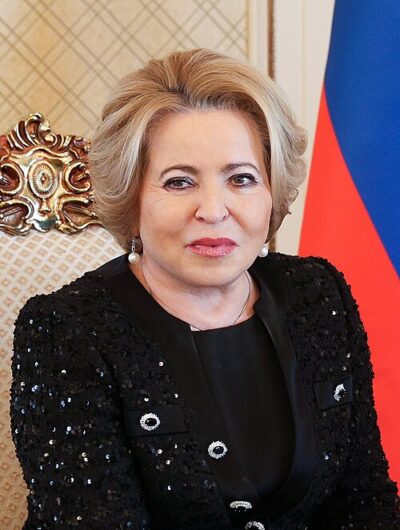
Valentina Matviyenko
Valentina Matviyenko is a Russian politician. Born April 7, 1949, in Shepetivka. Positions held include Chairman of the Federation Council of Russia (2011–), Deputy Chairman of the Government of the Russian Federation (1998–2003) and member of the Federation Council of Russia (2011–). Educated at Saint Petersburg State Chemical-Pharmaceutical University and Diplomatic Academy of the Ministry of Foreign Affairs of the Russian Federation. Awards include Order of Honour, Medal "In Commemoration of the 300th Anniversary of Saint Petersburg" and Order of the Badge of Honour.
Facts
42 facts · 1 confirmed by two sources · 13 cited · 28 from one source
Where this comes from
Papalocal keeps its own record. It started from these sources; what each one said is kept here as it was copied, so a change on their side never changes this page by itself. Tap one to read its version.
What Wikidata says · copied November 16, 2026 · revision 2558268122
- Described as
- Russian politician
- Other names
- Valentina Ivanovna Matviyenko, Valentina Matvienko, Ms. Valentina Matvienko
- Born
- April 7, 1949
- Born in
- Shepetivka
- Citizen of
- Soviet Union (–1991); Russia (1991–)
- Occupation
- expert pharmacist; diplomat; politician · 1 reference; statesperson; governor · 1 reference
- Positions held
- Chairman of the Federation Council of Russia (2011–); Deputy Chairman of the Government of the Russian Federation (1998–2003) · 1 reference; member of the Federation Council of Russia (2011–) · 1 reference; ambassador of Russia to Greece (1997–1998); Governor of Saint Petersburg (2003–2011); ambassador of Russia to Malta (1991–1994) · 1 reference; Permanent member of the Security Council of Russia (2011–) · 1 reference
- Political party
- United Russia; Communist Party of the Soviet Union
- Worked for
- Federation Council
- Education
- Saint Petersburg State Chemical-Pharmaceutical University (1967–1972); Diplomatic Academy of the Ministry of Foreign Affairs of the Russian Federation · 1 reference; Russian Presidential Academy of National Economy and Public Administration · 1 reference
- Member of
- Federation Council; CIS Interparliamentary Assembly · 1 reference
- Awards
- Order of Honour (1996) · 1 reference; Medal "In Commemoration of the 300th Anniversary of Saint Petersburg" (2003) · 1 reference; Order of the Badge of Honour (1976) · 1 reference; Order "For Merit to the Fatherland", 1st class (2014); Order "For Merit to the Fatherland", 2nd class (2009) · 1 reference; Order "For Merit to the Fatherland", 3rd class (2003) · 1 reference; Order "For Merit to the Fatherland", 4th class (1999) · 1 reference; Order of the Red Banner of Labour (1981) · 1 reference; Order of St. Sergius of Radonezh 2nd class · 1 reference; Order of St. Sergius of Radonezh 1st class (2010) · 1 reference; Russian government prize for science and technology (2010) · 1 reference; Order of St. Andrew the Apostle the First-Called (2019); Stolypin Medal, 1st class; Medal "For cooperation with the FSB of Russia"; Medal "For Strengthening of Brotherhood in Arms"
- Field
- politics
- Children
- Sergei Matvienko
- Religion
- Russian Orthodox Church
- Wikipedias with a page
- 61
Wikidata item Q182654 (wikidata.org/wiki/Q182654), public domain (CC0). Copied November 16, 2026.
What Wikipedia says · copied November 16, 2026 · revision 1378310149
Valentina Ivanovna Matviyenko (née Tyutina; born 7 April 1949) is a Russian politician and former diplomat serving as a Senator from Saint Petersburg and the Chairwoman of the Federation Council since 2011. Previously she was Governor of Saint Petersburg from 2003 to 2011.
Born in the Ukrainian SSR, Matviyenko began her political career in the 1980s in Leningrad (now Saint Petersburg), and was the First Secretary of the Krasnogvardeysky District Communist Party of the city from 1984 to 1986. In the 1990s, Matviyenko served as the Russian ambassador to Malta (1991–1995), and to Greece (1997–1998). From 1998 to 2003, Matviyenko was Deputy Prime Minister for Welfare, and briefly the Presidential Envoy to the Northwestern Federal District in 2003. By that time, Matviyenko was firmly allied with Russian president Vladimir Putin, an alliance which secured her a victory in the gubernatorial elections in Saint Petersburg, Putin's native city.
Matviyenko became the first female leader of Saint Petersburg. Since the start of Matviyenko's service as governor, a significant share of taxation money was transferred from the federal budget to the local budget, and along with the booming economy and improving investment climate the standard of living significantly increased in the city, making income levels much closer to Moscow, and far above most other Russian federal subjects. The profile of Saint Petersburg in Russian politics has risen, marked by the transfer of the Constitutional Court of Russia from Moscow in 2008. Matviyenko developed a large number of megaprojects in housing and infrastructure, such as the construction of the Saint Petersburg Ring Road, including the Big Obukhovsky Bridge (the only non-draw bridge over the Neva River in the city), completion of the Saint Petersburg Dam aimed to put an end to the infamous Saint Petersburg floods, launching Line 5 of Saint Petersburg Metro, and starting land reclamation in the Neva Bay for the new Marine Facade of the city (the largest European waterfront development project) containing the Passenger Port of St. Petersburg. Several major auto-producing companies were drawn to Saint Petersburg or its vicinity, including Toyota, General Motors, Nissan, Hyundai Motor, Suzuki, Magna International, Scania, and MAN SE (all having plants in the Shushary industrial zone), thus turning the city into an important center of automotive industry in Russia, specializing in foreign brands. Another development of Matviyenko's governorship was tourism; by 2010 the number of tourists in Saint Petersburg doubled and reached 5.2 million, which placed the city among the top five tourist centers in Europe.
Some actions and practices of Governor Matviyenko have drawn significant criticisms from the Saint Petersburg public, the media, and opposition groups. In particular, new construction in already heavily built-up areas and several building projects were deemed to conflict with the classical architecture of the city, where the entire centre is a UNESCO World Heritage Site. Some projects eventually were cancelled or modified, such as the controversial design of a 400-metre-tall Okhta Center skyscraper, planned to be built adjacent to the historical center of the city; however, after a public campaign and the personal involvement of Russian president Dmitry Medvedev, it was relocated from Okhta to the Lakhta suburb. Another major point of criticism was Matviyenko's handling of the city's snow removal problems during the unusually cold and snowy winters of 2009–10 and 2010–11. On 22 August 2011, soon after completion of the Saint Petersburg Dam, Matviyenko resigned from office. As a member of the ruling United Russia Party, on 21 September 2011, Matviyenko was elected as Chairwoman of the Federation Council, the country's third-highest elected office.
- Born, in its opening lines
- April 7, 1949
From the Wikipedia article “Valentina Matviyenko” (en.wikipedia.org/wiki/Valentina_Matviyenko), by its contributors, under CC BY-SA 4.0 (creativecommons.org/licenses/by-sa/4.0/). Copied November 16, 2026; not changed.
Confirmed Two sources agree. Cited One source, and it names where it got it. One source One source, without a reference of its own. Sources disagree The sources disagree. We show the best-supported value and keep theirs below.
