
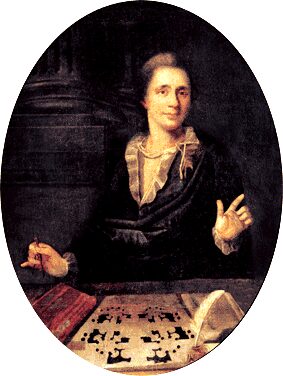
Vasili Bazhenov
Vasili Bazhenov was a Russian neoclassical architect. Born March 1, 1737, in Moscow. Died August 2, 1799, in Saint Petersburg. Known for Tsaritsyno Park + palace. Educated at Imperial Academy of Arts and Slavic Greek Latin Academy.
Facts
17 facts · 0 confirmed by two sources · 5 cited · 10 from one source · 2 where the sources disagree
What’s different
- Born: we show March 1, 1737 (Sources disagree). Wikipedia says March 12, 1737
- Died: we show August 2, 1799 (Sources disagree). Wikipedia says August 13, 1799
Where this comes from
Papalocal keeps its own record. It started from these sources; what each one said is kept here as it was copied, so a change on their side never changes this page by itself. Tap one to read its version.
What Wikidata says · copied November 18, 2026 · revision 2569061487
- Described as
- Russian neoclassical architect (1737-1799)
- Other names
- Vasily Ivanovich Bazhenov, Vasily Bazhenov, Vasiliĭ Ivanovich Bazhenov
- Born
- March 1, 1737
- Died
- August 2, 1799 · 1 reference
- Born in
- Moscow · 1 reference
- Died in
- Saint Petersburg · 1 reference
- Buried in
- Tula Oblast
- Citizen of
- Russian Empire
- Occupation
- linguist; architect · 1 reference; painter · 1 reference; draftsperson · 1 reference
- Education
- Imperial Academy of Arts; Slavic Greek Latin Academy; Moscow University Gymnasium · 1 reference
- Member of
- Russian Academy of Sciences; Accademia delle Arti del Disegno
- Known for
- Tsaritsyno Park + palace
- Field
- architecture · 1 reference
- Wikipedias with a page
- 23
Wikidata item Q51129 (wikidata.org/wiki/Q51129), public domain (CC0). Copied November 18, 2026.
What Wikipedia says · copied November 18, 2026 · revision 1376684372
Vasily Ivanovich Bazhenov (Russian: Васи́лий Ива́нович Баже́нов; 12 March [O.S. 1 March] 1737 or 1738 – 13 August [O.S. 2 August] 1799) was a Russian neoclassical architect, graphic artist, architectural theorist and educator. Bazhenov and his associates Matvey Kazakov and Ivan Starov were the leading local architects of the Russian Enlightenment, a period dominated by foreign architects (Charles Cameron, Giacomo Quarenghi, Antonio Rinaldi and others). According to Dmitry Shvidkovsky, in the 1770s, Bazhenov became the first Russian architect to create a national architectural language since the 17th-century tradition interrupted by Peter the Great.
Bazhenov's early success was followed by a tragic professional and private life. His two main construction projects were abandoned for political or financial reasons. His magnum opus, the neoclassical Grand Kremlin Palace, was cancelled shortly after groundbreaking. The imperial palace in Tsaritsyno Park fell victim to the Battle of the Palaces; Bazhenov's palace core was demolished on the orders of Catherine II. Another project, for the Moscow State University building, ended in a bitter conflict with Bazhenov's former benefactor Prokofi Demidov and led Bazhenov into bankruptcy. Before his death, Bazhenov implored his children to stay aside from the treacherous construction business.
Bazhenov's legacy remains debated. The attributions of Pashkov House and lesser projects to Bazhenov, backed by a sketchy paper trail, deductions and conjectures, are uncertain to the point where his life and work became subject of conspiracy theories. Even his place of birth and the location of Bazhenov's grave are unknown. His life story, as reconstructed by Igor Grabar and popularized by the historians of the Soviet period, is regarded by modern critics as the "Bazhenov myth", and even most recent academic research fails to replace this myth with a reliable biography.
- Born, in its opening lines
- March 12, 1737
- Died, in its opening lines
- August 13, 1799
From the Wikipedia article “Vasily Bazhenov” (en.wikipedia.org/wiki/Vasily_Bazhenov), by its contributors, under CC BY-SA 4.0 (creativecommons.org/licenses/by-sa/4.0/). Copied November 18, 2026; not changed.
Confirmed Two sources agree. Cited One source, and it names where it got it. One source One source, without a reference of its own. Sources disagree The sources disagree. We show the best-supported value and keep theirs below.
