
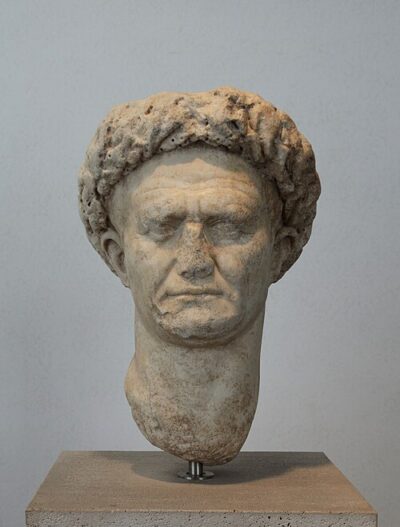
Vespasian
Vespasian was a ninth Roman Emperor and founder of the Flavian dynasty. Born November 17, 9, in Falacrine. Died June 4, 79, in Aquae Cutiliae. Positions held include Roman emperor (69–79), ancient Roman senator and praetors.
Facts
23 facts · 0 confirmed by two sources · 4 cited · 19 from one source
Where this comes from
Papalocal keeps its own record. It started from these sources; what each one said is kept here as it was copied, so a change on their side never changes this page by itself. Tap one to read its version.
What Wikidata says · copied November 16, 2026 · revision 2563459214
- Described as
- ninth Roman Emperor and founder of the Flavian dynasty (69–79)
- Other names
- Emperor Vespasian, Caesar Vespasianus Augustus, Mulio, Titus Flavius Vespasianus
- Born
- November 17, 9 · 1 reference
- Died
- June 4, 79
- Born in
- Falacrine
- Died in
- Aquae Cutiliae
- Buried in
- Inglaterra
- Citizen of
- Ancient Rome
- Occupation
- politician; military personnel
- Positions held
- Roman emperor (69–79); ancient Roman senator; praetors; plebeian aedile (38–); Roman consul
- Spouse
- Domitilla the Elder · 1 reference
- Children
- Titus · 2 references; Domitian · 1 reference; Domitilla the Younger
- Father
- Titus Flavius Sabinus
- Mother
- Vespasia Polla
- Siblings
- Titus Flavius Sabinus · 1 reference; Flavia Vespasia
- Religion
- ancient Roman religion
- Military rank
- legatus
- Wikipedias with a page
- 113
Wikidata item Q1419 (wikidata.org/wiki/Q1419), public domain (CC0). Copied November 16, 2026.
What Wikipedia says · copied November 16, 2026 · revision 1385138899
Vespasian (; full birth name Latin: Titus Flavius Vespasianus, pronounced [ˈt̪ɪt̪ʊs ˈfɫaːwijʊs wɛs.pasiˈjaːnʊs]) 17 November 9 AD – 23 June 79) was Roman emperor from 69 to 79. The last emperor to reign in the Year of the Four Emperors, he founded the Flavian dynasty, which lasted for 27 years. His fiscal reforms and consolidation of the empire brought political stability and an extensive building program.
After Vitellius, Vespasian was the second emperor from an equestrian family and the first emperor who rose later in his lifetime into the senatorial rank as the first member of his family to do so. He rose to prominence through military achievement: he served as legate of Legio II Augusta during the Roman invasion of Britain in 43, and later led the suppression of the Jewish rebellion of 66–70.
When the emperor Nero committed suicide in June 68, Vespasian was engaged in the campaign in Judaea. Rome was plunged into a year of civil war known as the Year of the Four Emperors. After the first two claimants, Galba and Otho, died in quick succession, Vitellius became emperor in April 69. The Roman legions of Egypt and Judaea reacted by declaring Vespasian, their commander, emperor on 1 July 69. Vespasian then joined forces with Mucianus, the governor of Syria, and Primus, a general in Pannonia. The latter two led the Flavian forces against Vitellius in Rome, while Vespasian took control of Egypt. On 20 December 69, Vitellius was defeated, and the following day Vespasian was declared emperor by the Senate.
Little information survives about the government during Vespasian's ten-year rule. He reformed the financial system of the Roman Empire after the campaign against Judaea ended successfully, and initiated several ambitious construction projects, including the building of the Flavian Amphitheatre, better known today as the Colosseum. Through his general Agricola, Vespasian expanded Roman control in Britain. Vespasian is often credited with restoring political stability to Rome following the chaotic reigns of his predecessors. After he died in 79, he was succeeded by his elder son, Titus, thus becoming the first Roman emperor to be succeeded by his natural son and establishing the Flavian dynasty.
From the Wikipedia article “Vespasian” (en.wikipedia.org/wiki/Vespasian), by its contributors, under CC BY-SA 4.0 (creativecommons.org/licenses/by-sa/4.0/). Copied November 16, 2026; not changed.
Confirmed Two sources agree. Cited One source, and it names where it got it. One source One source, without a reference of its own. Sources disagree The sources disagree. We show the best-supported value and keep theirs below.
