
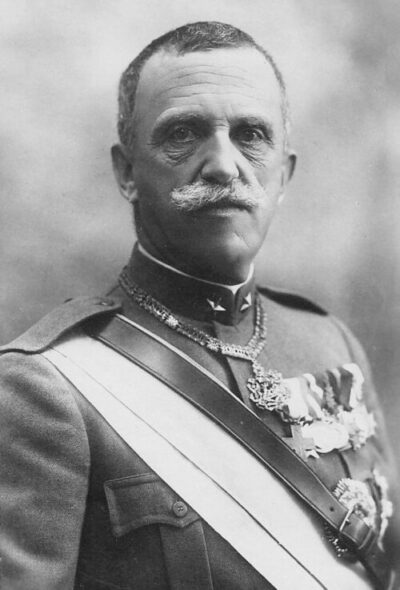
Victor Emmanuel III of Italy
Victor Emmanuel III of Italy was a King of Italy from 1900 to 1946. Born November 11, 1869, in Naples. Died December 28, 1947, in Alexandria. Positions held include Emperor of Ethiopia (1936–1941), Monarch of Italy (1900–1946) and King of Albania (1939–1943). Educated at Nunziatella military academy. Awards include Knight of the Order of the Golden Fleece, Order of the Black Eagle and Knight Grand Cross of the Order of the Bath.
Facts
46 facts · 2 confirmed by two sources · 6 cited · 38 from one source
Where this comes from
Papalocal keeps its own record. It started from these sources; what each one said is kept here as it was copied, so a change on their side never changes this page by itself. Tap one to read its version.
What Wikidata says · copied November 16, 2026 · revision 2567633228
- Described as
- King of Italy from 1900 to 1946
- Other names
- Vittorio Emanuele III, Victor Emmanuel III of Savoy, Vittorio Emanuele III of Italy, Victor Emmanuel III
- Born
- November 11, 1869 · 11 references
- Died
- December 28, 1947 · 10 references
- Born in
- Naples · 3 references
- Died in
- Alexandria · 3 references
- Buried in
- Basilica Shrine of Our Lady of Mondovi (2017–); St. Catherine's Cathedral, Alexandria (1947–2017)
- Citizen of
- Italy (1946–); Kingdom of Italy (–1946)
- Occupation
- numismatist; monarch; sovereign · 1 reference
- Positions held
- Emperor of Ethiopia (1936–1941); Monarch of Italy (1900–1946); King of Albania (1939–1943); Head of the House of Savoy
- Education
- Nunziatella military academy
- Member of
- Russian Academy of Sciences (1901–) · 1 reference; Académie des Inscriptions et Belles-Lettres (1915–1947) · 1 reference; Romanian Academy; Victor Emmanuel III of Italy and Queen Elena · 1 reference
- Awards
- Knight of the Order of the Golden Fleece; Order of the Black Eagle; Knight Grand Cross of the Order of the Bath; Order of the White Eagle; Order of St. Olav; Order of Lāčplēsis; Order of St. Andrew; Royal Victorian Chain (1903); Collar of the Imperial Order of the Red Arrows (1937) · 1 reference; Supreme Order of Christ; Knight Grand Cross of the Order of Saints Maurice and Lazarus; Medal of the Royal Numismatic Society; Collar of the Supreme Order of the Chrysanthemum; Order of the Elephant (1891); Grand Cross of the Order of Military Virtue · 1 reference
- Spouse
- Elena of Montenegro (1896–1947) · 1 reference
- Children
- Princess Iolanda, Countess of Bergolo · 1 reference; Princess Mafalda of Savoy; Umberto II of Italy; Giovanna of Savoy; Princess Maria Francesca of Savoy
- Father
- Umberto I of Italy
- Mother
- Margherita of Savoy
- Religion
- apatheism · 2 references
- Military branch
- Italian Air Force
- Military rank
- First marshal of the empire
- Wikipedias with a page
- 77
Wikidata item Q150642 (wikidata.org/wiki/Q150642), public domain (CC0). Copied November 16, 2026.
What Wikipedia says · copied November 16, 2026 · revision 1385895946
Victor Emmanuel III (Italian: Vittorio Emanuele Ferdinando Maria Gennaro di Savoia; 11 November 1869 – 28 December 1947) was King of Italy from 29 July 1900 until his abdication on 9 May 1946. A member of the House of Savoy, he was also King-Emperor of Italian East Africa (status within Ethiopia disputed) from 1936 to 1941 following the Second Italo-Ethiopian War and King of the Albanians from 1939 to 1943 following the Italian invasion of Albania. During his reign of nearly 46 years, which began after the assassination of his father Umberto I, the Kingdom of Italy became involved in World War I and in World War II. His reign also encompassed the birth, rise, and fall of the Fascist regime.
The first fourteen years of Victor Emmanuel's reign were dominated by prime minister Giovanni Giolitti, who focused on industrialization and passed several democratic reforms, such as the introduction of universal male suffrage. In foreign policy, Giolitti's Italy distanced itself from the fellow members of the Triple Alliance (the German Empire and Austria-Hungary) and colonized Libya following the Italo-Turkish War. Giolitti was succeeded by Antonio Salandra, Paolo Boselli, and Vittorio Emanuele Orlando. The First World War brought about Italian victory over the Habsburg Empire and the annexation of the Italian-speaking provinces of Trento and Trieste, completing the national unity of Italy, and the southern part of German-speaking Tyrol (South Tyrol). For this reason, Victor Emmanuel was labelled the "King of Victory". However, a part of Italian nationalists protested against the partial violation of the 1915 Treaty of London and what they defined as a "mutilated victory", demanding the annexation of Croatian-speaking territories in Dalmatia and temporarily occupying the town of Fiume without royal assent.
During the early 1920s, several short-serving prime ministers, including the well-respected Giolitti, serving an unprecedented fifth term as prime minister, could not unify the country in the face of the growing Italian fascist movement. Strengthened by the economic downturn facing the country, the National Fascist Party led the March on Rome, and Victor Emmanuel appointed Benito Mussolini as prime minister. He remained silent on the domestic political abuses of Fascist Italy, and he accepted the additional crowns of the Emperor of Ethiopia in 1936 and the King of Albania in 1939 as a result of Italian imperialism under fascism. When the Second World War broke out in 1939, Victor Emmanuel advised Mussolini against entering the war. In June 1940, he relented and granted Mussolini sweeping powers to enter and conduct the war.
After the Allied invasion of Sicily in July 1943, Victor Emmanuel discharged Mussolini and appointed Pietro Badoglio as the new Prime Minister. After weeks of negotiations, the Kingdom of Italy signed the armistice of Cassibile with the Allies in September 1943. During the German reprisal (Operation Achse), Victor Emmanuel III and the government fled to Brindisi, while the Germans established the Italian Social Republic as a puppet state in Northern Italy. Having signed the armistice with the Allies, he then declared war on Germany in October. After the liberation of Rome by Allied forces in June 1944, Victor Emmanuel transferred most of his powers to his son Umberto, effectively ending his involvement in the war and in the government of Italy. Victor Emmanuel officially abdicated his throne in 1946 in favour of his son, who became King Umberto II. Victor Emmanuel hoped to strengthen support for the monarchy against an ultimately successful referendum to abolish it.
After the 1946 Italian institutional referendum established the Republic, Victor Emmanuel went into exile to Alexandria, where he died and was buried the following year in St. Catherine's Cathedral, Alexandria. In 2017, his remains were returned to rest in Italy following an agreement between presidents Sergio Mattarella and Abdel Fattah el-Sisi.
- Born, in its opening lines
- November 11, 1869
- Died, in its opening lines
- December 28, 1947
From the Wikipedia article “Victor Emmanuel III” (en.wikipedia.org/wiki/Victor_Emmanuel_III), by its contributors, under CC BY-SA 4.0 (creativecommons.org/licenses/by-sa/4.0/). Copied November 16, 2026; not changed.
Confirmed Two sources agree. Cited One source, and it names where it got it. One source One source, without a reference of its own. Sources disagree The sources disagree. We show the best-supported value and keep theirs below.
