
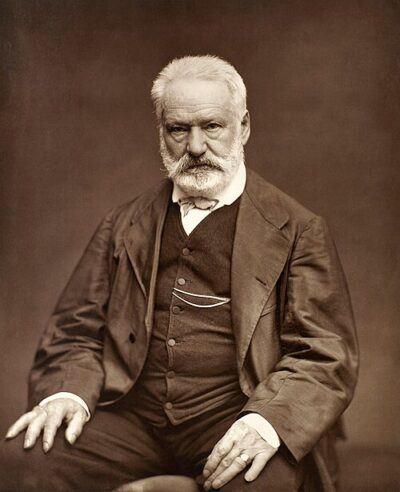
Victor Hugo
Victor Hugo was a French novelist, poet, dramatist and politician. Born February 26, 1802, in Besançon. Died May 22, 1885, in Paris. Positions held include Member of parliament for the Seine (2 times) (1848–1871), Senator of La Seine (1876–1885) and member of the Chamber of Peers (1845–1848). Known for Les Misérables, The Hunchback of Notre Dame and Les Contemplations. Educated at University of Paris and Lycée Louis-le-Grand. Awards include Officer of the Legion of Honour and Knight of the Legion of Honour.
Facts
56 facts · 2 confirmed by two sources · 23 cited · 31 from one source
Where this comes from
Papalocal keeps its own record. It started from these sources; what each one said is kept here as it was copied, so a change on their side never changes this page by itself. Tap one to read its version.
What Wikidata says · copied November 16, 2026 · revision 2568735916
- Described as
- French novelist, poet, dramatist and politician (1802–1885)
- Other names
- Homme océan, Ocean Man, Victor-Marie Hugo, Виктор Гюго, Victor Marie Hugo
- Born
- February 26, 1802 · 23 references
- Died
- May 22, 1885 · 22 references
- Born in
- Besançon · 4 references
- Died in
- Paris · 6 references
- Buried in
- Panthéon · 1 reference
- Cause of death
- pneumonia
- Name at birth
- Victor-Marie Hugo · 1 reference
- Citizen of
- France · 2 references
- Occupation
- playwright · 2 references; novelist · 2 references; draftsperson · 4 references; librettist; essayist; writer · 6 references; illustrator · 1 reference; travel writer
- Positions held
- Member of parliament for the Seine (2 times) (1848–1871); Senator of La Seine (1876–1885); member of the Chamber of Peers (1845–1848); Member of the Académie française (1841–1885) · 1 reference; president of the Société des gens de lettres (1840) · 1 reference
- Political party
- Parti de l'Ordre
- Education
- University of Paris; Lycée Louis-le-Grand; Lycée Michelet, Vanves
- Member of
- Académie Française (1841–1885) · 1 reference; Serbian Learned Society; Académie des sciences, belles-lettres et arts de Besançon et de Franche-Comté; Société des gens de lettres; Académie des sciences, belles-lettres et arts de Rouen
- Genre
- polemical lampoon
- Known for
- Les Misérables; The Hunchback of Notre Dame; Les Contemplations; L'Art d'être grand-père; The Man Who Laughs; Les Orientales; Toilers of the Sea; Ninety-Three
- Awards
- Officer of the Legion of Honour (1837) · 2 references; Knight of the Legion of Honour (1825) · 1 reference
- Field
- creative and professional writing · 1 reference
- Spouse
- Adèle Foucher (1822–1868) · 1 reference
- Children
- Adèle Hugo · 1 reference; Charles Hugo · 2 references; François-Victor Hugo · 2 references; Léopoldine Hugo · 1 reference
- Father
- Joseph Léopold Sigisbert Hugo · 1 reference
- Mother
- Sophie Trébuchet · 1 reference
- Siblings
- Abel Hugo · 1 reference; Eugène Hugo · 1 reference
- Lived in
- Place des Barricades - Barricadenplein; rue Laffitte (1871); Marine Terrace (1852–1855); Hauteville House (1856–1870); birthhouse of Victor Hugo (1802)
- Wikipedias with a page
- 269
Wikidata item Q535 (wikidata.org/wiki/Q535), public domain (CC0). Copied November 16, 2026.
What Wikipedia says · copied November 16, 2026 · revision 1385549212
Victor-Marie Hugo, vicomte Hugo (French: [viktɔʁ maʁi yɡo] ; 26 February 1802 – 22 May 1885) was a French Romantic author, poet, essayist, playwright, journalist, human rights activist and politician.
His most famous works are the novels The Hunchback of Notre-Dame (1831) and Les Misérables (1862). In France, Hugo is known for his poetry collections, such as Les Contemplations and La Légende des siècles (The Legend of the Ages). Hugo was at the forefront of the Romantic literary movement with his play Cromwell and drama Hernani. His works have inspired music, both during his lifetime and after his death, including the opera Rigoletto and the musicals Les Misérables and Notre-Dame de Paris. He produced more than 4,000 drawings in his lifetime, and campaigned for social causes such as the abolition of capital punishment and slavery.
Although he was a committed royalist when young, Hugo's views changed as the decades passed, and he became a passionate supporter of republicanism, serving in politics as both deputy and senator. His work touched upon most of the political and social issues and the artistic trends of his time. His opposition to absolutism, and his literary stature, established him as a national hero. Hugo died on 22 May 1885, aged 83. He was given a state funeral in the Panthéon of Paris, which was attended by over two million people, the largest in French history.
- Born, in its opening lines
- February 26, 1802
- Died, in its opening lines
- May 22, 1885
From the Wikipedia article “Victor Hugo” (en.wikipedia.org/wiki/Victor_Hugo), by its contributors, under CC BY-SA 4.0 (creativecommons.org/licenses/by-sa/4.0/). Copied November 16, 2026; not changed.
Confirmed Two sources agree. Cited One source, and it names where it got it. One source One source, without a reference of its own. Sources disagree The sources disagree. We show the best-supported value and keep theirs below.
