
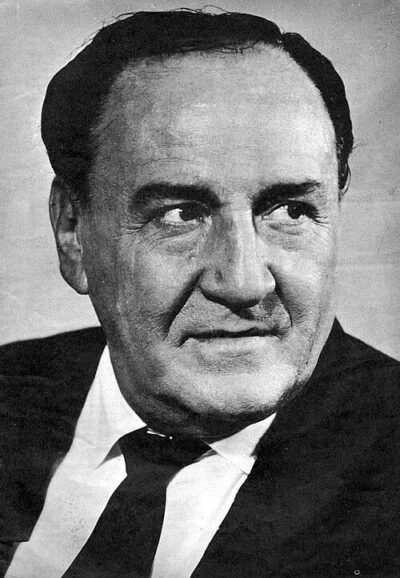
Víctor Raúl Haya de la Torre
Víctor Raúl Haya de la Torre was a Peruvian politician. Born February 22, 1895, in Trujillo. Died August 2, 1979, in Lima. Positions held include president of the Congress of the Republic of Peru and member of the Constituent Assembly of Peru (1978–). Educated at National University of Trujillo and National University of San Marcos. Awards include Grand Cross of the Order of the Sun of Peru.
Facts
19 facts · 2 confirmed by two sources · 6 cited · 11 from one source
Where this comes from
Papalocal keeps its own record. It started from these sources; what each one said is kept here as it was copied, so a change on their side never changes this page by itself. Tap one to read its version.
What Wikidata says · copied November 18, 2026 · revision 2560177588
- Described as
- Peruvian politician (1895–1979)
- Other names
- Haya de la Torre
- Born
- February 22, 1895 · 7 references
- Died
- August 2, 1979 · 6 references
- Born in
- Trujillo · 1 reference
- Died in
- Lima · 1 reference
- Citizen of
- Peru
- Occupation
- politician · 1 reference; lawyer; political activist; political theorist; jurist · 1 reference
- Positions held
- president of the Congress of the Republic of Peru; member of the Constituent Assembly of Peru (1978–) · 1 reference
- Political party
- American Popular Revolutionary Alliance
- Education
- National University of Trujillo; National University of San Marcos; Colegio San Andrés
- Awards
- Grand Cross of the Order of the Sun of Peru
- Field
- politics · 1 reference
- Lived in
- Lima
- Wikipedias with a page
- 21
Wikidata item Q379977 (wikidata.org/wiki/Q379977), public domain (CC0). Copied November 18, 2026.
What Wikipedia says · copied November 18, 2026 · revision 1378198426
Víctor Raúl Haya de la Torre (February 22, 1895 – August 2, 1979) was a Peruvian politician, philosopher, and author who founded the American Popular Revolutionary Alliance (APRA) political movement, the oldest currently existing political party in Peru by the name of the Peruvian Aprista Party (PAP).
Born to an aristocratic family in Trujillo, a city on the north Peruvian coast, he enrolled in the National University of Trujillo and then the School of Law of the National University of San Marcos. He soon stood out as a student leader supporting the working class. He participated in protests against the regime of Augusto B. Leguía, standing out as a vigorous and eloquent speaker, with great power of persuasion due to the depth of his ideas. Banished by Leguía in 1922, he emigrated to Mexico, where in 1924 he founded the APRA, a political movement with continental projection and a social democratic orientation, initially with a clear anti-imperialist position.
Returning to Peru in 1930 after a European and Latin American tour, he established the APRA party in Peru, the Peruvian Aprista Party, on whose political scene he would remain active from then until his death. He suffered imprisonment, exiles and political asylum. He ran for the presidency in the 1931 elections, losing to Luis Miguel Sánchez Cerro. Imprisoned in 1932 by the Sánchez Cerro administration, he was released in 1933, only to be persecuted again, already under the government of Óscar R. Benavides. He remained in hiding until 1945, when his party returned to legality; he supported the National Democratic Front, which elevated José Luis Bustamante y Rivero to the presidency. In 1948, his party was again banned and after the coup d'état by general Manuel A. Odría he was forced to take refuge in the Colombian embassy (1948–1954). In 1956, he contributed to the electoral victory of Manuel Prado Ugarteche, initiating the so-called "coexistence". Once again as presidential nominee, he placed first in the 1962 election, but the Armed Forces issued a veto against him, prompting a military coup that overthrew Prado and prevented his bidding to seal his victory in Congress in favor of Odría.
During the Armed Forces Revolutionary Government, he assembled and instructed a new generation of party leaders, which included his successor and future president of Peru, Alan García. He was overwhelmingly elected to the Constituent Assembly, being elected as the body's president, and leading the drafting of a new Peruvian constitution, which he would sign in his deathbed in July 1979. He died on August 2, 1979, and his remains rest in his hometown of Trujillo. He remains one of the most influential political thinkers in Peruvian history. His legacy is considered fundamental in Peruvian historiography, with his ideology coined as revolutionary by historians.
- Born, in its opening lines
- February 22, 1895
- Died, in its opening lines
- August 2, 1979
From the Wikipedia article “Víctor Raúl Haya de la Torre” (en.wikipedia.org/wiki/Víctor_Raúl_Haya_de_la_Torre), by its contributors, under CC BY-SA 4.0 (creativecommons.org/licenses/by-sa/4.0/). Copied November 18, 2026; not changed.
Confirmed Two sources agree. Cited One source, and it names where it got it. One source One source, without a reference of its own. Sources disagree The sources disagree. We show the best-supported value and keep theirs below.
