
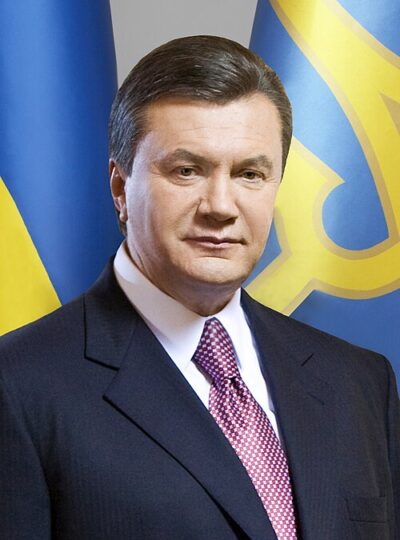
Viktor Yanukovych
Viktor Yanukovych is a President of Ukraine from 2010 to 2014. Born July 9, 1950, in Yenakiieve. Positions held include President of Ukraine (2010–2014), Prime Minister of Ukraine (2002–2007) and People's Deputy of Ukraine (2006–2010). Educated at Donetsk National Technical University and Ukrainian State University of Finance and International Trade. Awards include Order of José Martí, Order of St. Mesrop Mashtots and Medal of Anania Shirakatsi.
Facts
48 facts · 1 confirmed by two sources · 9 cited · 38 from one source
Where this comes from
Papalocal keeps its own record. It started from these sources; what each one said is kept here as it was copied, so a change on their side never changes this page by itself. Tap one to read its version.
What Wikidata says · copied November 16, 2026 · revision 2564937495
- Described as
- President of Ukraine from 2010 to 2014
- Other names
- Victor Fedorovych Yanukovych, Viktor Fedorovych Yanukovych, Віктор Федорович Янукович
- Born
- July 9, 1950 · 4 references
- Born in
- Yenakiieve · 1 reference
- Name at birth
- Віктор Федорович Янукович · 1 reference
- Citizen of
- Soviet Union (1950–1991); Ukraine (1991–2014); Russia (2014–)
- Occupation
- engineer; economist; politician · 1 reference; jurist; diplomat; lecturer
- Positions held
- President of Ukraine (2010–2014); Prime Minister of Ukraine (2002–2007); People's Deputy of Ukraine (2006–2010) · 1 reference; Representative of the Parliamentary Assembly of the Council of Europe (2006–2008) · 1 reference; substitute member of the Parliamentary Assembly of the Council of Europe (2008–2013) · 1 reference; Governor of Donetsk Oblast (1997–2002) · 1 reference; Chairman of the Donetsk Oblast Council; Chairman of the Council of CIS Heads of State (2014)
- Political party
- Communist Party of Ukraine (1980–1991); Party of Regions (2000–2014); Communist Party of the Soviet Union · 1 reference
- Education
- Donetsk National Technical University (–1980) · 2 references; Ukrainian State University of Finance and International Trade (2001)
- Member of
- 6th Verkhovna Rada; 5th Verkhovna Rada
- Sport
- auto racing
- Awards
- Order of José Martí (2011); Order of St. Mesrop Mashtots (2011) · 1 reference; Medal of Anania Shirakatsi (2004); Grand Cross of the Legion of Honour; Order of Ismoili Somoni; Silver Olympic Order (2007) · 1 reference; Order of the Republic of Serbia; Heydar Aliyev Order; Order of Zayed; Honorary Railwayman; Order of Holy Prince Daniel of Moscow 1st class; Order of St. Sergius of Radonezh 1st class; Miner's Glory 1st class; Miner's Glory 2nd class; Miner's Glory 3rd class
- Field
- politics
- Spouse
- Lyudmila Yanukovych · 1 reference
- Children
- Victor Yanukovych · 1 reference; Olexander Yanukovych · 1 reference
- Religion
- Eastern Orthodoxy
- Wikipedias with a page
- 119
Wikidata item Q1459658 (wikidata.org/wiki/Q1459658), public domain (CC0). Copied November 16, 2026.
What Wikipedia says · copied November 16, 2026 · revision 1380507735
Viktor Fedorovych Yanukovych (born 9 July 1950) is a Ukrainian former politician who served as the fourth president of Ukraine from 2010 to 2014. He also served as the prime minister of Ukraine several times between 2002 and 2007 and was a member of the Verkhovna Rada (parliament) from 2006 to 2010. Yanukovych was removed from the presidency during the 2014 Revolution of Dignity, which followed months of protests against him. Since then, he has lived in exile in Russia.
Yanukovych was a member of the pro-Russian Party of Regions. Before entering national politics, Yanukovych was the governor of his native Donetsk Oblast from 1997 to 2002. He was simultaneously the chairman of the oblast's legislature from 1999 to 2001. He first ran for president in the 2004 election, where he was declared the winner against Viktor Yushchenko. However, allegations of electoral fraud and voter intimidation caused widespread protests, in what became known as the Orange Revolution. The Ukrainian Supreme Court nullified the election and ordered a rerun, which Yanukovych lost to Yushchenko. Yanukovych ran for president again in 2010, this time beating Yulia Tymoshenko in an election deemed free and fair by international observers.
Yanukovych stood for economic modernisation, greater economic ties with the EU, and military non-alignment. However, his years in power saw what analysts described as democratic backsliding, which included the jailing of Tymoshenko, a decline in press freedom and an increase in cronyism and corruption. In November 2013, Yanukovych suddenly withdrew from signing an association agreement with the EU, amidst economic pressure from Russia. Ukraine's parliament had overwhelmingly approved finalizing the agreement. This sparked massive protests against him, known as the Euromaidan. The unrest peaked in February 2014, when almost 100 protesters were killed by government forces. An agreement was signed by Yanukovych and the opposition on 21 February 2014, but he secretly fled the capital that evening. The next day, Ukraine's parliament voted to remove him and schedule early elections on the grounds that he had withdrawn from his constitutional duties. Some of his own party voted for his removal.
Ukraine's new government issued an arrest warrant for Yanukovych, accusing him of responsibility for the killing of protesters. He fled to Russia, claiming to still be the head of state. In 2019, he was sentenced in absentia to a thirteen-year prison term for high treason by a Ukrainian court. In polling conducted since he left office, Yanukovych has ranked as one of the worst presidents in Ukrainian history. Yanukovych has also given his name to a collective term for blunders made by Ukrainian politicians: Yanukisms.
- Born, in its opening lines
- July 9, 1950
From the Wikipedia article “Viktor Yanukovych” (en.wikipedia.org/wiki/Viktor_Yanukovych), by its contributors, under CC BY-SA 4.0 (creativecommons.org/licenses/by-sa/4.0/). Copied November 16, 2026; not changed.
Confirmed Two sources agree. Cited One source, and it names where it got it. One source One source, without a reference of its own. Sources disagree The sources disagree. We show the best-supported value and keep theirs below.
