
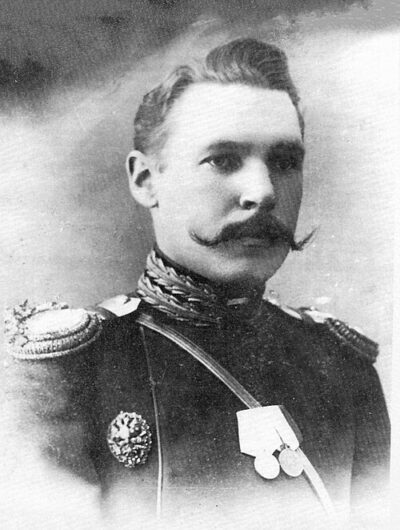
Vladimir Grigoryevich Fyodorov
Vladimir Grigoryevich Fyodorov was a Russian and Soviet weapons designer. Born May 3, 1874, in Saint Petersburg. Died September 19, 1966, in Moscow. Educated at Mikhailovsky Artillery School and Mikhailovskaya Military Artillery Academy. Awards include Order of Lenin, Hero of Labour and Order of the Red Star.
Facts
20 facts · 1 confirmed by two sources · 2 cited · 16 from one source · 1 where the sources disagree
What’s different
- Born: we show May 3, 1874 (Sources disagree). Wikipedia says May 15, 1874
Where this comes from
Papalocal keeps its own record. It started from these sources; what each one said is kept here as it was copied, so a change on their side never changes this page by itself. Tap one to read its version.
What Wikidata says · copied November 18, 2026 · revision 2570720036
- Described as
- Russian and Soviet weapons designer (1874-1966)
- Born
- May 3, 1874 · 1 reference
- Died
- September 19, 1966 · 1 reference
- Born in
- Saint Petersburg · 1 reference
- Died in
- Moscow · 1 reference
- Buried in
- Golovinskoye Cemetery
- Citizen of
- Russian Empire; Soviet Union
- Occupation
- military engineer; engineer
- Education
- Mikhailovsky Artillery School (–1895); Mikhailovskaya Military Artillery Academy (1897–1900)
- Awards
- Order of Lenin; Hero of Labour; Order of the Red Star; Order of the Patriotic War, 1st class; Order of Saint Anna, 3rd class; Order of Saint Stanislaus, 2nd class; Order of St. Vladimir, 4th class; Order of Saint Stanislaus · 1 reference
- Military rank
- lieutenant general
- Wikipedias with a page
- 21
Wikidata item Q2992341 (wikidata.org/wiki/Q2992341), public domain (CC0). Copied November 18, 2026.
What Wikipedia says · copied November 18, 2026 · revision 1338102968
Vladimir Grigoryevich Fyodorov (Russian: Владимир Григорьевич Фёдоров; 15 May [O.S. 3 May] 1874 – 19 September 1966) was a Russian and Soviet scientist, weapons designer, professor, lieutenant general of the Soviet technical-engineering service and a founder of the Soviet school of automatic small arms.
In 1900, Vladimir Fyodorov graduated from Mikhailovskaya Artillery Academy and was transferred to the artillery committee of the Chief Artillery Directorate (Главное артиллерийское управление). He designed several automatic rifles: one chambered in 7.62 mm (1912), another in 6.5 mm for a cartridge of his own design (1913), and one of the first prototype assault rifles in the world: the Avtomat Fyodorova (1916), which was originally designed to fire a shortened Arisaka 6.5mm rifle cartridge, but saw service firing the full-sized 6.5 mm Arisaka rifle cartridge due to reliability issues in testing and foresight of logistical problems. Automatic weapons designed by Fyodorov were used during World War I and the Russian Civil War.
After the October Revolution, Fyodorov was appointed head and technical director (1918–1931) of the first Soviet weapons plant, which produced submachine guns of his design.
In 1921, he organized and headed a design bureau at the automatic small arms factory.
In 1922, Fyodorov designed the Fyodorov-Shpagin machine gun with his protégé Georgy Shpagin, who would later design the PPSh-41 submachine gun.
From 1931 to 1933, Fyodorov worked as a standardization consultant at a weapons and machine gun trust. He then published several works on automatic weapons and was appointed a small arms consultant at Narkomat and with the Ministry of Arms (1942–1946).
Between 1946 and 1953, Fyodorov was a member of the Academy of Artillery Sciences. He tutored prominent Soviet arms designers, Shpagin, Vasily Degtyaryov, Sergei Simonov and others. Vladimir Fyodorov authored some scientific works on the history, design, production, and combat use of small firearms.
- Born, in its opening lines
- May 15, 1874
- Died, in its opening lines
- September 19, 1966
From the Wikipedia article “Vladimir Grigoryevich Fyodorov” (en.wikipedia.org/wiki/Vladimir_Grigoryevich_Fyodorov), by its contributors, under CC BY-SA 4.0 (creativecommons.org/licenses/by-sa/4.0/). Copied November 18, 2026; not changed.
Confirmed Two sources agree. Cited One source, and it names where it got it. One source One source, without a reference of its own. Sources disagree The sources disagree. We show the best-supported value and keep theirs below.
