
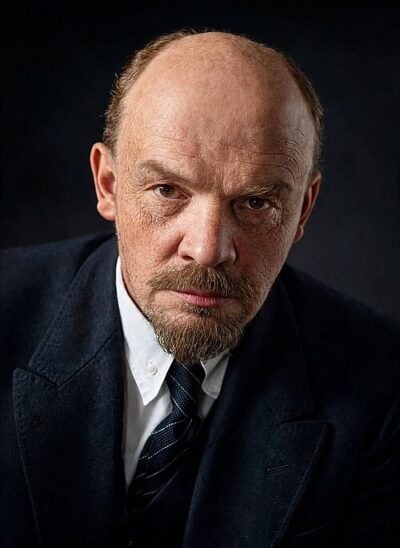
Vladimir Lenin
Vladimir Lenin was a Russian revolutionary, politician, political theorist, and founder of the Soviet Union. Born April 22, 1870, in Ulyanovsk. Died January 21, 1924, in Bolshiye Gorki. Positions held include Chairman of the Council of People's Commissars of the Russian SFSR (1917–1924), Chairman of the Council of People's Commissars (1923–1924) and president of the Council of Labour and Defence of the USSR (1923–1924). Known for Imperialism, the Highest Stage of Capitalism. Educated at Faculty of Law, Saint Petersburg State University and Kazan Imperial University. Awards include Work order of Corasmia and honorary citizen of Kazan.
Facts
54 facts · 2 confirmed by two sources · 11 cited · 41 from one source
Where this comes from
Papalocal keeps its own record. It started from these sources; what each one said is kept here as it was copied, so a change on their side never changes this page by itself. Tap one to read its version.
What Wikidata says · copied November 16, 2026 · revision 2566089308
- Described as
- Russian revolutionary, politician, political theorist, and founder of the Soviet Union (1870–1924)
- Other names
- Vladimir Ulyanov, Vladimir Ilyich Lenin, V. I. Ulyanov, V. I. Ul'yanov, Vladimir Il'ich Lenin, Vladimir Ul'yanov, Vladimir Il'ich Ul'yanov, Vl llyin, Lenin, Владимир Ильич Ульянов, V. I. Lenin, Vladimir Ilyich Ulyanov
- Born
- April 22, 1870 · 12 references
- Died
- January 21, 1924 · 17 references
- Born in
- Ulyanovsk · 2 references
- Died in
- Bolshiye Gorki
- Buried in
- Lenin's Mausoleum
- Cause of death
- cerebral hemorrhage
- Name at birth
- Владимир Ильич Ульянов
- Citizen of
- Russian Empire (–1918); Russian Socialist Federative Soviet Republic (1918–1922) · 1 reference; Soviet Union (1922–)
- Occupation
- politician · 4 references; writer; economist; lawyer · 2 references; revolutionary · 2 references; journalist; philosopher · 2 references; political theorist
- Positions held
- Chairman of the Council of People's Commissars of the Russian SFSR (1917–1924); Chairman of the Council of People's Commissars (1923–1924); president of the Council of Labour and Defence of the USSR (1923–1924); Member of the Politburo of the CPSU Central Committee (1917–1924)
- Political party
- Russian Social Democratic Labour Party (–1917); Russian Social Democratic Labour Party (bolshevik) (1917–1918); Communist Party of the Soviet Union (1918–1924)
- Worked for
- Saint Petersburg State University; Council of People's Commissars (1917) · 1 reference
- Education
- Faculty of Law, Saint Petersburg State University (1890–) · 1 reference; Kazan Imperial University (–1888); Simbirsk Classical Gymnasium · 1 reference; Imperial St. Petersburg University · 1 reference
- Member of
- All-Union Society of Old Bolsheviks
- Known for
- Imperialism, the Highest Stage of Capitalism
- Awards
- Work order of Corasmia (1922); honorary citizen of Kazan
- Field
- Leninism; politics · 1 reference; communism · 1 reference
- Spouse
- Nadezhda Krupskaya (1898–1924) · 1 reference
- Father
- Ilya Ulyanov
- Mother
- Maria Ulyanova
- Siblings
- Maria Ulyanova; Olga Ulyanova; Alexander Ulyanov; Dmitry Ulyanov · 1 reference; Anna Ulyanova · 1 reference
- Religion
- atheism (1886–) · 1 reference; Eastern Orthodoxy (–1886) · 1 reference
- Lived in
- Podolsk (1900); Saint Petersburg; Moscow; Shushenskoe (1897–1900); Schwabing (1900–1902)
- Height
- 1.65 m (5 ft 5 in)
- Wikipedias with a page
- 297
Wikidata item Q1394 (wikidata.org/wiki/Q1394), public domain (CC0). Copied November 16, 2026.
What Wikipedia says · copied November 16, 2026 · revision 1385147291
Vladimir Ilyich Ulyanov (22 April [O.S. 10 April] 1870 – 21 January 1924), better known as Vladimir Lenin, was a Russian revolutionary, politician, and political theorist. He served as the first and founding head of government of Soviet Russia from 1917 to 1924 and of the Soviet Union from 1922 to 1924. Ideologically a Marxist, his developments to the ideology are called Leninism.
Born to an upper-middle-class family in Simbirsk, Lenin embraced revolutionary socialist politics following his brother's 1887 execution. Expelled from Kazan Imperial University for protesting against the Tsarist government, he devoted the following years to a law degree. He moved to Saint Petersburg in 1893 and became a senior Marxist activist. In 1897, he was arrested for sedition and exiled to Shushenskoye in Siberia, where he married Nadezhda Krupskaya. After his exile, he moved to Western Europe, where he became a prominent theorist in the Marxist Russian Social Democratic Labour Party (RSDLP). In 1903, he took a key role in the RSDLP ideological split, leading the Bolshevik faction. Following Russia's failed Revolution of 1905, he campaigned for the First World War to be transformed into a Europe-wide proletarian revolution, which, as a Marxist, he believed would cause the overthrow of capitalism and its replacement with socialism. After the 1917 February Revolution ousted the Tsar and established a Provisional Government, he returned to Russia to play a leading role in the October Revolution in which the Bolsheviks overthrew the new regime.
Lenin's Bolshevik government initially shared power with the Left Socialist Revolutionaries, elected soviets, and a multi-party Constituent Assembly, although by 1918 it had centralised power in the new Communist Party. Lenin's administration redistributed land among the peasantry and nationalised banks and large-scale industry. It withdrew from the First World War by signing a treaty conceding territory to the Central Powers, and promoted world revolution through the Communist International. Opponents were suppressed in the Red Terror, a violent campaign administered by the state security services; tens of thousands were killed or interned in concentration camps. His administration defeated right and left-wing anti-Bolshevik armies in the Russian Civil War from 1917 to 1922 and oversaw the Polish–Soviet War of 1919–1921. Responding to wartime devastation, famine, and popular uprisings, in 1921 Lenin encouraged economic growth through the New Economic Policy. Several non-Russian nations had secured independence from the Russian Republic after 1917, but five were forcibly re-united into the new Soviet Union in 1922, while others repelled Soviet invasions. With his health failing, Lenin died in Gorki, and Joseph Stalin succeeded him as the pre-eminent figure in the Soviet government.
Widely considered one of the most significant and influential figures of the 20th century, Lenin was the posthumous subject of a pervasive personality cult within the Soviet Union until its dissolution in 1991. He became an ideological figurehead behind Marxism–Leninism and a prominent influence over the international communist movement. A controversial and highly divisive historical figure, Lenin is viewed by his supporters as a champion of revolutionary socialism and internationalism. Meanwhile, Lenin's critics accuse him of establishing a totalitarian dictatorship which oversaw mass killings and political repression.
- Born, in its opening lines
- April 22, 1870
- Died, in its opening lines
- January 21, 1924
From the Wikipedia article “Vladimir Lenin” (en.wikipedia.org/wiki/Vladimir_Lenin), by its contributors, under CC BY-SA 4.0 (creativecommons.org/licenses/by-sa/4.0/). Copied November 16, 2026; not changed.
Confirmed Two sources agree. Cited One source, and it names where it got it. One source One source, without a reference of its own. Sources disagree The sources disagree. We show the best-supported value and keep theirs below.
