
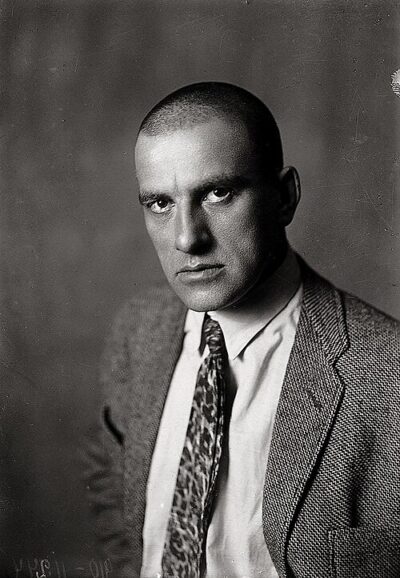
Vladimir Mayakovsky
Vladimir Mayakovsky was a Russian and Soviet poet. Born July 19, 1893, in Baghdati. Died April 14, 1930, in Moscow. Educated at Stroganov Moscow State Academy of Arts and Industry and Moscow School of Painting, Sculpture and Architecture. Awards include Lenin Komsomol Prize and Medal "For Diligence" (1801).
Facts
33 facts · 2 confirmed by two sources · 9 cited · 22 from one source
Where this comes from
Papalocal keeps its own record. It started from these sources; what each one said is kept here as it was copied, so a change on their side never changes this page by itself. Tap one to read its version.
What Wikidata says · copied November 16, 2026 · revision 2568873329
- Described as
- Russian and Soviet poet (1893–1930)
- Other names
- Vladimir Vladimirovich Majakovski, Vladimir Mayakov, Vladimir Vladimirovich Mayakovski, Vladimir Maiakovsky, Wladimir Wladimirowitsch Majakovskij, Vladimir Vladimirovič Majakovskij, Vladimir Vladimirovic Mayakovskij, Vladimir Vladimirovich Mayakovsky, Влади́мир Влади́мирович Маяко́вский
- Born
- July 19, 1893 · 11 references
- Died
- April 14, 1930 · 18 references
- Born in
- Baghdati
- Died in
- Moscow · 2 references
- Buried in
- Novodevichy Cemetery
- Cause of death
- gunshot wound
- Name at birth
- Влади́мир Влади́мирович Маяко́вский
- Citizen of
- Russian Empire; Soviet Union; Russian Republic · 1 reference; Russian Socialist Federative Soviet Republic · 1 reference
- Occupation
- poster artist; poet · 4 references; actor · 1 reference; playwright · 1 reference; writer · 2 references; painter · 1 reference; journalist · 1 reference; stage actor
- Political party
- Russian Social Democratic Labour Party
- Education
- Stroganov Moscow State Academy of Arts and Industry; Moscow School of Painting, Sculpture and Architecture; School № 91 (Moscow)
- Member of
- LEF
- Genre
- verse · 1 reference; narrative poetry · 1 reference; agitprop · 1 reference
- Awards
- Lenin Komsomol Prize; Medal "For Diligence" (1801)
- Children
- Patricia Thompson · 1 reference; Nikita Lavinsky
- Siblings
- Ljudmila Vladimirovna Majakovskaja · 1 reference
- Website
- http://v-v-mayakovsky.ru/
- Wikipedias with a page
- 124
Wikidata item Q132964 (wikidata.org/wiki/Q132964), public domain (CC0). Copied November 16, 2026.
What Wikipedia says · copied November 16, 2026 · revision 1381677547
Vladimir Vladimirovich Mayakovsky (19 July [O.S. 7 July] 1893 – 14 April 1930) was a Russian poet, playwright, artist, and actor. During his early, pre-Revolution period leading into 1917, Mayakovsky became renowned as a prominent figure of the Russian Futurist movement. He co-signed the Futurist manifesto, A Slap in the Face of Public Taste (1913), and wrote such poems as A Cloud in Trousers (1915) and Backbone Flute (1916). Mayakovsky produced a large and diverse body of work during the course of his career: he wrote poems, wrote and directed plays, appeared in films, edited the art journal LEF, and produced agitprop posters in support of the Communist Party during the Russian Civil War of 1917–1922.
Though Mayakovsky's work regularly demonstrated ideological and patriotic support for the ideology of the Bolsheviks and a strong admiration of Vladimir Lenin, his relationship with the Soviet state was always complex and often tumultuous. Mayakovsky often found himself engaged in confrontation with the increasing involvement of the Soviet state in cultural censorship and the development of the State doctrine of Socialist realism. Works that criticized or satirized aspects of the Soviet system, such as the poem "Talking With the Taxman About Poetry" (1926), and the plays The Bedbug (1929) and The Bathhouse (1929), met with scorn from the Soviet state and literary establishment.
In 1930, Mayakovsky committed suicide. Even after death, his relationship with the Soviet state remained unsteady. Though Mayakovsky had previously been harshly criticised by Soviet governmental bodies such as the Russian Association of Proletarian Writers, Premier Joseph Stalin described Mayakovsky after his death as "the best and the most talented poet of our Soviet epoch".
- Born, in its opening lines
- July 19, 1893
- Died, in its opening lines
- April 14, 1930
From the Wikipedia article “Vladimir Mayakovsky” (en.wikipedia.org/wiki/Vladimir_Mayakovsky), by its contributors, under CC BY-SA 4.0 (creativecommons.org/licenses/by-sa/4.0/). Copied November 16, 2026; not changed.
Confirmed Two sources agree. Cited One source, and it names where it got it. One source One source, without a reference of its own. Sources disagree The sources disagree. We show the best-supported value and keep theirs below.
