
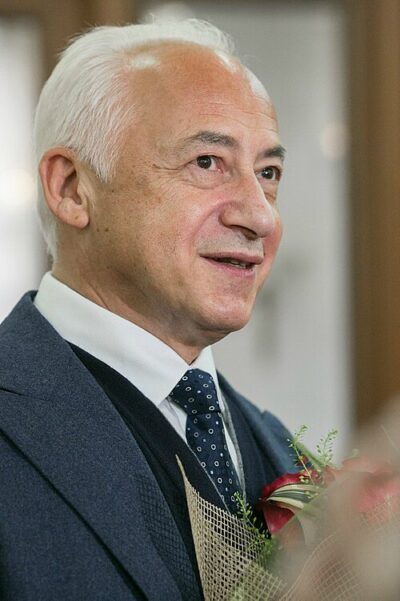
Vladimir Spivakov
Vladimir Spivakov is a Soviet-Russian conductor and violinist. Born September 12, 1944, in Ufa. Positions held include UNESCO Goodwill Ambassador. Educated at Central Music School and Special Music School of the St. Petersburg Conservatory. Awards include USSR State Prize, People's Artist of the USSR and Order "For Merit to the Fatherland", 2nd class.
Facts
32 facts · 1 confirmed by two sources · 3 cited · 28 from one source
Where this comes from
Papalocal keeps its own record. It started from these sources; what each one said is kept here as it was copied, so a change on their side never changes this page by itself. Tap one to read its version.
What Wikidata says · copied November 18, 2026 · revision 2567100647
- Described as
- Soviet-Russian conductor and violinist (born 1944)
- Other names
- Vladimir Teodorovich Spivakov, Владимир Теодорович Спиваков, Владимир Спиваков
- Born
- September 12, 1944 · 2 references
- Born in
- Ufa · 1 reference
- Citizen of
- Soviet Union (–1991); Russia
- Occupation
- conductor · 1 reference; violinist · 2 references; music educator · 1 reference
- Positions held
- UNESCO Goodwill Ambassador
- Education
- Central Music School; Special Music School of the St. Petersburg Conservatory; Moscow Conservatory
- Genre
- classical music
- Instrument
- violin
- Record label
- Melodiya; RCA Red Seal
- Awards
- USSR State Prize (1989); People's Artist of the USSR (1990); Order "For Merit to the Fatherland", 2nd class (2009); Order "For Merit to the Fatherland", 3rd class (1999); Order "For Merit to the Fatherland", 4th class (2014); Order of St. Mesrop Mashtots (1999); Lenin Komsomol Prize (1982); Officer of Arts and Letters (1999) · 2 references; Officer of the Legion of Honour (2011); People's Artist of the RSFSR (1986); Honored Artist of the RSFSR (1978); Order of Friendship (1994); People's Artist of Ukraine (1999); Order of Merit (Ukraine), 3rd class (1997); Order of the Badge of Honour (1980)
- Spouse
- Sati Spivakova
- Website
- https://vladimirspivakov.ru
- Wikipedias with a page
- 21
Wikidata item Q579170 (wikidata.org/wiki/Q579170), public domain (CC0). Copied November 18, 2026.
What Wikipedia says · copied November 18, 2026 · revision 1372628989
Vladimir Teodorovich Spivakov (Russian: Владимир Теодорович Спиваков; born 12 September 1944) is a Soviet and Russian conductor and violinist best known for his work with the Moscow Virtuosi chamber orchestra.
Spivakov was born in Ufa. He was taught by Yuri Yankelevich at the Moscow Conservatory and is considered one of the leading violinists of his generation.
Spivakov currently serves as the Artistic Director and Principal Conductor of the National Philharmonic of Russia. He conducted the music for Garri Bardin's 2010 animated feature, The Ugly Duckling.
In March 2014, he signed a letter in support of Vladimir Putin's policies regarding the 2014 Russian annexation of Crimea and Ukraine. However, in 2022, he and other Russian artists signed a letter against the Russian invasion of Ukraine initiated by Putin.
- Born, in its opening lines
- September 12, 1944
From the Wikipedia article “Vladimir Spivakov” (en.wikipedia.org/wiki/Vladimir_Spivakov), by its contributors, under CC BY-SA 4.0 (creativecommons.org/licenses/by-sa/4.0/). Copied November 18, 2026; not changed.
Confirmed Two sources agree. Cited One source, and it names where it got it. One source One source, without a reference of its own. Sources disagree The sources disagree. We show the best-supported value and keep theirs below.
