
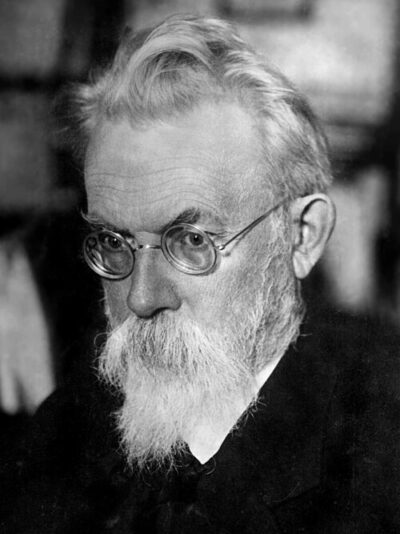
Vladimir Vernadsky
Vladimir Vernadsky was a Russian and Soviet mineralogist and geochemist, one of the founders of geochemistry, biogeochemistry, and of radiogeology. Born February 28, 1863, in Saint Petersburg. Died January 6, 1945, in Moscow. Positions held include professor and member of the State Council of the Russian Empire. Educated at Faculty of Physics and Mathematics of the Saint Petersburg University and Imperial St. Petersburg University. Awards include USSR State Prize, Order of the Red Banner of Labour and Order of Saint Anna, 2nd class.
Facts
59 facts · 1 confirmed by two sources · 15 cited · 42 from one source · 1 where the sources disagree
What’s different
- Born: we show February 28, 1863 (Sources disagree). Wikipedia says March 12, 1863
Where this comes from
Papalocal keeps its own record. It started from these sources; what each one said is kept here as it was copied, so a change on their side never changes this page by itself. Tap one to read its version.
What Wikidata says · copied November 16, 2026 · revision 2561597371
- Described as
- Russian and Soviet mineralogist and geochemist, one of the founders of geochemistry, biogeochemistry, and of radiogeology
- Other names
- V. I. Vernadsky, Vernadsky V I, Volodymyr Ivanovych Vernadsky, Vladimir Ivanovich Vernadsky
- Born
- February 28, 1863 · 2 references
- Died
- January 6, 1945 · 7 references
- Born in
- Saint Petersburg · 2 references
- Died in
- Moscow · 2 references
- Buried in
- Novodevichy Cemetery · 1 reference
- Cause of death
- stroke
- Citizen of
- Russian Empire; Russian Republic; Russian Socialist Federative Soviet Republic; Soviet Union
- Occupation
- philosopher · 1 reference; geologist · 3 references; biogeochemist; university teacher · 1 reference; ecologist; geochemist · 2 references; mineralogist · 2 references; teacher · 1 reference
- Positions held
- professor; member of the State Council of the Russian Empire
- Political party
- Constitutional Democratic Party (1905–1918) · 1 reference
- Worked for
- Saint Petersburg State University; Imperial St. Petersburg University; Imperial Moscow University; Tavrida National V.I. Vernadsky University · 1 reference; Academy of Sciences of the USSR; Lomonosov Moscow State University · 2 references; National Academy of Sciences of Ukraine · 2 references; V.G. Khlopin Radium Institute · 1 reference
- Education
- Faculty of Physics and Mathematics of the Saint Petersburg University · 1 reference; Imperial St. Petersburg University; Saint Petersburg State University (–1885) · 2 references
- Member of
- Russian Academy of Sciences (1906–) · 1 reference; National Academy of Sciences of Ukraine; Shevchenko Scientific Society; Russian Mountain Society
- Awards
- USSR State Prize; Order of the Red Banner of Labour (1943) · 1 reference; Order of Saint Anna, 2nd class; Order of Saint Stanislaus, 2nd class; State Stalin Prize, 1st degree (1943) · 1 reference; Order of Saint Anna, 3rd class · 1 reference; Order of Saint Stanislaus · 1 reference; honorary citizen of Crimea · 1 reference
- Field
- geology; crystallography · 1 reference; mineralogy; geochemistry; radiogeology; biology
- Spouse
- Natalii︠a︡ Egorovna Vernadskai︠a︡
- Children
- George Vernadsky; Nina Vernadska
- Father
- Ivan Vernadsky
- Mother
- Anna Petrovna
- Religion
- atheism
- Lived in
- Russian Empire · 1 reference; Soviet Union; Saint Petersburg (1911–) · 1 reference
- Wikipedias with a page
- 71
Wikidata item Q316371 (wikidata.org/wiki/Q316371), public domain (CC0). Copied November 16, 2026.
What Wikipedia says · copied November 16, 2026 · revision 1384934832
Vladimir Ivanovich Vernadsky (Russian: Владимир Иванович Вернадский), known in Ukraine as Volodymyr Ivanovych Vernadsky (Ukrainian: Володимир Іванович Вернадський; 12 March [O.S. 28 February] 1863 – 6 January 1945), was a Russian, Ukrainian, and Soviet mineralogist and geochemist who is considered one of the founders of geochemistry, biogeochemistry, and radiogeology. He was one of the founders and the first president of the Ukrainian Academy of Sciences (now National Academy of Sciences of Ukraine). Vladimir Vernadsky is most noted for his 1926 book The Biosphere in which he inadvertently worked to popularize Eduard Suess's 1875 term biosphere, by hypothesizing that life is the geological force that shapes the earth. In 1943 he was awarded the Stalin Prize. Vernadsky's portrait is depicted on the Ukrainian ₴1,000 hryvnia banknote.
- Born, in its opening lines
- March 12, 1863
- Died, in its opening lines
- January 6, 1945
From the Wikipedia article “Vladimir Vernadsky” (en.wikipedia.org/wiki/Vladimir_Vernadsky), by its contributors, under CC BY-SA 4.0 (creativecommons.org/licenses/by-sa/4.0/). Copied November 16, 2026; not changed.
Confirmed Two sources agree. Cited One source, and it names where it got it. One source One source, without a reference of its own. Sources disagree The sources disagree. We show the best-supported value and keep theirs below.
