
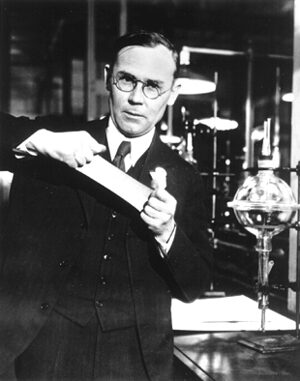
Wallace Carothers
Wallace Carothers was an American organic chemist. Born April 27, 1896, in Burlington. Died April 29, 1937, in Wilmington. Educated at University of Illinois System and Tarkio College. Awards include National Inventors Hall of Fame and Lavoisier Medal for Lifetime Technical Achievement.
Facts
21 facts · 2 confirmed by two sources · 6 cited · 13 from one source
Where this comes from
Papalocal keeps its own record. It started from these sources; what each one said is kept here as it was copied, so a change on their side never changes this page by itself. Tap one to read its version.
What Wikidata says · copied November 13, 2026 · revision 2567408462
- Described as
- American organic chemist (1896–1937)
- Other names
- Wallace Hume Carothers
- Born
- April 27, 1896 · 5 references
- Died
- April 29, 1937 · 5 references
- Born in
- Burlington · 1 reference
- Died in
- Wilmington
- Buried in
- Glendale Cemetery · 1 reference
- Cause of death
- poison
- Citizen of
- United States
- Occupation
- chemist · 1 reference; inventor; engineer
- Worked for
- Harvard University; DuPont · 1 reference
- Education
- University of Illinois System; Tarkio College
- Member of
- National Academy of Sciences
- Awards
- National Inventors Hall of Fame (1984) · 1 reference; Lavoisier Medal for Lifetime Technical Achievement (1990) · 1 reference
- Field
- chemistry; polymer · 1 reference; organic chemistry · 1 reference
- Siblings
- Isobel Berolzheimer · 1 reference
- Wikipedias with a page
- 44
Wikidata item Q333724 (wikidata.org/wiki/Q333724), public domain (CC0). Copied November 13, 2026.
What Wikipedia says · copied November 13, 2026 · revision 1378306843
Wallace Hume Carothers (; April 27, 1896 – April 29, 1937) was an American chemist, inventor, and the leader of organic chemistry at DuPont, who was credited with the invention of nylon.
Carothers was a group leader at the DuPont Experimental Station laboratory, near Wilmington, Delaware, where most polymer research was done. Carothers was an organic chemist who, in addition to first developing nylon, also helped lay the groundwork for neoprene. After receiving his PhD, he taught at several universities before he was hired by DuPont to work on fundamental research.
He married Helen Sweetman on February 21, 1936. Carothers had been troubled by periods of depression since his youth. Despite his success with nylon, he felt that he had not accomplished much and had run out of ideas. His unhappiness was exacerbated by the death of his sister, and on April 28, 1937, he committed suicide by drinking potassium cyanide, sixteen months before the public announcement of nylon's discovery on October 27, 1938. His daughter, Jane, was born on November 27, 1937.
- Born, in its opening lines
- April 27, 1896
- Died, in its opening lines
- April 29, 1937
From the Wikipedia article “Wallace Carothers” (en.wikipedia.org/wiki/Wallace_Carothers), by its contributors, under CC BY-SA 4.0 (creativecommons.org/licenses/by-sa/4.0/). Copied November 13, 2026; not changed.
Confirmed Two sources agree. Cited One source, and it names where it got it. One source One source, without a reference of its own. Sources disagree The sources disagree. We show the best-supported value and keep theirs below.
