
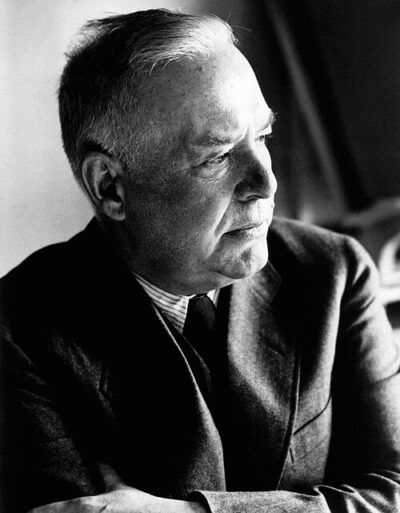
Wallace Stevens
Wallace Stevens was an American poet. Born October 2, 1879, in Reading. Died August 2, 1955, in Hartford. Known for The Auroras of Autumn. Educated at New York Law School and Harvard University. Awards include Bollingen Prize, Pulitzer Prize for Poetry and National Book Award (2 times).
Facts
23 facts · 2 confirmed by two sources · 10 cited · 11 from one source
Where this comes from
Papalocal keeps its own record. It started from these sources; what each one said is kept here as it was copied, so a change on their side never changes this page by itself. Tap one to read its version.
What Wikidata says · copied November 13, 2026 · revision 2567486549
- Described as
- American poet (1879–1955)
- Born
- October 2, 1879 · 10 references
- Died
- August 2, 1955 · 10 references
- Born in
- Reading · 1 reference
- Died in
- Hartford · 1 reference
- Buried in
- Cedar Hill Cemetery
- Cause of death
- stomach cancer
- Citizen of
- United States
- Occupation
- poet · 2 references; journalist; writer · 1 reference; playwright; poet lawyer; lawyer
- Political party
- Republican Party
- Education
- New York Law School · 1 reference; Harvard University · 1 reference
- Member of
- American Academy of Arts and Letters
- Known for
- The Auroras of Autumn
- Awards
- Bollingen Prize (1949) · 1 reference; Pulitzer Prize for Poetry (1955) · 1 reference; National Book Award (2 times) (1951, 1955) · 1 reference; Robert Frost Medal (1951) · 1 reference
- Lived in
- Hartford
- Wikipedias with a page
- 55
Wikidata item Q166835 (wikidata.org/wiki/Q166835), public domain (CC0). Copied November 13, 2026.
What Wikipedia says · copied November 13, 2026 · revision 1379640262
Wallace Stevens (October 2, 1879 – August 2, 1955) was an American modernist poet. He was born in Reading, Pennsylvania, educated at Harvard and then New York Law School, and spent most of his life working as an executive for an insurance company in Hartford, Connecticut.
Stevens's first period begins with the publication of Harmonium (1923), followed by a slightly revised and amended second edition in 1930. It features, among other poems, "The Emperor of Ice-Cream", "Sunday Morning", "The Snow Man", and "Thirteen Ways of Looking at a Blackbird". His second period commenced with Ideas of Order (1933), included in Transport to Summer (1947). His third and final period began with the publication of The Auroras of Autumn (1950), followed by The Necessary Angel: Essays On Reality and the Imagination (1951).
Many of Stevens's poems, like "Anecdote of the Jar", "The Man with the Blue Guitar", "The Idea of Order at Key West", "Of Modern Poetry", and "Notes Towards a Supreme Fiction", deal with the art of making art and poetry in particular. His Collected Poems (1954) won the Pulitzer Prize for Poetry in 1955.
- Born, in its opening lines
- October 2, 1879
- Died, in its opening lines
- August 2, 1955
From the Wikipedia article “Wallace Stevens” (en.wikipedia.org/wiki/Wallace_Stevens), by its contributors, under CC BY-SA 4.0 (creativecommons.org/licenses/by-sa/4.0/). Copied November 13, 2026; not changed.
Confirmed Two sources agree. Cited One source, and it names where it got it. One source One source, without a reference of its own. Sources disagree The sources disagree. We show the best-supported value and keep theirs below.
