
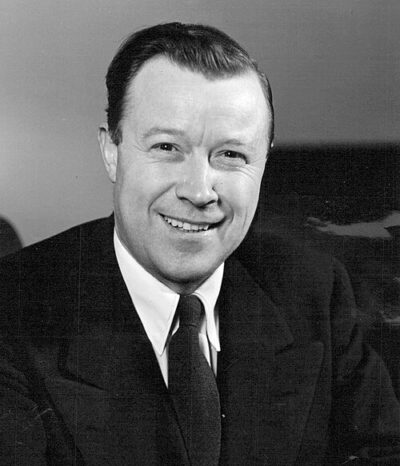
Walter Reuther
Walter Reuther was a labor union leader and progressive activist. Born September 1, 1907, in Wheeling. Died May 9, 1970, in Pellston. Educated at Fordson High School. Awards include Labor Hall of Honor, Presidential Medal of Freedom and Eugene V. Debs Award.
Facts
17 facts · 2 confirmed by two sources · 4 cited · 11 from one source
Where this comes from
Papalocal keeps its own record. It started from these sources; what each one said is kept here as it was copied, so a change on their side never changes this page by itself. Tap one to read its version.
What Wikidata says · copied November 16, 2026 · revision 2568771543
- Described as
- labor union leader and progressive activist (1907–1970)
- Other names
- Walter P. Reuther, Walter Philip Reuther
- Born
- September 1, 1907 · 4 references
- Died
- May 9, 1970 · 3 references
- Born in
- Wheeling
- Died in
- Pellston
- Cause of death
- aviation accident · 1 reference
- Citizen of
- United States
- Occupation
- trade unionist; politician · 1 reference
- Political party
- Democratic Party; Socialist Party of America
- Education
- Fordson High School · 1 reference
- Member of
- American Academy of Arts and Sciences
- Awards
- Labor Hall of Honor (1990) · 1 reference; Presidential Medal of Freedom (1995) · 1 reference; Eugene V. Debs Award (1968) · 1 reference
- Siblings
- Roy Reuther; Victor G. Reuther
- Wikipedias with a page
- 24
Wikidata item Q3055932 (wikidata.org/wiki/Q3055932), public domain (CC0). Copied November 16, 2026.
What Wikipedia says · copied November 16, 2026 · revision 1384277985
Walter Philip Reuther ( ROOTH-er; September 1, 1907 – May 9, 1970) was an American leader of organized labor and civil rights activist who built the United Automobile Workers (UAW) into one of the most progressive labor unions in American history. He considered labor movements not as narrow special interest groups but as instruments to advance social justice and human rights in democratic societies. He leveraged the UAW's resources and influence to advocate for workers' rights, civil rights, women's rights, universal health care, public education, affordable housing, environmental stewardship, profit-sharing for employees, and nuclear nonproliferation around the world. He believed in Swedish-style social democracy and societal change through nonviolent civil disobedience. He cofounded the AFL-CIO in 1955 with George Meany. He survived two attempted assassinations, including one at home where he was struck by a 12-gauge shotgun blast fired through his kitchen window. He was the fourth and longest serving president of the UAW, serving from 1946 until his death in 1970.
As the leader of five million autoworkers, including retirees and their families, Reuther was influential inside the Democratic Party. Following the Bay of Pigs in 1961, President John F. Kennedy sent Reuther to Cuba to negotiate a prisoner exchange with Fidel Castro. He was instrumental in spearheading the creation of the Peace Corps and in marshaling support for the Civil Rights Act of 1964, the Voting Rights Act of 1965, Medicare and Medicaid, and the Fair Housing Act. He met weekly in 1964 and 1965 with President Lyndon B. Johnson at the White House to discuss policies and legislation for the Great Society and War on Poverty. The Republican Party was wary of Reuther, leading presidential candidate Richard Nixon to say about John F. Kennedy during the 1960 election, "I can think of nothing so detrimental to this nation than for any President to owe his election to, and therefore be a captive of, a political boss like Walter Reuther." Conservative politician Barry Goldwater declared that Reuther "was more dangerous to our country than Sputnik or anything Soviet Russia might do."
A powerful ally of Martin Luther King Jr. and the civil rights movement, Reuther marched with King in Detroit, Selma, Birmingham, Montgomery, and Jackson. When King and others including children were jailed in Birmingham, Alabama, and King authored his famous Letter from Birmingham Jail, Reuther arranged $160,000 for the protestors' release. He also helped organize and finance the March on Washington on August 28, 1963, delivering remarks from the steps of the Lincoln Memorial shortly before King gave his historic "I Have a Dream" speech on the National Mall. An early supporter of Cesar Chavez and the United Farm Workers, he asked Robert F. Kennedy to visit and support Chavez. He served on the board of directors for the National Association for the Advancement of Colored People (NAACP) and was one of the founders of Americans for Democratic Action. A lifelong environmentalist, Reuther played a critical role in funding and organizing the first Earth Day on April 22, 1970 and he died weeks later in a plane accident at age 62. According to Denis Hayes, the principal national organizer of the first Earth Day, "Without the UAW, the first Earth Day would have likely flopped!"
Reuther was recognized by Time Magazine as one of the 100 most influential people of the 20th century. He was posthumously awarded the Presidential Medal of Freedom in 1995 by President Bill Clinton, who remarked at the ceremony, "Walter Reuther was an American visionary so far ahead of his times that although he died a quarter of a century ago, our Nation has yet to catch up to his dreams."
- Born, in its opening lines
- September 1, 1907
- Died, in its opening lines
- May 9, 1970
From the Wikipedia article “Walter Reuther” (en.wikipedia.org/wiki/Walter_Reuther), by its contributors, under CC BY-SA 4.0 (creativecommons.org/licenses/by-sa/4.0/). Copied November 16, 2026; not changed.
Confirmed Two sources agree. Cited One source, and it names where it got it. One source One source, without a reference of its own. Sources disagree The sources disagree. We show the best-supported value and keep theirs below.
