
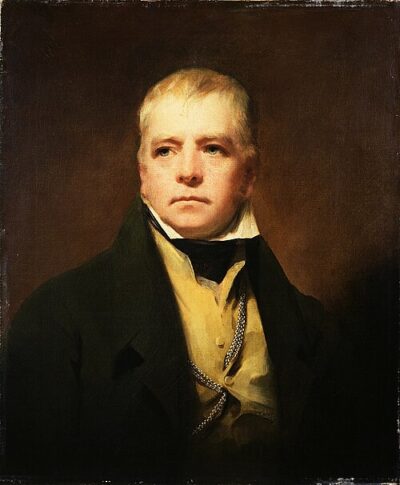
Walter Scott
Walter Scott was a Scottish novelist, poet and playwright. Born August 15, 1771, in Edinburgh. Died September 21, 1832, in Abbotsford House. Positions held include judge and President of the Royal Society of Edinburgh (1820–1832). Known for Waverley, Rob Roy and Ivanhoe. Educated at University of Edinburgh and Royal High School. Awards include Fellow of the Royal Society of Edinburgh and baronet.
Facts
48 facts · 2 confirmed by two sources · 11 cited · 35 from one source
Where this comes from
Papalocal keeps its own record. It started from these sources; what each one said is kept here as it was copied, so a change on their side never changes this page by itself. Tap one to read its version.
What Wikidata says · copied November 16, 2026 · revision 2564779348
- Described as
- Scottish novelist, poet and playwright (1771–1832)
- Other names
- Laurence Templeton, Great Magician, Wizard of the North, Sir Walter Scott, 1st Baronet, The Great Unknown, Somnambulus, Sir Walter Scott, Bart., Jedediah Cleishbotham, Walter Skott, Malachi Malagrowther, Walter Sir Scott, Sir Walter Scott
- Born
- August 15, 1771 · 21 references
- Died
- September 21, 1832 · 22 references
- Born in
- Edinburgh · 3 references
- Died in
- Abbotsford House · 2 references
- Buried in
- Dryburgh Abbey
- Cause of death
- stroke
- Citizen of
- Kingdom of Great Britain · 1 reference; United Kingdom
- Occupation
- poet · 1 reference; playwright; linguist; translator; novelist · 1 reference; musicologist; biographer; writer · 4 references
- Positions held
- judge; President of the Royal Society of Edinburgh (1820–1832)
- Education
- University of Edinburgh; Royal High School; Kelso High School; Jordan High School; University of Edinburgh School of Law
- Member of
- Faculty of Advocates; Freemasonry; Royal Society of Edinburgh; Celtic Society; Bannatyne Club
- Genre
- theatre; Romanticism · 1 reference; historical fiction
- Known for
- Waverley; Rob Roy; Ivanhoe; Old Mortality; The Lady of the Lake
- Awards
- Fellow of the Royal Society of Edinburgh; baronet
- Field
- fiction · 1 reference
- Spouse
- Charlotte Genevieve Charpentier (1797–) · 2 references
- Children
- Charlotte Sophia Lockhart · 1 reference; Anne Scott · 1 reference; Charles Scott · 1 reference; Sir Walter Scott, 2nd Baronet
- Father
- Walter Scott · 2 references
- Mother
- Anne Rutherford · 2 references
- Lived in
- Abbotsford House
- Nickname
- Border Minstrel
- Wikipedias with a page
- 139
Wikidata item Q79025 (wikidata.org/wiki/Q79025), public domain (CC0). Copied November 16, 2026.
What Wikipedia says · copied November 16, 2026 · revision 1383137754
Sir Walter Scott, 1st Baronet (15 August 1771 – 21 September 1832), was a Scottish novelist, poet and historian. Many of his works remain classics of European and Scottish literature. He is known for his Waverley novels (1814–1831), which were, for nearly a century, among the most popular and widely read novels in Europe. He is also known for his narrative poems Marmion (1808) and The Lady of the Lake (1810). He greatly influenced European and American literature.
As an advocate and legal administrator by profession, he combined writing and editing with his daily work as Clerk of Session and Sheriff-Depute of Selkirkshire. He was prominent in Edinburgh's Tory establishment, active in the Highland Society, a long time president of the Royal Society of Edinburgh (1820–1832), and a vice president of the Society of Antiquaries of Scotland (1827–1829). His knowledge of history and literary facility equipped him to establish the historical novel genre as an exemplar of European Romanticism. He became a baronet of Abbotsford in the County of Roxburgh on 22 April 1820; the title became extinct upon his son's death in 1847.
- Born, in its opening lines
- August 15, 1771
- Died, in its opening lines
- September 21, 1832
From the Wikipedia article “Walter Scott” (en.wikipedia.org/wiki/Walter_Scott), by its contributors, under CC BY-SA 4.0 (creativecommons.org/licenses/by-sa/4.0/). Copied November 16, 2026; not changed.
Confirmed Two sources agree. Cited One source, and it names where it got it. One source One source, without a reference of its own. Sources disagree The sources disagree. We show the best-supported value and keep theirs below.
