
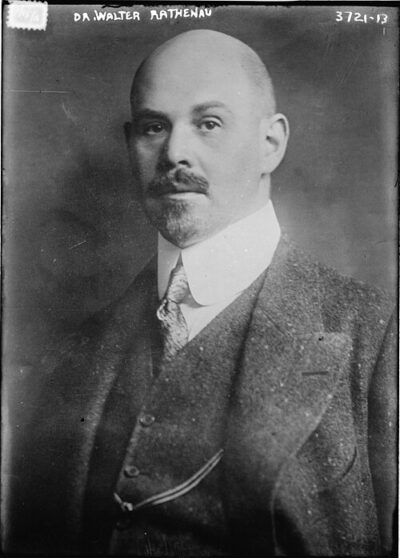
Walther Rathenau
Walther Rathenau was a German businessman, writer, art collector and politician. Born September 29, 1867, in Berlin. Died June 24, 1922, in Berlin. Positions held include German Foreign Minister (1922) and Federal Minister for Foreign Affairs (1922). Educated at University of Strasbourg and Humboldt-Universität zu Berlin.
Facts
30 facts · 2 confirmed by two sources · 10 cited · 18 from one source
Where this comes from
Papalocal keeps its own record. It started from these sources; what each one said is kept here as it was copied, so a change on their side never changes this page by itself. Tap one to read its version.
What Wikidata says · copied November 16, 2026 · revision 2569149212
- Described as
- German businessman, writer, art collector and politician (1867-1922)
- Other names
- Dr. Walter Rathenau
- Born
- September 29, 1867 · 10 references
- Died
- June 24, 1922 · 12 references
- Born in
- Berlin · 3 references
- Died in
- Berlin · 2 references
- Buried in
- Waldfriedhof Oberschöneweide
- Cause of death
- gunshot wound
- Citizen of
- Kingdom of Prussia; German Empire; Weimar Republic; Germany · 1 reference
- Occupation
- politician · 1 reference; engineer; writer; entrepreneur; science fiction writer; art collector · 1 reference; essayist · 1 reference; Master's Degree in Economics · 1 reference
- Positions held
- German Foreign Minister (1922); Federal Minister for Foreign Affairs (1922) · 1 reference
- Political party
- German Democratic Party (1918–)
- Education
- University of Strasbourg; Humboldt-Universität zu Berlin; Technical University of Munich · 1 reference
- Member of
- VDI – The Association of German Engineers (1894) · 1 reference
- Father
- Emil Rathenau · 1 reference
- Mother
- Mathilde Rathenau · 1 reference
- Siblings
- Edith Andreae · 1 reference; Erich Rathenau
- Religion
- Judaism
- Wikipedias with a page
- 56
Wikidata item Q135645 (wikidata.org/wiki/Q135645), public domain (CC0). Copied November 16, 2026.
What Wikipedia says · copied November 16, 2026 · revision 1384452742
Walther Rathenau (German: [ˈvaltɐ ˈʁaːtənaʊ]; 29 September 1867 – 24 June 1922) was a German industrialist, writer and politician who served as foreign minister of Germany from February 1922 until his assassination in June 1922.
Rathenau was one of Germany's leading industrialists in the late German Empire. During World War I, he played a key role in the organisation of the German war economy and headed the War Raw Materials Department from August 1914 to March 1915.
After the war, Rathenau was an influential figure in the politics of the Weimar Republic. In 1921 he was appointed minister of reconstruction and a year later became foreign minister. Rathenau negotiated the 1922 Treaty of Rapallo, which normalised relations and strengthened economic ties between Germany and Soviet Russia. The agreement, along with Rathenau's insistence that Germany fulfil its obligations under the Treaty of Versailles, led right-wing nationalist groups, including a nascent Nazi Party, to brand him part of a Jewish-communist conspiracy.
Two months after the signing of the treaty, Rathenau was assassinated by members of the ultra-nationalist Organisation Consul in Berlin in the belief that he was a literal "Elder of Zion". His death was followed by national mourning as well as widespread demonstrations against counter-revolutionary terrorism, which briefly strengthened the Weimar Republic. Rathenau came to be viewed as a democratic martyr during the Weimar era. After the Nazis came to power in 1933, all commemorations of Rathenau were banned.
- Born, in its opening lines
- September 29, 1867
- Died, in its opening lines
- June 24, 1922
From the Wikipedia article “Walther Rathenau” (en.wikipedia.org/wiki/Walther_Rathenau), by its contributors, under CC BY-SA 4.0 (creativecommons.org/licenses/by-sa/4.0/). Copied November 16, 2026; not changed.
Confirmed Two sources agree. Cited One source, and it names where it got it. One source One source, without a reference of its own. Sources disagree The sources disagree. We show the best-supported value and keep theirs below.
