
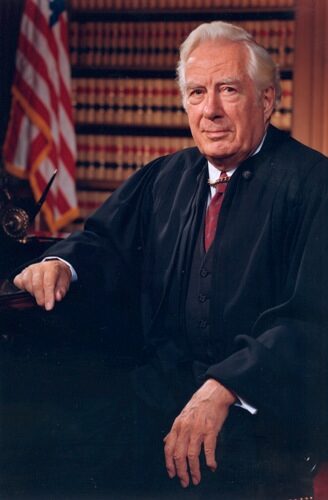
Warren E. Burger
Warren E. Burger was a chief justice of the United States from 1969 to 1986. Born September 17, 1907, in Saint Paul. Died June 25, 1995, in Washington, D.C.. Positions held include Chief Justice of the United States (1969–1986) and Judge of the United States Court of Appeals for the D.C. Circuit. Educated at University of Minnesota and William Mitchell College of Law. Awards include Presidential Medal of Freedom.
Facts
18 facts · 2 confirmed by two sources · 2 cited · 14 from one source
Where this comes from
Papalocal keeps its own record. It started from these sources; what each one said is kept here as it was copied, so a change on their side never changes this page by itself. Tap one to read its version.
What Wikidata says · copied November 15, 2026 · revision 2532927965
- Described as
- chief justice of the United States from 1969 to 1986 (1907–1995)
- Other names
- Chief Justice Burger, Warren Burger, Warren Earl Burger
- Born
- September 17, 1907 · 5 references
- Died
- June 25, 1995 · 5 references
- Born in
- Saint Paul
- Died in
- Washington, D.C.
- Buried in
- Arlington National Cemetery (1995) · 1 reference
- Cause of death
- myocardial infarction
- Name at birth
- Warren Earl Burger
- Citizen of
- United States
- Occupation
- judge; lawyer; politician
- Positions held
- Chief Justice of the United States (1969–1986); Judge of the United States Court of Appeals for the D.C. Circuit
- Political party
- Republican Party
- Education
- University of Minnesota; William Mitchell College of Law; Johnson Senior High School · 1 reference
- Awards
- Presidential Medal of Freedom (1988) · 1 reference
- Wikipedias with a page
- 31
Wikidata item Q346685 (wikidata.org/wiki/Q346685), public domain (CC0). Copied November 15, 2026.
What Wikipedia says · copied November 15, 2026 · revision 1385317759
Warren Earl Burger (September 17, 1907 – June 25, 1995) was an American attorney and jurist who served as the 15th chief justice of the United States from 1969 to 1986.
Born in Saint Paul, Minnesota, Burger graduated from the St. Paul College of Law in 1931. He helped secure the Minnesota delegation's support for Dwight D. Eisenhower at the 1952 Republican National Convention. After Eisenhower won the 1952 presidential election, he appointed Burger to the position of Assistant Attorney General in charge of the Civil Division. In 1956, Eisenhower appointed Burger to the United States Court of Appeals for the District of Columbia Circuit. Burger served on this court until 1969 and became known as a critic of the Warren Court.
In 1969, President Richard Nixon nominated Burger to succeed Earl Warren as Chief Justice, and Burger won Senate confirmation with little opposition. He did not emerge as a strong intellectual force on the Court, but sought to improve the administration of the federal judiciary. He also helped establish the National Center for State Courts and the Supreme Court Historical Society. Burger remained on the Court until his retirement in 1986, when he became Chairman of the Commission on the Bicentennial of the United States Constitution. He was succeeded as Chief Justice by William H. Rehnquist, who had served as an associate justice since 1972.
In 1974, Burger wrote for a unanimous court in United States v. Nixon, which rejected Nixon's invocation of executive privilege in the wake of the Watergate scandal. The ruling played a major role in Nixon's resignation. Burger joined the majority in Roe v. Wade in holding that the right to privacy prohibited states from banning abortions. Later analyses have suggested that Burger joined the majority in Roe solely to prevent Justice William O. Douglas from controlling assignment of the opinion. Burger's later votes aligned with this suspicion when he abandoned Roe in Harris v. McRae (voting with the majority), formally launching the restrictive Hyde Amendment into effect, and in Thornburgh v. American College of Obstetricians and Gynecologists (voting with the dissent). His majority opinion in INS v. Chadha struck down the one-house legislative veto.
Although Burger was nominated by a conservative president, the Burger Court also delivered some of the most liberal decisions regarding abortion, capital punishment, religious establishment, sex discrimination, and school desegregation during his tenure.
- Born, in its opening lines
- September 17, 1907
- Died, in its opening lines
- June 25, 1995
From the Wikipedia article “Warren E. Burger” (en.wikipedia.org/wiki/Warren_E._Burger), by its contributors, under CC BY-SA 4.0 (creativecommons.org/licenses/by-sa/4.0/). Copied November 15, 2026; not changed.
Confirmed Two sources agree. Cited One source, and it names where it got it. One source One source, without a reference of its own. Sources disagree The sources disagree. We show the best-supported value and keep theirs below.
