
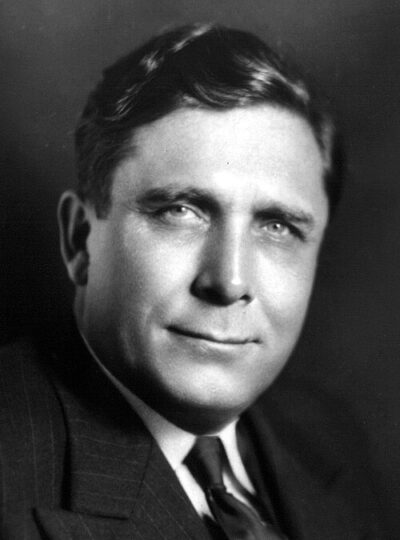
Wendell Willkie
Wendell Willkie was an American lawyer and corporate executive. Born February 18, 1892, in Elwood. Died October 8, 1944, in New York City. Educated at Indiana University and Indiana University Maurer School of Law.
Facts
21 facts · 2 confirmed by two sources · 9 cited · 10 from one source
Where this comes from
Papalocal keeps its own record. It started from these sources; what each one said is kept here as it was copied, so a change on their side never changes this page by itself. Tap one to read its version.
What Wikidata says · copied November 15, 2026 · revision 2558278226
- Described as
- American lawyer and corporate executive (1892–1944)
- Other names
- Wendell Lewis Willkie, Lewis Wendell Willkie
- Born
- February 18, 1892 · 7 references
- Died
- October 8, 1944 · 7 references
- Born in
- Elwood · 1 reference
- Died in
- New York City · 1 reference
- Buried in
- East Hill Cemetery · 1 reference
- Cause of death
- myocardial infarction
- Citizen of
- United States
- Occupation
- politician · 1 reference; lawyer; writer · 2 references; businessperson · 1 reference; jurist · 1 reference
- Political party
- Democratic Party (–1939); Republican Party (1939–)
- Education
- Indiana University; Indiana University Maurer School of Law
- Field
- law · 1 reference; politics · 1 reference
- Children
- Philip Willkie
- Religion
- Episcopal Church
- Lived in
- Wendell Lewis Willkie House (1940–1944) · 1 reference
- Wikipedias with a page
- 31
Wikidata item Q698714 (wikidata.org/wiki/Q698714), public domain (CC0). Copied November 15, 2026.
What Wikipedia says · copied November 15, 2026 · revision 1385172658
Wendell Lewis Willkie (born Lewis Wendell Willkie; February 18, 1892 – October 8, 1944) was an American lawyer, corporate executive and the 1940 Republican nominee for president of the United States. Willkie appealed to many convention delegates as the Republican field's only interventionist: although the U.S. remained neutral prior to Pearl Harbor, he favored greater U.S. involvement in World War II to support Britain and other Allies. His Democratic opponent, incumbent President Franklin D. Roosevelt, who had made campaign pledges against U.S. involvement in World War II, won the 1940 election with about 55% of the popular vote and took the electoral college vote by a wide margin.
Willkie was born in Elwood, Indiana, in 1892; both his parents were lawyers, and he also became one. He served in World War I but was not sent to France until the final days of the war, and saw no action. Willkie settled in Akron, Ohio, where he was initially employed by Firestone, but left for a law firm, becoming one of the leaders of the Akron Bar Association. Much of his work was representing electric utilities, and in 1929 Willkie accepted a job in New York City as counsel for Commonwealth & Southern Corporation (C&S), a utility holding company. He was rapidly promoted, and became corporate president in 1933. Roosevelt was sworn in as U.S. president soon after Willkie became head of C&S, and announced plans for a Tennessee Valley Authority (TVA) that would supply power in competition with C&S. Between 1933 and 1939, Willkie fought against the TVA before Congress, in the courts, and before the public. He was ultimately unsuccessful, but sold C&S's property for a good price, and gained public esteem.
A longtime Democratic activist, Willkie changed his party registration to Republican in late 1939. He did not run in the 1940 presidential primaries, but positioned himself as an acceptable choice for a deadlocked convention. He sought backing from uncommitted delegates, while his supporters—many youthful—enthusiastically promoted his candidacy. As German forces advanced through western Europe in 1940, many Republicans did not wish to nominate an isolationist like Robert A. Taft, or a non-interventionist like Thomas E. Dewey, and turned to Willkie, who was nominated on the sixth ballot. Willkie's support for aid to Britain removed it as a major factor in his race against Roosevelt, and Willkie also backed the president on a peacetime draft. Both men took more isolationist positions towards the end of the race. Roosevelt won an unprecedented third term, taking 38 of the 48 states.
After the election, Willkie made two wartime foreign trips as Roosevelt's informal envoy, and as nominal leader of the Republican Party gave the president his full support. This angered many conservatives, especially as Willkie increasingly advocated liberal or internationalist causes. Willkie ran for the Republican nomination in 1944, but bowed out after a disastrous showing in the Wisconsin primary in April. He and Roosevelt discussed the possibility of forming a liberal political party after the war, but Willkie unexpectedly died in October 1944 at the age of 52 before the idea was finalised. Willkie is remembered for giving Roosevelt vital political assistance in 1941, which helped the president to pass Lend-Lease to send supplies to the United Kingdom and other Allied nations.
- Born, in its opening lines
- February 18, 1892
- Died, in its opening lines
- October 8, 1944
From the Wikipedia article “Wendell Willkie” (en.wikipedia.org/wiki/Wendell_Willkie), by its contributors, under CC BY-SA 4.0 (creativecommons.org/licenses/by-sa/4.0/). Copied November 15, 2026; not changed.
Confirmed Two sources agree. Cited One source, and it names where it got it. One source One source, without a reference of its own. Sources disagree The sources disagree. We show the best-supported value and keep theirs below.
