
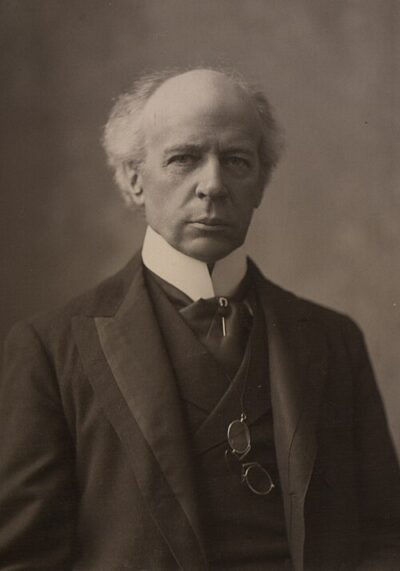
Wilfrid Laurier
Wilfrid Laurier was the 7th prime minister of Canada. Born November 20, 1841, in Saint-Lin–Laurentides. Died February 17, 1919, in Ottawa. Positions held include Prime Minister of Canada (1896–1911), Member of the National Assembly of Quebec (1871–1874) and President of the King's Privy Council for Canada (1896–1911). Educated at McGill Faculty of Law and L'Assomption College. Awards include Knight Grand Cross of the Order of St Michael and St George and honorary doctorate at the Laval University.
Facts
28 facts · 2 confirmed by two sources · 7 cited · 19 from one source
Where this comes from
Papalocal keeps its own record. It started from these sources; what each one said is kept here as it was copied, so a change on their side never changes this page by itself. Tap one to read its version.
What Wikidata says · copied November 13, 2026 · revision 2568865672
- Described as
- 7th prime minister of Canada (1841-1919)
- Other names
- Sir Wilfrid Laurier, Sir Wilfred Laurier, Sir Henri Charles Wilfrid Laurier, Hon. Sir Wilfrid Laurier, Henri Charles Wilfrid Laurier
- Born
- November 20, 1841 · 8 references
- Died
- February 17, 1919 · 8 references
- Born in
- Saint-Lin–Laurentides
- Died in
- Ottawa · 1 reference
- Buried in
- Notre-Dame Cemetery
- Cause of death
- stroke
- Name at birth
- Henri Charles Wilfrid Laurier
- Citizen of
- Canada
- Occupation
- politician · 1 reference; lawyer · 1 reference; journalist; essayist; writer · 1 reference
- Positions held
- Prime Minister of Canada (1896–1911); Member of the National Assembly of Quebec (1871–1874); President of the King's Privy Council for Canada (1896–1911); Leader of the Liberal Party of Canada (1887–1919); Bâtonnier d'Arthabaska (1889–1890); Leader of the Official Opposition (2 times) (1887–1919); member of the House of Commons of Canada (1874–1919) · 1 reference
- Political party
- Liberal Party of Canada
- Education
- McGill Faculty of Law; L'Assomption College
- Awards
- Knight Grand Cross of the Order of St Michael and St George; honorary doctorate at the Laval University · 1 reference
- Spouse
- Zoé Laurier
- Father
- Carolus Laurier · 1 reference
- Religion
- Catholicism
- Wikipedias with a page
- 46
Wikidata item Q128664 (wikidata.org/wiki/Q128664), public domain (CC0). Copied November 13, 2026.
What Wikipedia says · copied November 13, 2026 · revision 1384870030
Sir Henri Charles Wilfrid Laurier (November 20, 1841 – February 17, 1919) was the seventh prime minister of Canada from 1896 to 1911. The first French Canadian prime minister, his 15-year tenure remains the longest uninterrupted term of office among Canadian prime ministers and his nearly 45 years of service in the House of Commons is a record for the House. Laurier is best known for his compromises between English and French Canada.
Laurier studied law at McGill University and practised as a lawyer before being elected to the Legislative Assembly of Quebec in 1871. He was then elected as a member of Parliament (MP) in the 1874 federal election. As an MP, Laurier gained a large personal following among French Canadians and the Québécois. After serving as minister of inland revenue under Prime Minister Alexander Mackenzie from 1877 to 1878, Laurier became leader of the Liberal Party in 1887. He lost the 1891 federal election to Prime Minister John A. Macdonald's Conservative Party. However, controversy surrounding the Conservative government's handling of the Manitoba Schools Question gave Laurier's Liberal Party a victory in the 1896 federal election. He led the Liberals to three more majority governments in 1900, 1904, and 1908.
As prime minister, Laurier resolved the Manitoba Schools Question by persuading the Manitoba government to permit Catholic students to receive a Catholic education on a school-by-school basis. While this compromise drew criticism from some French Canadians, it earned him the nickname "the Great Conciliator" for balancing the interests of French and English Canada. Laurier also sharply increased immigration levels, oversaw the creation of the provinces of Alberta and Saskatchewan in 1905, and initiated the Grand Trunk Pacific and National Transcontinental railway projects. In foreign policy, Laurier promoted Canada's autonomy within the British Empire. His government dispatched a volunteer force to fight in the Second Boer War after Britain requested Canadian troops, established the Department of External Affairs, and enacted the Naval Service Act to create Canada's own navy.
Laurier's proposed reciprocity agreement with the United States to lower tariffs became a main issue in the 1911 federal election. The Liberals were defeated by the Conservatives led by Robert Borden. Despite his defeat, Laurier stayed on as Liberal leader. During World War I and the Conscription Crisis of 1917, Laurier faced divisions within the Liberal Party as pro-conscription Liberals joined Borden's Unionist government. The anti-conscription faction of the Liberal Party, led by Laurier, became the Laurier Liberals, though the group was heavily defeated by Borden's Unionists in the 1917 federal election. Laurier remained Opposition leader until his death in 1919. Laurier is ranked among the top three of Canadian prime ministers. At 31 years and 8 months, Laurier is the longest-serving leader of a major Canadian political party. He is the fourth-longest serving prime minister of Canada, behind Pierre Trudeau, John A. Macdonald, and William Lyon Mackenzie King.
- Born, in its opening lines
- November 20, 1841
- Died, in its opening lines
- February 17, 1919
From the Wikipedia article “Wilfrid Laurier” (en.wikipedia.org/wiki/Wilfrid_Laurier), by its contributors, under CC BY-SA 4.0 (creativecommons.org/licenses/by-sa/4.0/). Copied November 13, 2026; not changed.
Confirmed Two sources agree. Cited One source, and it names where it got it. One source One source, without a reference of its own. Sources disagree The sources disagree. We show the best-supported value and keep theirs below.
