
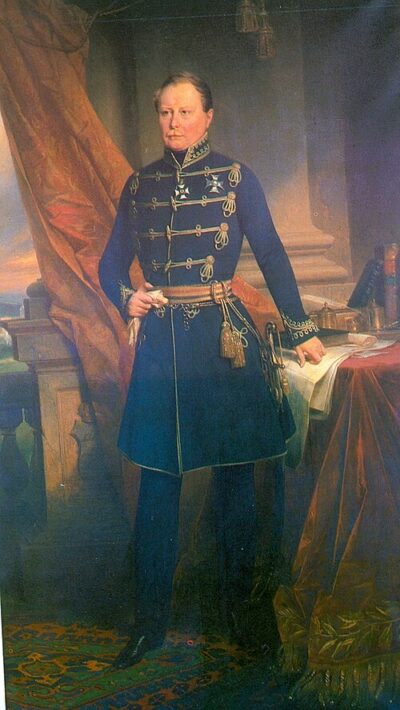
Wilhelm I of Württemberg
Wilhelm I of Württemberg was a king of Württemberg. Born September 27, 1781, in Lubin. Died June 25, 1864, in Rosenstein Castle. Positions held include King of Württemberg. Awards include Order of Saint Alexander Nevsky, Order of St. Andrew and Order of St. George, 3rd class.
Facts
33 facts · 2 confirmed by two sources · 3 cited · 28 from one source
Where this comes from
Papalocal keeps its own record. It started from these sources; what each one said is kept here as it was copied, so a change on their side never changes this page by itself. Tap one to read its version.
What Wikidata says · copied November 16, 2026 · revision 2564578204
- Described as
- king of Württemberg
- Born
- September 27, 1781 · 3 references
- Died
- June 25, 1864 · 3 references
- Born in
- Lubin · 1 reference
- Died in
- Rosenstein Castle
- Buried in
- Württemberg Mausoleum
- Citizen of
- Kingdom of Württemberg
- Occupation
- monarch · 1 reference; aristocrat
- Positions held
- King of Württemberg
- Awards
- Order of Saint Alexander Nevsky; Order of St. Andrew; Order of St. George, 3rd class; Knight Grand Cross of the Military Order of William (1815); Order of St. George, 2nd class; Military Order of Maria Theresa · 1 reference; Knight of the Order of the Elephant (1817); Iron Cross (1813), 2nd class (1813) · 2 references
- Spouse
- Catherine Pavlovna of Russia (1816–1819) · 1 reference; Caroline Augusta of Bavaria (1808–1816) · 1 reference; Pauline Therese of Württemberg (1820–1864) · 1 reference
- Children
- Marie Friederike Charlotte of Württemberg; Sophie of Württemberg; Princess Katharina of Württemberg; Karl I of Württemberg; Princess Augusta of Württemberg
- Father
- Frederick I of Württemberg
- Mother
- Princess Auguste Karoline of Brunswick-Wolfenbüttel
- Siblings
- Catharina of Württemberg; Prince Paul of Württemberg; stillborn daughter von Württemberg; Princess Sophie Dorothea of Württemberg
- Religion
- Lutheranism
- Military rank
- general
- Wikipedias with a page
- 39
Wikidata item Q170398 (wikidata.org/wiki/Q170398), public domain (CC0). Copied November 16, 2026.
What Wikipedia says · copied November 16, 2026 · revision 1384011231
William I (German: Friedrich Wilhelm Karl; 27 September 1781 – 25 June 1864) was King of Württemberg from 30 October 1816 until his death.
Upon William's accession, Württemberg was suffering crop failures and famine in the "Year Without a Summer", in 1816. After taking office, he initiated sweeping reforms, resulting in the approval of the Estates of Württemberg to a constitution on 25 September 1819. In his 47-year reign, the kingdom moved from one that was created from different denominational principalities and a heterogeneous agricultural country, into a constitutional state with a common identity and a well-organised management.
In addition to his successful domestic policy, he pursued throughout his reign an ambition focused on German and European foreign policy. Alongside the great powers of Prussia and Austria, he imagined a third major German power in the form of Bavaria, Saxony, Hanover and Württemberg. Although this plan never succeeded, it ensured a consistent, coherent and targeted policy during his reign.
William was the only German monarch who was forced to recognise the Frankfurt Constitution of 1848. After the failure of the March Revolution of 1848, he pursued reactionary policies that counteracted his liberal image from before the revolution. He died in 1864 at Rosenstein Castle in Bad Cannstatt and is buried in the Württemberg Mausoleum.
- Born, in its opening lines
- September 27, 1781
- Died, in its opening lines
- June 25, 1864
From the Wikipedia article “William I of Württemberg” (en.wikipedia.org/wiki/William_I_of_Württemberg), by its contributors, under CC BY-SA 4.0 (creativecommons.org/licenses/by-sa/4.0/). Copied November 16, 2026; not changed.
Confirmed Two sources agree. Cited One source, and it names where it got it. One source One source, without a reference of its own. Sources disagree The sources disagree. We show the best-supported value and keep theirs below.
