
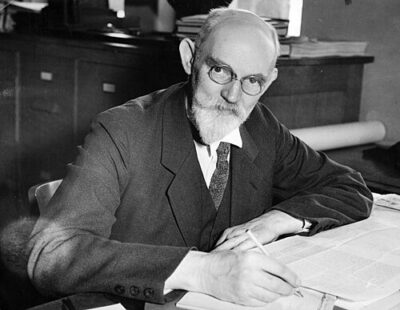
Willem de Sitter
Willem de Sitter was a Dutch cosmologist (*1872 – †1934). Born May 6, 1872, in Sneek. Died November 20, 1934, in Leiden. Positions held include rector magnificus of Leiden University (1925–1926), director (1918–1934) and chairperson (1925–1928). Known for dark matter, Einstein–De Sitter universe and The Size of the Universe. Educated at University of Groningen (2 times) and Stedelijk Gymnasium Arnhem. Awards include Gold Medal of the Royal Astronomical Society, Bruce Medal and Prix Jules Janssen.
Facts
32 facts · 2 confirmed by two sources · 14 cited · 16 from one source
Where this comes from
Papalocal keeps its own record. It started from these sources; what each one said is kept here as it was copied, so a change on their side never changes this page by itself. Tap one to read its version.
What Wikidata says · copied November 16, 2026 · revision 2558281676
- Described as
- Dutch cosmologist (*1872 – †1934)
- Other names
- W. de Sitter
- Born
- May 6, 1872 · 10 references
- Died
- November 20, 1934 · 10 references
- Born in
- Sneek · 2 references
- Died in
- Leiden · 2 references
- Buried in
- Westerveld · 1 reference
- Citizen of
- Kingdom of the Netherlands · 1 reference
- Occupation
- astronomer · 1 reference; mathematician; physicist; university teacher · 2 references
- Positions held
- rector magnificus of Leiden University (1925–1926) · 1 reference; director (1918–1934) · 1 reference; chairperson (1925–1928) · 1 reference
- Worked for
- Leiden University (1908–1934) · 1 reference; University of Groningen (1901–1908) · 1 reference; Royal Observatory, Cape of Good Hope (1897–1899) · 1 reference
- Education
- University of Groningen (2 times) (1891–1901) · 2 references; Stedelijk Gymnasium Arnhem (1885–1891) · 1 reference
- Member of
- Royal Netherlands Academy of Arts and Sciences; American Academy of Arts and Sciences; International Astronomical Union · 1 reference; National Academy of Sciences (1929–)
- Known for
- dark matter · 1 reference; Einstein–De Sitter universe; The Size of the Universe
- Awards
- Gold Medal of the Royal Astronomical Society (1931) · 1 reference; Bruce Medal (1931) · 2 references; Prix Jules Janssen (1934) · 1 reference; James Craig Watson Medal (1929) · 1 reference
- Field
- astronomy
- Children
- Aernout de Sitter; Ulbo de Sitter
- Wikipedias with a page
- 48
Wikidata item Q313059 (wikidata.org/wiki/Q313059), public domain (CC0). Copied November 16, 2026.
What Wikipedia says · copied November 16, 2026 · revision 1372011284
Willem de Sitter (6 May 1872 – 20 November 1934) was a Dutch mathematician, physicist, and astronomer. He is known for the de Sitter universe, which is a cosmological model that was named after him.
- Born, in its opening lines
- May 6, 1872
- Died, in its opening lines
- November 20, 1934
From the Wikipedia article “Willem de Sitter” (en.wikipedia.org/wiki/Willem_de_Sitter), by its contributors, under CC BY-SA 4.0 (creativecommons.org/licenses/by-sa/4.0/). Copied November 16, 2026; not changed.
Confirmed Two sources agree. Cited One source, and it names where it got it. One source One source, without a reference of its own. Sources disagree The sources disagree. We show the best-supported value and keep theirs below.
