
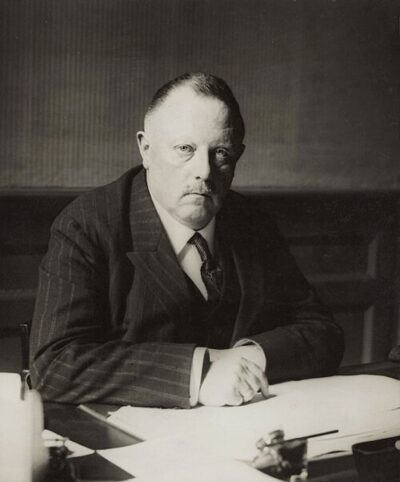
Willem Hendrik Keesom
Willem Hendrik Keesom was a Dutch physicist. Born June 21, 1876, in Texel. Died March 3, 1956, in Leiden. Educated at University of Amsterdam.
Facts
16 facts · 2 confirmed by two sources · 7 cited · 7 from one source
What’s different
- Died: we show March 3, 1956 (Confirmed). Wikidata also lists March 24, 1956
Where this comes from
Papalocal keeps its own record. It started from these sources; what each one said is kept here as it was copied, so a change on their side never changes this page by itself. Tap one to read its version.
What Wikidata says · copied November 18, 2026 · revision 2533490167
- Described as
- Dutch physicist (1876–1956)
- Other names
- W.H. Keesom, Wilhelmus Hendrikus Keesom, Willem Keesom
- Born
- June 21, 1876 · 6 references
- Died
- March 3, 1956 · 2 references; March 24, 1956 · 1 reference
- Born in
- Texel · 1 reference
- Died in
- Leiden
- Name at birth
- Wilhelmus Hendrikus Keesom · 1 reference
- Citizen of
- Kingdom of the Netherlands · 2 references
- Occupation
- physicist; university teacher · 2 references
- Worked for
- Utrecht University (1917–1923) · 1 reference; Leiden University (1923–1945) · 1 reference
- Education
- University of Amsterdam
- Member of
- German Academy of Sciences Leopoldina; Royal Netherlands Academy of Arts and Sciences; Pontifical Academy of Sciences · 1 reference; Koninklijke Vlaamse Academie van België voor Wetenschappen en Kunsten · 1 reference
- Field
- physics · 1 reference
- Wikipedias with a page
- 22
Wikidata item Q1356820 (wikidata.org/wiki/Q1356820), public domain (CC0). Copied November 18, 2026.
What Wikipedia says · copied November 18, 2026 · revision 1386026845
Willem Hendrik Keesom () (21 June 1876, Texel – 3 March 1956, Leiden) was a Dutch physicist who, in 1926, invented a method to freeze liquid helium.
He also developed the first mathematical description of dipole–dipole interactions in 1921. Thus, dipole–dipole interactions are also known as Keesom interactions.
He was previously a student of Heike Kamerlingh Onnes, who had discovered superconductivity (a feat for which Kamerlingh Onnes received the 1913 Nobel Prize in Physics).
He also discovered the lambda point transition at 2.2 K with a specific-heat maximum between the two states of liquid helium-4 (states called helium I and helium II) in 1930.
He and his daughter Anna Keesom (also doctor in physics), discovered the unusual thermal conductivity of liquid helium in 1936.
In 1924 he became member of the Royal Netherlands Academy of Arts and Sciences. In 1966, the minor planet
9686 Keesom was named after him.
- Born, in its opening lines
- June 21, 1876
- Died, in its opening lines
- March 3, 1956
From the Wikipedia article “Willem Hendrik Keesom” (en.wikipedia.org/wiki/Willem_Hendrik_Keesom), by its contributors, under CC BY-SA 4.0 (creativecommons.org/licenses/by-sa/4.0/). Copied November 18, 2026; not changed.
Confirmed Two sources agree. Cited One source, and it names where it got it. One source One source, without a reference of its own. Sources disagree The sources disagree. We show the best-supported value and keep theirs below.
