
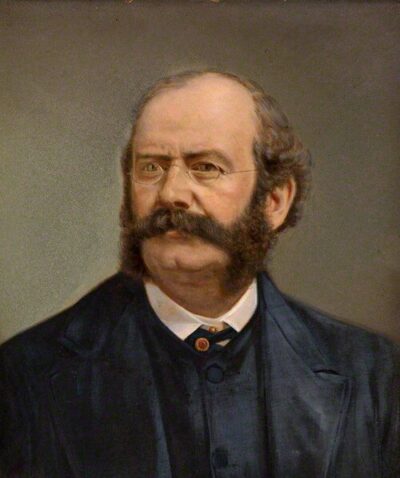
William Burges
William Burges was an English architect. Born December 2, 1827, in London. Died April 20, 1881, in The Tower House. Known for Saint Fin Barre's Cathedral, Church of Christ the Consoler and St Michael and All Angels Church, Lowfield Heath. Educated at King's College School and King's College London.
Facts
24 facts · 2 confirmed by two sources · 10 cited · 12 from one source
Where this comes from
Papalocal keeps its own record. It started from these sources; what each one said is kept here as it was copied, so a change on their side never changes this page by itself. Tap one to read its version.
What Wikidata says · copied November 18, 2026 · revision 2521026200
- Described as
- English architect (1827–1881)
- Other names
- William Burgess dz
- Born
- December 2, 1827 · 11 references
- Died
- April 20, 1881 · 10 references
- Born in
- London
- Died in
- The Tower House
- Buried in
- West Norwood Cemetery
- Citizen of
- United Kingdom of Great Britain and Ireland
- Occupation
- architect · 1 reference; designer · 1 reference; jewelry designer · 1 reference; jeweler · 1 reference
- Education
- King's College School; King's College London
- Member of
- Royal Academy of Arts
- Known for
- Saint Fin Barre's Cathedral; Church of Christ the Consoler; St Michael and All Angels Church, Lowfield Heath
- Field
- architecture · 1 reference; architectural design · 1 reference; furniture design · 1 reference; industrial design right · 1 reference; design · 1 reference; industrial design · 1 reference
- Father
- Alfred Burges
- Military branch
- British Army
- Wikipedias with a page
- 23
Wikidata item Q186265 (wikidata.org/wiki/Q186265), public domain (CC0). Copied November 18, 2026.
What Wikipedia says · copied November 18, 2026 · revision 1372247341
William Burges (; 2 December 1827 – 20 April 1881) was an English architect and designer. Among the greatest of the Victorian art-architects, he sought in his work to escape from both nineteenth-century industrialisation and the Neoclassical architectural style and re-establish the architectural and social values of a utopian medieval England. Burges stands within the tradition of the Gothic Revival, his works echoing those of the Pre-Raphaelites and heralding those of the Arts and Crafts movement.
Burges won his first major commission for Saint Fin Barre's Cathedral in Cork in 1863 when he was 35. He died in 1881 at his Kensington home, The Tower House aged only 53. His architectural output was small but varied. Working with a long-standing team of craftsmen, he built churches, a cathedral, a warehouse, a university, a school, houses and castles. Burges's most notable works are Cardiff Castle, constructed between 1866 and 1928, and Castell Coch (1872–1891), both of which were built for John Crichton-Stuart, 3rd Marquess of Bute. Other significant buildings include Gayhurst House, Buckinghamshire (1858–1865), Knightshayes Court (1867–1874), the Church of Christ the Consoler (1870–1876), St Mary's, Studley Royal (1870–1878), in Yorkshire, and Park House, Cardiff (1871–1880).
Many of his designs were never executed or were subsequently demolished or altered. His competition entries for cathedrals at Lille (1854), Adelaide (1856), Colombo, Brisbane (1859), Edinburgh (1873), and Truro (1878) were all unsuccessful. He lost out to George Edmund Street in the competition for the Royal Courts of Justice (1866–67) in The Strand. His plans for the redecoration of the interior of St Paul's Cathedral (1870–1877) were abandoned and he was dismissed from his post. Skilbeck's Warehouse (1865–66) was demolished in the 1970s, and work at Salisbury Cathedral (1855–1859), Worcester College, Oxford (1873–1879), and at Knightshayes Court had been lost in the decades before.
Beyond architecture, Burges designed metalwork, sculpture, jewellery, furniture and stained glass. Art Applied to Industry, a series of lectures he gave to the Society of Arts in 1864, illustrates the breadth of his interests; the topics covered including glass, pottery, brass and iron, gold and silver, furniture, the weaver's art and external architectural decoration. For most of the century following his death, Victorian architecture was neither the subject of intensive study nor sympathetic attention and Burges's work was largely ignored. The revival of interest in Victorian art, architecture, and design in the later twentieth century led to a renewed appreciation of Burges and his work.
- Born, in its opening lines
- December 2, 1827
- Died, in its opening lines
- April 20, 1881
From the Wikipedia article “William Burges” (en.wikipedia.org/wiki/William_Burges), by its contributors, under CC BY-SA 4.0 (creativecommons.org/licenses/by-sa/4.0/). Copied November 18, 2026; not changed.
Confirmed Two sources agree. Cited One source, and it names where it got it. One source One source, without a reference of its own. Sources disagree The sources disagree. We show the best-supported value and keep theirs below.
