
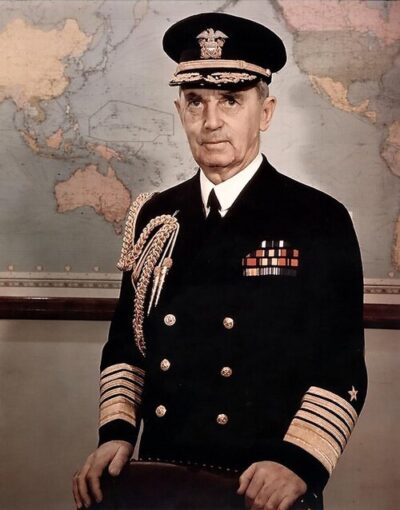
William D. Leahy
William D. Leahy was an United States admiral, ambassador to France, Chief of Staff. Born May 6, 1875, in Hampton. Died July 20, 1959, in Bethesda. Positions held include Chairman of the Joint Chiefs of Staff (1942–1949), Governor of Puerto Rico (1939–1940) and Chief of Naval Operations (1937–1939). Educated at United States Naval Academy. Awards include Navy Cross, Spanish Campaign Medal and Mexican Service Medal.
Facts
37 facts · 2 confirmed by two sources · 5 cited · 29 from one source · 1 where the sources disagree
What’s different
- Died in: we show Bethesda (Sources disagree). Wikidata also lists Walter Reed National Military Medical Center
Where this comes from
Papalocal keeps its own record. It started from these sources; what each one said is kept here as it was copied, so a change on their side never changes this page by itself. Tap one to read its version.
What Wikidata says · copied November 15, 2026 · revision 2569097502
- Described as
- United States admiral, ambassador to France, Chief of Staff (1875–1959)
- Other names
- William Daniel Leahy
- Born
- May 6, 1875 · 7 references
- Died
- July 20, 1959 · 8 references
- Born in
- Hampton · 1 reference
- Died in
- Bethesda · 2 references; Walter Reed National Military Medical Center
- Buried in
- Arlington National Cemetery (1959) · 1 reference
- Citizen of
- United States
- Occupation
- naval officer (1897–1939); diplomat (1941–1942); politician; ambassador · 1 reference; governor · 1 reference; admiral · 1 reference
- Positions held
- Chairman of the Joint Chiefs of Staff (1942–1949); Governor of Puerto Rico (1939–1940); Chief of Naval Operations (1937–1939); United States Ambassador to France (1941–1942); ambassador
- Education
- United States Naval Academy
- Awards
- Navy Cross; Spanish Campaign Medal; Mexican Service Medal; American Campaign Medal; Navy Distinguished Service Medal; Philippine Campaign Medal; Dominican Campaign Medal; World War II Victory Medal; Sampson Medal; Nicaraguan Campaign Medal; World War I Victory Medal (United States) · 1 reference; National Defense Service Medal; Asiatic-Pacific Campaign Medal; European-African-Middle Eastern Campaign Medal
- Children
- William Harrington Leahy
- Military branch
- United States Navy
- Military rank
- ensign (1899–); lieutenant (junior grade) (1902–); lieutenant (1903–)
- Wikipedias with a page
- 32
Wikidata item Q729082 (wikidata.org/wiki/Q729082), public domain (CC0). Copied November 15, 2026.
What Wikipedia says · copied November 15, 2026 · revision 1385864108
William Daniel Leahy ( LAY-(h)ee; 6 May 1875 – 20 July 1959) was an American naval officer and was the most senior United States military officer on active duty during World War II; he held several titles and exercised considerable influence over foreign and military policy. As a fleet admiral, he was the first flag officer ever to hold a five-star rank in the U.S. Armed Forces.
An 1897 graduate of the United States Naval Academy, Leahy saw active service in the Spanish–American War, the Philippine–American War, the Boxer Rebellion in China, the Banana Wars in Central America, and World War I. He was the first member of his cadet class to reach flag rank, as the Chief of the Bureau of Ordnance from 1927 to 1931. He subsequently served as Chief of the Bureau of Navigation from 1933 to 1936, and commanded the Battle Fleet from 1936 to 1937. As Chief of Naval Operations from 1937 to 1939, he was the senior officer in the United States Navy, overseeing the expansion of the fleet and preparations for war.
After retiring from the Navy, Leahy was appointed the governor of Puerto Rico in 1939 by President Franklin D. Roosevelt. In his most controversial role, he served as the Ambassador to France from 1940 to 1942. American policy was aimed at keeping the government of Vichy France free of German control, but Leahy had limited success and came to believe the United States should back Free France instead of Vichy France. He asked to be recalled to the United States after the Japanese attack on Pearl Harbor brought the United States into the Second World War.
Leahy was recalled to active duty and became the Chief of Staff to President Roosevelt in 1942, serving in that position for the rest of the war. As the de facto first Chairman of the Joint Chiefs of Staff, he oversaw all of the American armed forces and was a major decision-maker during the war. He also presided over the American delegation to the Combined Chiefs of Staff. In December 1944, he was promoted to the five-star rank of fleet admiral. In the aftermath of World War II, he served Roosevelt's successor Harry S. Truman, helping shape postwar foreign policy until he retired in 1949. Although he did not oppose the use of the nuclear weapons during the war, in the post-war period he rejected war plans that overemphasised the first use of nuclear weapons.
- Born, in its opening lines
- May 6, 1875
- Died, in its opening lines
- July 20, 1959
From the Wikipedia article “William D. Leahy” (en.wikipedia.org/wiki/William_D._Leahy), by its contributors, under CC BY-SA 4.0 (creativecommons.org/licenses/by-sa/4.0/). Copied November 15, 2026; not changed.
Confirmed Two sources agree. Cited One source, and it names where it got it. One source One source, without a reference of its own. Sources disagree The sources disagree. We show the best-supported value and keep theirs below.
