
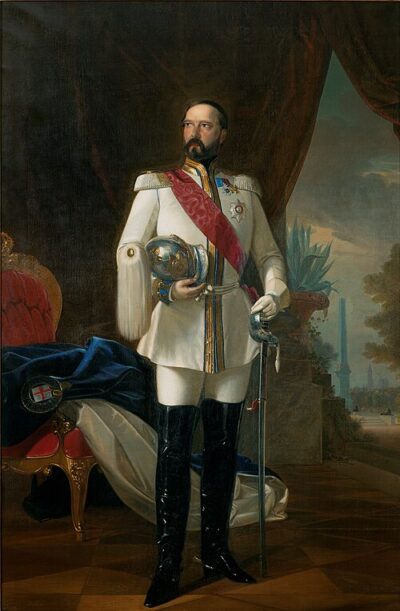
William, Duke of Brunswick
William, Duke of Brunswick was a Duke of Brunswick. Born April 25, 1806, in Brunswick. Died October 18, 1884, in Szczodre, Wrocław County. Positions held include member of the Prussian House of Lords. Awards include Order of St. Andrew, Order of Saint Stephen of Hungary and Knight Grand Cross in the Order of the Netherlands Lion.
Facts
20 facts · 2 confirmed by two sources · 5 cited · 13 from one source
Where this comes from
Papalocal keeps its own record. It started from these sources; what each one said is kept here as it was copied, so a change on their side never changes this page by itself. Tap one to read its version.
What Wikidata says · copied November 18, 2026 · revision 2569133920
- Described as
- Duke of Brunswick (1806–1884)
- Other names
- August Ludwig Wilhelm Maximilian Friedrich Herzog von Braunschweig-Wolfenbüttel
- Born
- April 25, 1806 · 2 references
- Died
- October 18, 1884 · 2 references
- Born in
- Brunswick · 1 reference
- Died in
- Szczodre, Wrocław County · 1 reference
- Buried in
- Brunswick Cathedral
- Name at birth
- Wilhelm August Ludwig Maximilian Friedrich von Braunschweig
- Citizen of
- Duchy of Brunswick
- Occupation
- military personnel
- Positions held
- member of the Prussian House of Lords
- Awards
- Order of St. Andrew; Order of Saint Stephen of Hungary · 1 reference; Knight Grand Cross in the Order of the Netherlands Lion (1881) · 1 reference; honorary citizenship (1861)
- Father
- Frederick William, Duke of Brunswick-Wolfenbüttel · 1 reference
- Mother
- Princess Marie of Baden · 1 reference
- Siblings
- Karl II, Duke of Brunswick; unnamed daughter von Braunschweig-Wolfenbüttel; Carl Friedrich Kohlbach
- Religion
- Lutheranism
- Military rank
- general
- Wikipedias with a page
- 21
Wikidata item Q62667 (wikidata.org/wiki/Q62667), public domain (CC0). Copied November 18, 2026.
What Wikipedia says · copied November 18, 2026 · revision 1370466488
William, Duke of Brunswick (German: Wilhelm August Ludwig Maximilian Friedrich; 25 April 1806 – 18 October 1884), was ruling duke of the Duchy of Brunswick from 1830 until his death.
William was the second son of Frederick William, Duke of Brunswick-Lüneburg, and after the death of his father in 1815, was under the guardianship of his paternal great-granduncle King George IV of the United Kingdom. He became a Prussian major in 1823. When his brother, Charles, was deposed as ruling duke by a rebellion in 1830, William took over the government provisionally. In 1831, a family law of the House of Welf made William the ruling duke permanently. William left most government business to his ministers, spending most of his time at Oleśnica Castle in what is now southwestern Poland.While William joined the Prussian-led North German Confederation in 1866, his relationship to Prussia was strained, since Prussia refused to recognize his paternal grandnephew Ernest Augustus, Crown Prince of Hanover, as his heir, because of the Duke of Cumberland's claim to the throne of Hanover. William died in 1884; he passed on his private possessions to the Duke of Cumberland. His death caused a constitutional crisis for Brunswick that lasted until the accession of his paternal great-grandnephew Ernest Augustus, Duke of Brunswick (a male line descendant of William, the younger brother of Henry, his male line ancestor), in 1913.
William died unmarried, but had a number of illegitimate children.
- Born, in its opening lines
- April 25, 1806
- Died, in its opening lines
- October 18, 1884
From the Wikipedia article “William, Duke of Brunswick” (en.wikipedia.org/wiki/William,_Duke_of_Brunswick), by its contributors, under CC BY-SA 4.0 (creativecommons.org/licenses/by-sa/4.0/). Copied November 18, 2026; not changed.
Confirmed Two sources agree. Cited One source, and it names where it got it. One source One source, without a reference of its own. Sources disagree The sources disagree. We show the best-supported value and keep theirs below.
