
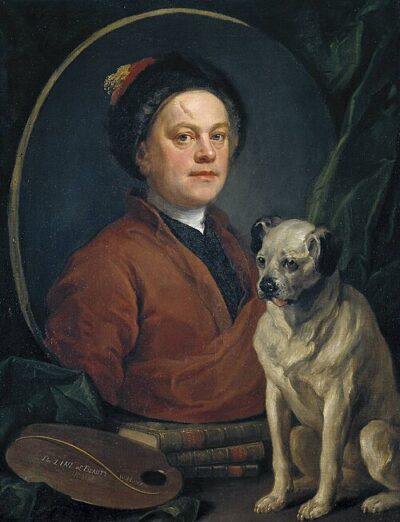
William Hogarth
William Hogarth was an English painter, printmaker, pictorial satirist, social critic and editorial cartoonist. Born November 10, 1697, in London. Died October 26, 1764, in London. Positions held include court painter. Known for The Graham Children, Marriage A-la-Mode: 2. The Tête à Tête and The Shrimp Girl.
Facts
33 facts · 2 confirmed by two sources · 16 cited · 15 from one source
What’s different
- Died: we show October 26, 1764 (Confirmed). Wikidata also lists October 25, 1764
Where this comes from
Papalocal keeps its own record. It started from these sources; what each one said is kept here as it was copied, so a change on their side never changes this page by itself. Tap one to read its version.
What Wikidata says · copied November 16, 2026 · revision 2565835217
- Described as
- English painter, printmaker, pictorial satirist, social critic and editorial cartoonist (1697-1764)
- Other names
- hogarth w., Guglielmo Hogarth, Horarth, Uilʹi︠a︡m Khogart, Khogart, W. Hogarth, sir wm. hogarth, Hogarth, hogarth sir w., William Horarth, Hogart, Hogardt
- Born
- November 10, 1697 · 15 references
- Died
- October 26, 1764 · 4 references; October 25, 1764 · 3 references
- Born in
- London · 3 references
- Died in
- London · 3 references
- Buried in
- St. Nicholas Church, Chiswick
- Citizen of
- Kingdom of Great Britain
- Occupation
- painter · 5 references; caricaturist · 3 references; illustrator · 2 references; printmaker · 3 references; exlibrist; draftsperson · 3 references; proofreader; engraver · 2 references
- Positions held
- court painter
- Genre
- history painting; portrait · 1 reference; caricature · 1 reference; genre painting · 1 reference
- Known for
- The Graham Children; Marriage A-la-Mode: 2. The Tête à Tête; The Shrimp Girl; Satire on False Perspective; A Rake's Progress
- Field
- painting · 1 reference; visual arts · 1 reference; graphics · 1 reference
- Spouse
- Jane Hogarth
- Father
- Richard Hogarth · 1 reference
- Mother
- Anne Gibbons · 1 reference
- Religion
- deism
- Lived in
- London; Hogarth's House
- Wikipedias with a page
- 82
Wikidata item Q171344 (wikidata.org/wiki/Q171344), public domain (CC0). Copied November 16, 2026.
What Wikipedia says · copied November 16, 2026 · revision 1384127752
William Hogarth (; 10 November 1697 – 26 October 1764) was an English painter, engraver, cartoonist, and satirist. His work ranges from realistic portraiture to comic strip-like series of pictures called "modern moral subjects", and he is perhaps best known for his series A Harlot's Progress, A Rake's Progress and Marriage A-la-Mode. Familiarity with his work is so widespread that satirical political illustrations in this style are often referred to as "Hogarthian".
Hogarth was born in the City of London into a lower-middle-class family. In his youth he took up an apprenticeship with an engraver, but did not complete the apprenticeship. His father underwent periods of mixed fortune, and was at one time imprisoned in lieu of payment of outstanding debts, an event that is thought to have informed William's paintings and prints with a hard edge.
Influenced by French and Italian painting and engraving, Hogarth's works are mostly satirical caricatures, sometimes bawdily sexual, mostly of the first rank of realistic portraiture. They became widely popular and mass-produced via prints in his lifetime, and he was by far the most significant English artist of his generation. Charles Lamb deemed Hogarth's images to be books, filled with "the teeming, fruitful, suggestive meaning of words. Other pictures we look at; his pictures we read."
- Born, in its opening lines
- November 10, 1697
- Died, in its opening lines
- October 26, 1764
From the Wikipedia article “William Hogarth” (en.wikipedia.org/wiki/William_Hogarth), by its contributors, under CC BY-SA 4.0 (creativecommons.org/licenses/by-sa/4.0/). Copied November 16, 2026; not changed.
Confirmed Two sources agree. Cited One source, and it names where it got it. One source One source, without a reference of its own. Sources disagree The sources disagree. We show the best-supported value and keep theirs below.
