
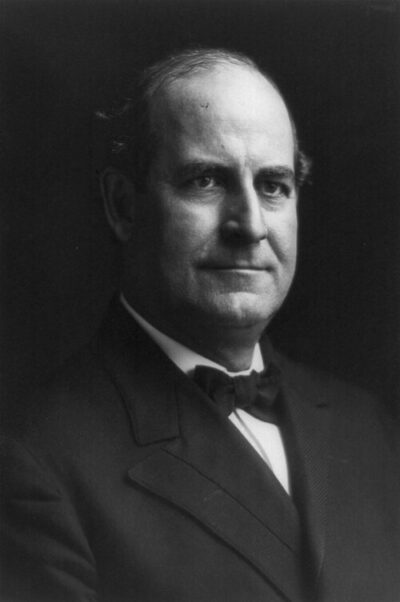
William Jennings Bryan
William Jennings Bryan was an American politician. Born March 19, 1860, in Salem. Died July 26, 1925, in Dayton. Positions held include United States representative (1891–1895) and United States Secretary of State (1913–1915). Educated at Illinois College and Northwestern University Pritzker School of Law. Awards include Honorary doctorate of the University of Florida.

Facts
35 facts · 2 confirmed by two sources · 13 cited · 20 from one source
Where this comes from
Papalocal keeps its own record. It started from these sources; what each one said is kept here as it was copied, so a change on their side never changes this page by itself. Tap one to read its version.
What Wikidata says · copied November 13, 2026 · revision 2567469432
- Described as
- American politician (1860–1925)
- Other names
- William Bryan, W. J. Bryan, William J. Bryan
- Born
- March 19, 1860 · 5 references
- Died
- July 26, 1925 · 8 references
- Born in
- Salem · 1 reference
- Died in
- Dayton · 1 reference
- Buried in
- Arlington National Cemetery
- Citizen of
- United States
- Occupation
- politician · 1 reference; lawyer · 1 reference; diplomat; publisher; editor; writer · 1 reference; foreign minister · 1 reference
- Positions held
- United States representative (1891–1895); United States Secretary of State (1913–1915)
- Political party
- Democratic Party
- Education
- Illinois College; Northwestern University Pritzker School of Law
- Member of
- Delta Chi
- Awards
- Honorary doctorate of the University of Florida (1923)
- Spouse
- Mary Baird Bryan · 1 reference
- Children
- Ruth Bryan Owen; William Jennings Bryan Jr.; Grace Bryan Hargreaves
- Father
- Silas Bryan
- Mother
- Mariah Jennings Bryan · 1 reference
- Siblings
- Charles W. Bryan · 1 reference; Mary Elizabeth Bryan; Frances Mariah Bryan
- Religion
- Christianity; Presbyterianism
- Lived in
- William Jennings Bryan House (1917–1919) · 1 reference; Villa Serena · 1 reference; William Jennings Bryan Boyhood Home (1860–1866) · 1 reference; William Jennings Bryan House · 1 reference
- Wikipedias with a page
- 52
Wikidata item Q205282 (wikidata.org/wiki/Q205282), public domain (CC0). Copied November 13, 2026.
What Wikipedia says · copied November 13, 2026 · revision 1385105160
William Jennings Bryan (March 19, 1860 – July 26, 1925) was an American lawyer, orator, and a left-wing populist politician. He was a dominant force in the Democratic Party, running three times as the party's nominee for President of the United States in the 1896, 1900, and 1908 elections. He served in the House of Representatives from 1891 to 1895 and as the secretary of state under Woodrow Wilson from 1913 to 1915. Because of his faith in the wisdom of the common people, Bryan was often called "the Great Commoner", and because of his rhetorical power and early fame as the youngest presidential candidate, "the Boy Orator".
Born and raised in Illinois, Bryan moved to Nebraska in the 1880s. He won election to the House of Representatives in the 1890 elections, served two terms, and made an unsuccessful run for the Senate in 1894. At the 1896 Democratic National Convention, Bryan delivered his "Cross of Gold" speech, which attacked the gold standard and the eastern moneyed interests and crusaded for inflationary policies built around the expanded coinage of silver coins. In a repudiation of incumbent President Grover Cleveland and his conservative Bourbon Democrats, the Democratic convention nominated Bryan for president, making Bryan the youngest major party presidential nominee in U.S. history. Subsequently, Bryan was also nominated for president by the left-wing Populist Party, and many Populists would eventually follow Bryan into the Democratic Party. In the intensely-fought 1896 presidential election, the Republican nominee, William McKinley, emerged triumphant. At age 36, Bryan remains the youngest person in United States history to receive an electoral vote for president and cumulatively, the most electoral votes without ever being elected president. Bryan gained fame as an orator, as he invented the national stumping tour when he reached an audience of 5 million people in 27 states in 1896, and continued to deliver well-attended lectures on the Chautauqua circuit well into the 20th century.
Bryan retained control of the Democratic Party and again won the nomination for the 1900 presidential election. After serving as a colonel in the 3rd Nebraska Infantry Regiment during the Spanish–American War, Bryan became a fierce opponent of American imperialism, and much of his campaign centered on that issue. In the election, McKinley again defeated Bryan and won several Western states that Bryan had won in 1896. Bryan's influence in the party weakened after the 1900 election, and the Democrats nominated the conservative Alton B. Parker in the 1904 presidential election. Bryan regained his stature in the party after Parker's resounding defeat by Theodore Roosevelt and voters from both parties increasingly embraced some of the progressive reforms that had long been championed by Bryan. Bryan won his party's nomination in the 1908 presidential election but was defeated by Roosevelt's chosen successor, William Howard Taft. Along with Henry Clay, Bryan is one of the two individuals who never won a presidential election despite receiving electoral votes in three separate presidential elections held after the ratification of the 12th Amendment.
After the Democrats won the 1912 presidential election, Wilson rewarded Bryan's support with the important cabinet position of Secretary of State. Bryan helped Wilson pass several progressive reforms through Congress. In 1915, before the US joined World War I, he considered that Wilson was too harsh on Germany and finally resigned after Wilson had sent Germany a note of protest with a veiled threat of war in response to the sinking of the Lusitania by a German U-boat. After leaving office, Bryan retained some of his influence within the Democratic Party but increasingly devoted himself to Prohibition, religious matters, and anti-evolution activism. He opposed Darwinism on religious and humanitarian grounds, most famously as a prosecutor in the 1925 Scopes trial, dying soon after. Bryan has elicited mixed reactions from various commentators but is acknowledged by historians as one of the most influential figures of the Progressive Era.
- Born, in its opening lines
- March 19, 1860
- Died, in its opening lines
- July 26, 1925
From the Wikipedia article “William Jennings Bryan” (en.wikipedia.org/wiki/William_Jennings_Bryan), by its contributors, under CC BY-SA 4.0 (creativecommons.org/licenses/by-sa/4.0/). Copied November 13, 2026; not changed.
Confirmed Two sources agree. Cited One source, and it names where it got it. One source One source, without a reference of its own. Sources disagree The sources disagree. We show the best-supported value and keep theirs below.
