
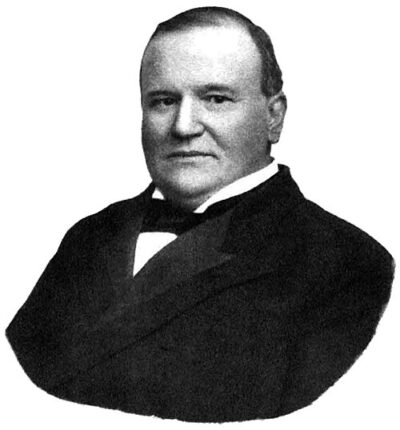
William O'Connell Bradley
William O'Connell Bradley was a politician from the US state of Kentucky. Born March 18, 1847, in Garrard County. Died May 23, 1914, in Washington, D.C.. Positions held include Governor of Kentucky (1895–1899) and United States senator (1909–1914).
Facts
12 facts · 2 confirmed by two sources · 1 cited · 9 from one source
Where this comes from
Papalocal keeps its own record. It started from these sources; what each one said is kept here as it was copied, so a change on their side never changes this page by itself. Tap one to read its version.
What Wikidata says · copied November 18, 2026 · revision 2499141693
- Described as
- politician from the US state of Kentucky (1847-1914)
- Born
- March 18, 1847 · 1 reference
- Died
- May 23, 1914 · 1 reference
- Born in
- Garrard County
- Died in
- Washington, D.C.
- Buried in
- Frankfort Cemetery
- Cause of death
- kidney failure
- Citizen of
- United States
- Occupation
- politician; lawyer
- Positions held
- Governor of Kentucky (1895–1899); United States senator (1909–1914) · 1 reference
- Political party
- Republican Party
- Wikipedias with a page
- 14
Wikidata item Q880992 (wikidata.org/wiki/Q880992), public domain (CC0). Copied November 18, 2026.
What Wikipedia says · copied November 18, 2026 · revision 1377380157
William O'Connell Bradley (March 18, 1847 – May 23, 1914) was an American politician from the state of Kentucky. He served as the 32nd governor of Kentucky and was later elected by the state legislature as a U.S. senator from that state. The first Republican to serve as governor of Kentucky, Bradley became known as the father of the Republican Party in Kentucky.
As a Republican in a heavily Democratic state, Bradley found little success early in his political career. He was defeated for a seat in the United States House of Representatives and in the United States Senate twice each. After rising to national prominence as a "Stalwart Republican" with his speech seconding the presidential nomination of Ulysses S. Grant at the 1880 Republican National Convention, he was nominated for governor in 1887. Although he lost the contest to Simon Bolivar Buckner, he reduced the usual Democratic majority substantially. He was again nominated for governor in 1895. Capitalizing on divisions in the Democratic Party over the issue of free silver, he defeated Parker Watkins Hardin in the general election. His term was marked by political struggles and violence. He was an advocate for African Americans and did much to advance their status in the state, but was unable to enact much of his pro-civil rights agenda due to a hostile Democratic majority in the state legislature.
Republican William S. Taylor was elected to succeed Bradley in the contentious 1899 gubernatorial election. When Democratic nominee William Goebel and his running mate J. C. W. Beckham challenged the election results, Bradley formed part of the legal team for the Republicans. The case was appealed to the Supreme Court, which found in favor of the Democrats. Despite being a member of the state's minority party, Bradley was elected to the U.S. Senate in 1907. Again, divisions within the Democratic Party played a role in his election. Bradley's opposition to Prohibition made him more palatable to some Democrats than their candidate, outgoing Governor Beckham. Beckham refused to withdraw in favor of a compromise candidate, and after two months of balloting, four Democratic legislators crossed party lines and elected Bradley. Bradley had a largely undistinguished career in the Senate. On the day he announced he would not seek re-election to his Senate seat, he was involved in a streetcar accident. He died from his injuries on May 23, 1914.
- Born, in its opening lines
- March 18, 1847
- Died, in its opening lines
- May 23, 1914
From the Wikipedia article “William O'Connell Bradley” (en.wikipedia.org/wiki/William_O'Connell_Bradley), by its contributors, under CC BY-SA 4.0 (creativecommons.org/licenses/by-sa/4.0/). Copied November 18, 2026; not changed.
Confirmed Two sources agree. Cited One source, and it names where it got it. One source One source, without a reference of its own. Sources disagree The sources disagree. We show the best-supported value and keep theirs below.
