
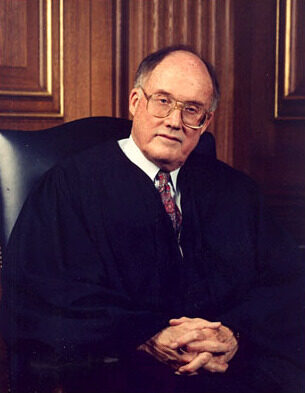
William Rehnquist
William Rehnquist was a chief justice of the United States from 1986 to 2005. Born October 1, 1924, in Milwaukee. Died September 3, 2005, in Arlington County. Positions held include Chief Justice of the United States (1986–2005) and Associate Justice of the Supreme Court of the United States (1972–1986). Educated at Harvard Law School and Stanford Law School.
Facts
25 facts · 2 confirmed by two sources · 3 cited · 20 from one source
Where this comes from
Papalocal keeps its own record. It started from these sources; what each one said is kept here as it was copied, so a change on their side never changes this page by itself. Tap one to read its version.
What Wikidata says · copied November 15, 2026 · revision 2533438105
- Described as
- chief justice of the United States from 1986 to 2005 (1924–2005)
- Other names
- William Hubbs Rehnquist, Justice Rehnquist, Chief Justice Rehnquist
- Born
- October 1, 1924 · 6 references
- Died
- September 3, 2005 · 7 references
- Born in
- Milwaukee
- Died in
- Arlington County
- Buried in
- Arlington National Cemetery (2005) · 1 reference
- Cause of death
- thyroid cancer
- Citizen of
- United States
- Occupation
- judge; lawyer; historian; politician
- Positions held
- Chief Justice of the United States (1986–2005); Associate Justice of the Supreme Court of the United States (1972–1986)
- Political party
- Republican Party
- Worked for
- Tulane University Law School
- Education
- Harvard Law School; Stanford Law School; Kenyon College; Denison University; Shorewood High School · 1 reference; Sandra Day O'Connor College of Law
- Member of
- American Academy of Arts and Sciences
- Father
- William Benjamin Rehnquist · 1 reference
- Mother
- Margery Peck · 1 reference
- Religion
- Lutheranism
- Wikipedias with a page
- 38
Wikidata item Q311562 (wikidata.org/wiki/Q311562), public domain (CC0). Copied November 15, 2026.
What Wikipedia says · copied November 15, 2026 · revision 1384435620
William Hubbs Rehnquist (October 1, 1924 – September 3, 2005) was an American attorney and jurist who served as the 16th chief justice of the United States from 1986 until his death in 2005, having previously been an associate justice from 1972 to 1986. Considered a staunch conservative, Rehnquist favored a conception of federalism that emphasized the Tenth Amendment's reservation of powers to the states.
Rehnquist grew up in Milwaukee, Wisconsin, and served in the U.S. Army Air Forces from 1943 to 1946. Afterward, he studied political science at Stanford University and Harvard University, then attended Stanford Law School, where he was an editor of the Stanford Law Review and graduated first in his class. Rehnquist clerked for Justice Robert H. Jackson during the Supreme Court's 1952–1953 term, then entered private practice in Phoenix, Arizona. Rehnquist served as a legal adviser for Republican presidential nominee Barry Goldwater in the 1964 U.S. presidential election, and President Richard Nixon appointed him U.S. Assistant Attorney General of the Office of Legal Counsel in 1969. In that capacity, he played a role in forcing Justice Abe Fortas to resign for accepting $20,000 from financier Louis Wolfson before Wolfson was convicted of selling unregistered shares.
In 1971, Nixon nominated Rehnquist to succeed Associate Justice John Marshall Harlan II, and the U.S. Senate confirmed him that year. During his confirmation hearings, Rehnquist was criticized for allegedly opposing the Supreme Court's decision in Brown v. Board of Education (1954) and allegedly taking part in voter suppression efforts targeting minorities as a lawyer in the early 1960s. Historians debate whether he committed perjury during the hearings by denying his suppression efforts despite at least ten witnesses to the acts, but it is known that at the very least he had defended segregation by private businesses in the early 1960s on the grounds of freedom of association. Rehnquist quickly established himself as the Burger Court's most conservative member. In 1986, President Ronald Reagan nominated Rehnquist to succeed retiring Chief Justice Warren Burger, and the Senate confirmed him.
Rehnquist served as Chief Justice for nearly 19 years, making him the fifth-longest-serving chief justice and the ninth-longest-serving justice overall. He became an intellectual and social leader of the Rehnquist Court, earning respect even from the justices who frequently opposed his opinions. As Chief Justice, Rehnquist presided over the impeachment trial of President Bill Clinton. Rehnquist wrote the majority opinions in United States v. Lopez (1995) and United States v. Morrison (2000), holding in both cases that Congress had exceeded its power under the Commerce Clause. He dissented in Roe v. Wade (1973) and continued to argue that Roe had been incorrectly decided in Planned Parenthood v. Casey (1992). In Bush v. Gore, he voted with the court's majority to end the Florida recount in the 2000 U.S. presidential election.
- Born, in its opening lines
- October 1, 1924
- Died, in its opening lines
- September 3, 2005
From the Wikipedia article “William Rehnquist” (en.wikipedia.org/wiki/William_Rehnquist), by its contributors, under CC BY-SA 4.0 (creativecommons.org/licenses/by-sa/4.0/). Copied November 15, 2026; not changed.
Confirmed Two sources agree. Cited One source, and it names where it got it. One source One source, without a reference of its own. Sources disagree The sources disagree. We show the best-supported value and keep theirs below.
