
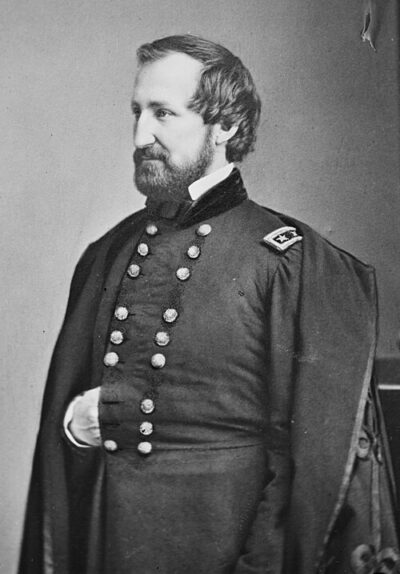
William Rosecrans
William Rosecrans was an American diplomat, politician and army officer. Born September 6, 1819, in Delaware County. Died March 11, 1898, in Redondo Beach. Positions held include United States representative (1881–1885) and United States Ambassador to Mexico (1868–1869). Educated at United States Military Academy. Awards include Laetare Medal.
Facts
19 facts · 2 confirmed by two sources · 6 cited · 11 from one source
Where this comes from
Papalocal keeps its own record. It started from these sources; what each one said is kept here as it was copied, so a change on their side never changes this page by itself. Tap one to read its version.
What Wikidata says · copied November 16, 2026 · revision 2567708126
- Described as
- American diplomat, politician and army officer (1819–1898)
- Other names
- William Starke Rosecrans
- Born
- September 6, 1819 · 3 references
- Died
- March 11, 1898 · 3 references
- Born in
- Delaware County
- Died in
- Redondo Beach · 1 reference
- Buried in
- Arlington National Cemetery (1902) · 1 reference
- Citizen of
- United States
- Occupation
- politician · 1 reference; military officer; diplomat; businessperson · 1 reference; inventor · 1 reference
- Positions held
- United States representative (1881–1885); United States Ambassador to Mexico (1868–1869) · 1 reference
- Political party
- Democratic Party
- Education
- United States Military Academy
- Awards
- Laetare Medal (1896) · 1 reference
- Military branch
- Union Army; United States Army
- Military rank
- general · 1 reference
- Wikipedias with a page
- 22
Wikidata item Q541708 (wikidata.org/wiki/Q541708), public domain (CC0). Copied November 16, 2026.
What Wikipedia says · copied November 16, 2026 · revision 1382675630
William Starke Rosecrans (September 6, 1819 – March 11, 1898) was an American inventor, coal-oil company executive, diplomat, politician, and U.S. Army officer. He gained fame for his role as a Union general during the American Civil War. He was the victor at prominent battles in the Western theater of the American Civil War. However, his military career declined after his defeat at the Battle of Chickamauga in 1863.
Rosecrans graduated in 1842 from the United States Military Academy, where he served in engineering assignments and was a professor before leaving the Army to pursue a career in civil engineering. At the start of the Civil War, he led troops from Ohio and achieved early combat success in western Virginia. In 1862, in the Western theater, he won the Battle of Iuka and the Second Battle of Corinth while under the command of Maj. Gen. Ulysses S. Grant. His brusque manner and willingness to quarrel openly with superiors caused a professional rivalry with Grant (as well as with Secretary of War Edwin M. Stanton) that would adversely affect Rosecrans' career.
Given command of the Army of the Cumberland, he fought against Confederate general Braxton Bragg at Stones River. He then outmaneuvered him in the Tullahoma campaign, driving the Confederates from Middle Tennessee. His strategic movements then caused Bragg to abandon the critical city of Chattanooga, Tennessee, but Rosecrans' pursuit of Bragg ended during the bloody Battle of Chickamauga, where the wording of his order mistakenly opened a gap in the Union line and Rosecrans and a third of his army were swept from the field. Besieged in Chattanooga, Rosecrans was relieved of command by Grant.
Following his defeat, Rosecrans was reassigned to command the Department of Missouri, where he opposed Price's Raid. After the war, he served in diplomatic and appointed political positions and in 1880 was elected to Congress, representing California.
- Born, in its opening lines
- September 6, 1819
- Died, in its opening lines
- March 11, 1898
From the Wikipedia article “William Rosecrans” (en.wikipedia.org/wiki/William_Rosecrans), by its contributors, under CC BY-SA 4.0 (creativecommons.org/licenses/by-sa/4.0/). Copied November 16, 2026; not changed.
Confirmed Two sources agree. Cited One source, and it names where it got it. One source One source, without a reference of its own. Sources disagree The sources disagree. We show the best-supported value and keep theirs below.
