
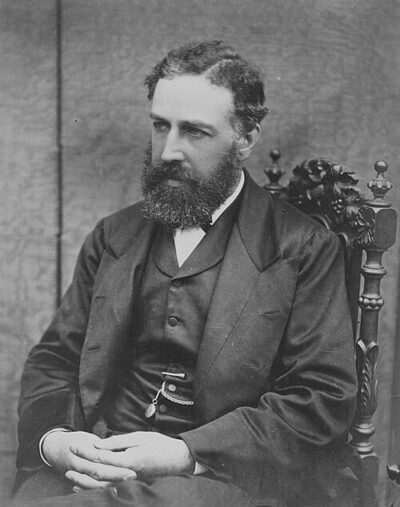
William Stanley Jevons
William Stanley Jevons was an English economist and logician. Born September 1, 1835, in Liverpool. Died August 13, 1882, in Bulverhythe. Known for The Theory of Political Economy, The Coal Question and Jevons paradox. Educated at University College London (2 times) and University College School. Awards include Fellow of the Royal Society.
Facts
33 facts · 2 confirmed by two sources · 16 cited · 15 from one source
Where this comes from
Papalocal keeps its own record. It started from these sources; what each one said is kept here as it was copied, so a change on their side never changes this page by itself. Tap one to read its version.
What Wikidata says · copied November 16, 2026 · revision 2554651588
- Described as
- English economist and logician
- Born
- September 1, 1835 · 8 references
- Died
- August 13, 1882 · 8 references
- Born in
- Liverpool · 2 references
- Died in
- Bulverhythe · 1 reference
- Buried in
- Hampstead Cemetery · 4 references
- Cause of death
- drowning · 1 reference
- Citizen of
- United Kingdom of Great Britain and Ireland
- Occupation
- philosopher · 2 references; economist; statistician; photographer; logician
- Worked for
- University College London (1876–1882) · 1 reference; Royal Mint, Melbourne (1854–1859) · 1 reference; Victoria University of Manchester (1863–1876) · 1 reference; Liverpool College (1865–1876) · 1 reference
- Education
- University College London (2 times) (1851–1863) · 1 reference; University College School (1850–1851) · 1 reference
- Member of
- Royal Society of London; Manchester Literary and Philosophical Society
- Known for
- The Theory of Political Economy; The Coal Question; Jevons paradox; The principles of science : a treatise on logic and scientific method; Money and the Mechanism of Exchange
- Awards
- Fellow of the Royal Society (1872) · 1 reference
- Field
- economics; statistics; logic
- Spouse
- Harriet Ann Taylor · 1 reference
- Father
- Thomas Jevons · 1 reference
- Mother
- Mary Anne Jevons · 1 reference
- Religion
- Unitarianism · 1 reference
- Wikipedias with a page
- 50
Wikidata item Q312546 (wikidata.org/wiki/Q312546), public domain (CC0). Copied November 16, 2026.
What Wikipedia says · copied November 16, 2026 · revision 1385359437
William Stanley Jevons (; 1 September 1835 – 13 August 1882) was an English economist and logician.
Irving Fisher described Jevons's book The Theory of Political Economy (1871) as the start of the mathematical method in economics. It made the case that economics, as a science concerned with quantities, is necessarily mathematical. In so doing, it expounded upon the "final" (marginal) utility theory of value. Jevons's work, along with similar discoveries made by Carl Menger in Vienna (1871) and by Léon Walras in Switzerland (1874), marked the opening of a new period in the history of economic thought. Jevons' contribution to the marginal revolution in economics in the late 19th century established his reputation as a leading political economist and logician of the time.
Jevons broke off his studies of the natural sciences in London in 1854 to work as an assayer in Sydney, where he acquired an interest in political economy. Returning to the UK in 1859, he issued a "Notice of a General Mathematical Theory of Political Economy" in 1862, outlining the marginal utility theory of value, and published A Serious Fall in the Value of Gold in 1863. For Jevons, the utility or value to a consumer of an additional unit of a product is inversely related to the number of units of that product he already owns, at least beyond some critical quantity.
Jevons received public recognition for his work on The Coal Question (1865), in which he called attention to the gradual exhaustion of Britain's coal supplies and also put forth the view that increases in energy production efficiency leads to more, not less, consumption. This view is known today as the Jevons paradox, named after him. Due to this particular work, Jevons is regarded today as the first economist of some standing to develop an 'ecological' perspective on the economy.
The most important of his works on logic and scientific methods is his Principles of Science (1874), as well as The Theory of Political Economy (1871) and The State in Relation to Labour (1882). Among his inventions was the logic piano, a mechanical computer.
- Born, in its opening lines
- September 1, 1835
- Died, in its opening lines
- August 13, 1882
From the Wikipedia article “William Stanley Jevons” (en.wikipedia.org/wiki/William_Stanley_Jevons), by its contributors, under CC BY-SA 4.0 (creativecommons.org/licenses/by-sa/4.0/). Copied November 16, 2026; not changed.
Confirmed Two sources agree. Cited One source, and it names where it got it. One source One source, without a reference of its own. Sources disagree The sources disagree. We show the best-supported value and keep theirs below.
